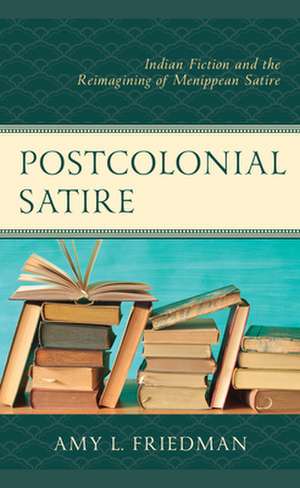
Postcolonial Satire: Indian Fiction and the Reimagining of Menippean Satire
Autor Amy L. Friedmanen Limba Engleză Hardback – 16 oct 2019
Preț: 555.81 lei
Preț vechi: 837.33 lei
-34%
Puncte Express: 834
Preț estimativ în valută:
98.37€ • 114.96$ • 85.40£
98.37€ • 114.96$ • 85.40£
Carte tipărită la comandă
Livrare economică 19 februarie-05 martie
Preluare comenzi: 021 569.72.76
Specificații
ISBN-13: 9781498571968
ISBN-10: 1498571964
Pagini: 258
Dimensiuni: 160 x 233 x 22 mm
Greutate: 0.51 kg
Editura: Bloomsbury Publishing
Colecția Lexington Books
Locul publicării:New York, United States
ISBN-10: 1498571964
Pagini: 258
Dimensiuni: 160 x 233 x 22 mm
Greutate: 0.51 kg
Editura: Bloomsbury Publishing
Colecția Lexington Books
Locul publicării:New York, United States
V-ar putea interesa
-
 Violent Beginnings: Literary Representations of Postcolonial AlgeriaLucie Knight-Santos-34%Preț: 539.96 lei816.63 lei
 -
 Dragon in Ambush: The Art of War in the Poems of Mao ZedongJeremy Ingalls-33%Preț: 633.44 lei950.80 lei
 -
 -34%Preț: 677.47 lei1021.69 lei
 -
 Spirit Possession in French, Haitian, and Vodou Thought: An Intellectual HistoryAlessandra Benedicty-Kokken, M.D.-34%Preț: 770.84 lei1161.26 lei
 -
 -22%Preț: 327.91 lei422.49 lei
 -
 Cervantes’s Novelas ejemplares: Reading their Lessons from His Time to OursWilliam H. Clamurro-26%Preț: 269.08 lei366.04 lei
 -
 -22%Preț: 329.09 lei423.13 lei
 -
 -34%Preț: 500.38 lei753.96 lei
 -
 Toward a Cultural Archive of la Movida: Back to the FutureFrancisco Fernández de Alba-34%Preț: 679.92 lei1023.20 lei
 -
 The Universal Vampire: Origins and Evolution of a LegendBarbara Brodman-22%Preț: 329.00 lei423.09 lei
 -
 -22%Preț: 306.72 lei394.86 lei
 -
 -23%Preț: 326.75 lei421.89 lei
 -
 Preț: 118.56 lei
 -
 Preț: 154.91 lei
 -
 Preț: 83.36 lei
 -
 Aquitaine Et Languedoc, Ou Histoire Pittoresque de la Gaule MéridionaleJustin Cénac-MoncautPreț: 236.22 lei
 -
 Preț: 75.66 lei
 -
 Preț: 69.60 lei
 -
 Robinson Crusoé. Tome 2Daniel DefoePreț: 273.14 lei
 -
 Preț: 76.21 lei
 -
 Preț: 90.69 lei
 -
 Preț: 176.51 lei
 -
 Preț: 132.68 lei
 -
 Preț: 177.29 lei
 -
 Preț: 120.53 lei
 -
 Preț: 75.66 lei
 -
 Salammbô (2e Édition)Gustave FlaubertPreț: 213.70 lei
 -
 Preț: 104.28 lei
 -
 Preț: 69.60 lei
 -
 Preț: 177.08 lei
Cuprins
Acknowledgements
Chapter 1: Menippean Satire and Counter-realism in Indian Postcolonial Fictions
Chapter 2: G.V. Desani's Postcolonial Menippean Satiric Subversions
Chapter 3: Aubrey Menen and Menippean Wit
Chapter 4: Salman Rushdie's Menippean Strategies of Language
Chapter 5: Irwin Allan Sealy's Menippean Strategies of Form
Conclusion: From Hatterr to Trotter and Beyond
Bibliography
Index
About the author
Chapter 1: Menippean Satire and Counter-realism in Indian Postcolonial Fictions
Chapter 2: G.V. Desani's Postcolonial Menippean Satiric Subversions
Chapter 3: Aubrey Menen and Menippean Wit
Chapter 4: Salman Rushdie's Menippean Strategies of Language
Chapter 5: Irwin Allan Sealy's Menippean Strategies of Form
Conclusion: From Hatterr to Trotter and Beyond
Bibliography
Index
About the author
Recenzii
In this scrupulously researched study, Amy L. Friedman clears fertile theoretical ground on which to interpret some of India's most capacious and impudent novels. Fictions often labelled magic realism or postmodern fabulation are convincingly re-visioned here as Menippean satire, and an elusive, ancient genre gains an exponent finely attuned to its powerful sway on the postcolonial literary imagination.
This book breaks new ground by revealing something that has been sensed in postcolonial studies for some time but never deeply explored. The role of Menippean satire in contesting imperial power is shown here to lie in its vigorous and irreverent boundary challenging and this exuberance finds it most powerful expression in the South Asian novels of Desani, Rushdie, Sealy and others. The Menippean character of this satiric confrontation is shown to be the key to its power and suggests why the Indian novel is so important to postcolonial literary study.
Dr. Friedman brings a sharp eye, a good ear for languages, and incisive intelligence to the task of unravelling deliberately challenging fictions by four postcolonial Indian writers. She gives particular explanatory emphasis to their skillful deployment of age-old strategies of Menippean satire -- literary echoes and glancing allusions to earlier culture, ironical subversions, unexpected sidetracks or authorial interventions -- to jar their readers into critical awareness. Handling these unwieldy materials with confident energy, Dr. Friedman appreciates the carnivalesque qualities of improbable characters and wandering stories even as she demonstrates the ethical seriousness of the underlying satire. In the end she conveys persuasively the double aspect of postcolonial satiric creativity: sophisticated writers look over their shoulders at influential cultural antecedents all the while they reach forward to establish artistic and political independence.
This book breaks new ground by revealing something that has been sensed in postcolonial studies for some time but never deeply explored. The role of Menippean satire in contesting imperial power is shown here to lie in its vigorous and irreverent boundary challenging and this exuberance finds it most powerful expression in the South Asian novels of Desani, Rushdie, Sealy and others. The Menippean character of this satiric confrontation is shown to be the key to its power and suggests why the Indian novel is so important to postcolonial literary study.
Dr. Friedman brings a sharp eye, a good ear for languages, and incisive intelligence to the task of unravelling deliberately challenging fictions by four postcolonial Indian writers. She gives particular explanatory emphasis to their skillful deployment of age-old strategies of Menippean satire -- literary echoes and glancing allusions to earlier culture, ironical subversions, unexpected sidetracks or authorial interventions -- to jar their readers into critical awareness. Handling these unwieldy materials with confident energy, Dr. Friedman appreciates the carnivalesque qualities of improbable characters and wandering stories even as she demonstrates the ethical seriousness of the underlying satire. In the end she conveys persuasively the double aspect of postcolonial satiric creativity: sophisticated writers look over their shoulders at influential cultural antecedents all the while they reach forward to establish artistic and political independence.