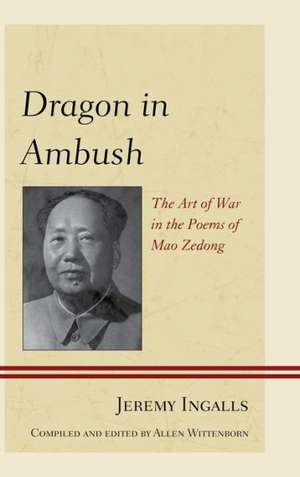
Dragon in Ambush: The Art of War in the Poems of Mao Zedong
Autor Jeremy Ingalls Editat de Allen Wittenbornen Limba Engleză Hardback – 16 mai 2013
The crux of Prof. Ingalls' work lies in her focus on the symbolism in the poems. The poems are, in Mao's use of them as a means of communication, meaningless on their surface. No image, however seemingly commonplace, is ever employed for merely lyrical or aesthetic description. Every image functions as a factor in an entirely political calculus. According to Dr. Ingalls, "When Mao mentions streams or mountains, suns or moons, clouds or winds or icicles, horses, elephants, snakes, tigers, leopards or bears, specifies kinds of trees or birds or fish, flies, brooms, mats or bridges, these and all his other images have, as their primary function, neither happenstance descriptions nor whimsical metaphor. They all have politically symbolic functions in Mao's algebra of versified political discourse."
Furthermore, in her analysis, Prof. Ingalls downplays the significance of Marxism-Leninism in the Thought of Mao Zedong. She shows that throughout his career, Mao regarded Marxism-Leninism as a political convenience, not as a doctrine permanently essential to his master-plan. Just as Mao used the Nationalists of Chiang Kai-shek and Stalin's Soviet Union as means to further his own political ambitions, so did he manipulate Marxist-Leninist ideology to hoodwink and attract, at home and abroad, professional revolutionaries to help do his bidding. Mao's aims express, in their worldviews, an entirely Chinese tradition. In his poems Mao's dialectics, his materialism, and his authoritarianism all take their points of reference from within the Chinese cultural order. Dragon in Ambush is a thoroughly unique and revolutionary approach to understanding the Mind of Mao Zedong.
Preț: 664.73 lei
Preț vechi: 1056.89 lei
-37%
Puncte Express: 997
Carte tipărită la comandă
Livrare economică 17 noiembrie-01 decembrie
Livrare prin curier în România Termenul estimat este afișat lângă disponibilitate.
Transport gratuit pentru acest produs Plată online sau ramburs, în funcție de opțiunile comenzii.
Retur gratuit în 14 zile Comandă securizată și suport în română.
Specificații
ISBN-13: 9780739177822
ISBN-10: 0739177826
Pagini: 405
Dimensiuni: 160 x 235 x 32 mm
Greutate: 0.82 kg
Editura: Bloomsbury Publishing
Colecția Lexington Books
Locul publicării:New York, United States
ISBN-10: 0739177826
Pagini: 405
Dimensiuni: 160 x 235 x 32 mm
Greutate: 0.82 kg
Editura: Bloomsbury Publishing
Colecția Lexington Books
Locul publicării:New York, United States
Cuprins
Preface
Part 1: Recognizing the Terrain
Chapter 1: Methods of Approach
Chapter 2: A Rationale for Ruthlessness
Part 2: Mao's Poems 1 - 20
Section A: A Dragon Bides His Time, 1925-1929
Poem 1 Changsha
Poem 2 Yellow Crane Tower
Poem 3 Jingangshan
Poem 4 Chiang's War
Section B: Hidden Dragon, 1929-1934
Poem 5: Double Yang
Poem 6: New Year's Day
Poem 7: On the Road to Guangchang
Poem 8: From Tingzhou toward Changsha
Poem 9: Eluding the First Major Encirclement
Poem 10: Eluding the Second Major Encirclement
Poem 11: Dabodi
Poem 12: Huichang
Section C: Dragon in the Field, 1935-1949
Poem 13: Loushan Barrier Gate
Poems 14, 15, 16: Mountain Poems
Poem 17: The Long March
Poem 18: Kunlun
Poem 19: Six Turns' Mountain
Poem 20: Snow
Part 1: Recognizing the Terrain
Chapter 1: Methods of Approach
Chapter 2: A Rationale for Ruthlessness
Part 2: Mao's Poems 1 - 20
Section A: A Dragon Bides His Time, 1925-1929
Poem 1 Changsha
Poem 2 Yellow Crane Tower
Poem 3 Jingangshan
Poem 4 Chiang's War
Section B: Hidden Dragon, 1929-1934
Poem 5: Double Yang
Poem 6: New Year's Day
Poem 7: On the Road to Guangchang
Poem 8: From Tingzhou toward Changsha
Poem 9: Eluding the First Major Encirclement
Poem 10: Eluding the Second Major Encirclement
Poem 11: Dabodi
Poem 12: Huichang
Section C: Dragon in the Field, 1935-1949
Poem 13: Loushan Barrier Gate
Poems 14, 15, 16: Mountain Poems
Poem 17: The Long March
Poem 18: Kunlun
Poem 19: Six Turns' Mountain
Poem 20: Snow
Recenzii
Carefully translating and analyzing Mao's first 20 published poems for their political expression, the late Ingalls (poet, scholar, editor, and translator) presents Mao's poetry as an extension of his political thought rather than simply a leisure activity. After all, within China, poems had a long history of playing a role as political gauges. Part 1 establishes the historical and literary background needed to understand Mao's poems and his desire to become China's next emperor. Part 2 provides a more detailed literary, ideological, and textural analysis of each poem through Ingalls's examination of the ideas and words that explain the 'paradox that [Mao] understands but which ... he does not expect all of his readers to perceive.' This is an exceptionally well-written text, with extensive analytical notes, a bibliography, and a glossary of characters used. Readers do not have to be familiar with Mao's poems, but to fully benefit from this work, readers must be familiar with Mao's other writings and the writings of his contemporaries, with Chinese literary tradition, and with Chinese history from ancient times through the 20th century. Summing Up: Recommended. Graduate students, researchers, faculty.
Dragon in Ambush is immensely detailed. . . .[The author's] emphasis is a much-needed corrective to the work of the many earlier translators and compilers, Chinese and foreign, who have been far too reverential toward Mao. Ingalls surpasses her predecessors in the detail and erudition of her work, and in the end conveys a sense of the inner Mao that is more credible than theirs.
Ingalls provides a seminal translation of twenty of Mao's poems, which will be of interest to many scholars across multiple fields. Her assertion that Mao intended to deliver a series of military and political messages for potential successors, which combine to endorse a strategy of ruthless psychological domination, represents a thought-provoking proposition, albeit one which may have been formed using subjective interpretations and a teleological approach. The work has considerable merit.
Jeremy Ingalls's translations and analysis may be. . . .informative and educative to government policy makers and researchers, scholars, and students seeking to understand the impact of Mao Zedong on his country. It would also provide readers with the fundamentals in discovering why the People's Republic of China in the twentieth-first century has advanced to the level of a colossal global power.
Jeremy Ingalls' translation and explication of Mao Zedong's poems is an extraordinary work, so full of information that it seems bursting at its roughly 500-page seams. . . .Ingalls book is a rich source of information about Mao's poetic work, and in some respects his personal and political philosophy.
Dragon in Ambush is immensely detailed. . . .[The author's] emphasis is a much-needed corrective to the work of the many earlier translators and compilers, Chinese and foreign, who have been far too reverential toward Mao. Ingalls surpasses her predecessors in the detail and erudition of her work, and in the end conveys a sense of the inner Mao that is more credible than theirs.
Ingalls provides a seminal translation of twenty of Mao's poems, which will be of interest to many scholars across multiple fields. Her assertion that Mao intended to deliver a series of military and political messages for potential successors, which combine to endorse a strategy of ruthless psychological domination, represents a thought-provoking proposition, albeit one which may have been formed using subjective interpretations and a teleological approach. The work has considerable merit.
Jeremy Ingalls's translations and analysis may be. . . .informative and educative to government policy makers and researchers, scholars, and students seeking to understand the impact of Mao Zedong on his country. It would also provide readers with the fundamentals in discovering why the People's Republic of China in the twentieth-first century has advanced to the level of a colossal global power.
Jeremy Ingalls' translation and explication of Mao Zedong's poems is an extraordinary work, so full of information that it seems bursting at its roughly 500-page seams. . . .Ingalls book is a rich source of information about Mao's poetic work, and in some respects his personal and political philosophy.