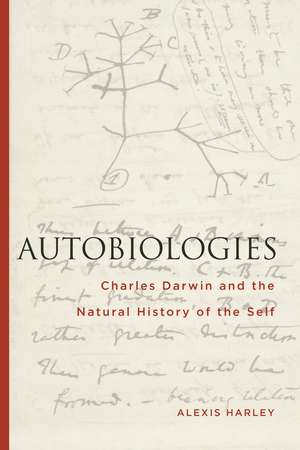
Autobiologies: Charles Darwin and the Natural History of the Self
Autor Dr Alexis Harleyen Limba Engleză Paperback – 7 iun 2016
Preț: 321.15 lei
Preț vechi: 416.44 lei
-23%
Puncte Express: 482
Carte tipărită la comandă
Livrare economică 18 noiembrie-02 decembrie
Livrare prin curier în România Termenul estimat este afișat lângă disponibilitate.
Transport gratuit de la 400.00 lei Plată online sau ramburs, în funcție de opțiunile comenzii.
Retur gratuit în 14 zile Comandă securizată și suport în română.
Specificații
ISBN-13: 9781611486025
ISBN-10: 1611486025
Pagini: 248
Dimensiuni: 150 x 228 x 16 mm
Greutate: 0.32 kg
Editura: Bloomsbury Publishing
Colecția Bucknell University Press
Locul publicării:New York, United States
ISBN-10: 1611486025
Pagini: 248
Dimensiuni: 150 x 228 x 16 mm
Greutate: 0.32 kg
Editura: Bloomsbury Publishing
Colecția Bucknell University Press
Locul publicării:New York, United States
Cuprins
Preface
Acknowledgments
Abbreviations
Introduction: Darwinian Selves
Part I: Darwin
Chapter 1: Darwin's Family
Chapter 2: Naturalist Self-Fashioning: Darwin and the Beagle Diary
Chapter 3: Animal Darwin and the Sympathy Instinct ... 93
Part II: Variations
Chapter 4: Theories of Self-Transformation
Chapter 5: "A natural history of myself": Herbert Spencer's Individuation
Chapter 6: Harriet Martineau's Autothanatography and the Comtean Self
Part III: Autobiologies
Chapter 7: De Profundis, Degeneration and Wilde's Spencerian Individualism
Chapter 8: Father and Son: Darwinism and the Struggle of Two Temperaments
Chapter 9:In Memoriam and the Consolations of Development
Conclusion: After the Victorians
Bibliography
Index
About the Author
Acknowledgments
Abbreviations
Introduction: Darwinian Selves
Part I: Darwin
Chapter 1: Darwin's Family
Chapter 2: Naturalist Self-Fashioning: Darwin and the Beagle Diary
Chapter 3: Animal Darwin and the Sympathy Instinct ... 93
Part II: Variations
Chapter 4: Theories of Self-Transformation
Chapter 5: "A natural history of myself": Herbert Spencer's Individuation
Chapter 6: Harriet Martineau's Autothanatography and the Comtean Self
Part III: Autobiologies
Chapter 7: De Profundis, Degeneration and Wilde's Spencerian Individualism
Chapter 8: Father and Son: Darwinism and the Struggle of Two Temperaments
Chapter 9:In Memoriam and the Consolations of Development
Conclusion: After the Victorians
Bibliography
Index
About the Author
Recenzii
Overall, Harley's book offers a well-researched and accessible glimpse into the often contradictory convergence of Victorian life-writing and evolutionary science. It is also a timely addition, given both the recent critical interest in nineteenth-century life-writing and the push for more interdisciplinary academic research. . . this text remains, on the whole, a convincing study, which significantly enlarges our understanding of Darwin's staggering impact upon the Victorian age.
Harley suggests that the 'Victorian preoccupation with self' was a force in driving the development of evolutionary ideas, indicating that Charles Darwin's evolutionary scheme resulted from his concept of self; i.e., 'life around him shaped his theory.' The author finds a relation between the work of the biologist and the autobiographer because both biologists and autobiographers are obsessed with observation and documenting life, thus reinforcing the idea that there is a strong connection between biology and biography. . . .[The author] explains that such Victorian evolutionists as Darwin took up autobiography (or autobiology) by examining the effects of evolutionary theories on the self. . . .The book is primarily for those concerned with literary subjects. Summing Up: Recommended. Graduate students and researchers/faculty.
The eloquent and often challenging Autobiologies argues that Victorian thinkers investigated their own lives as instances within a holistic evolutionary theory. Alexis Harley explores a range of Darwinian and post-Darwinian life-writings along the grain of a fresh narrative that allows us to see the autobiographic writings of Darwin, Spencer, Martineau, Tennyson, Wilde, and Gosse as forms of 'autobiology'. Wisely, she does not attempt to draw all these diverse writers together under a single template but she does explore the various ways in which evolutionary theory, with its emphasis on change, on the individual under the stress of environment, and on loss, unsettled and challenged earlier construals of the self. The Conclusion takes the work forward into 20th century dilemmas and displacements concerning the relations of 'nature' and 'culture' and ends with a beautiful use of Barthes' idea of a text as 'a tissue of quotations' to express (as it were against the understanding possible to him during the nineteenth century) Darwin's understanding of the individual. This wide-ranging and pleasurable work ought to be widely read.
Harley suggests that the 'Victorian preoccupation with self' was a force in driving the development of evolutionary ideas, indicating that Charles Darwin's evolutionary scheme resulted from his concept of self; i.e., 'life around him shaped his theory.' The author finds a relation between the work of the biologist and the autobiographer because both biologists and autobiographers are obsessed with observation and documenting life, thus reinforcing the idea that there is a strong connection between biology and biography. . . .[The author] explains that such Victorian evolutionists as Darwin took up autobiography (or autobiology) by examining the effects of evolutionary theories on the self. . . .The book is primarily for those concerned with literary subjects. Summing Up: Recommended. Graduate students and researchers/faculty.
The eloquent and often challenging Autobiologies argues that Victorian thinkers investigated their own lives as instances within a holistic evolutionary theory. Alexis Harley explores a range of Darwinian and post-Darwinian life-writings along the grain of a fresh narrative that allows us to see the autobiographic writings of Darwin, Spencer, Martineau, Tennyson, Wilde, and Gosse as forms of 'autobiology'. Wisely, she does not attempt to draw all these diverse writers together under a single template but she does explore the various ways in which evolutionary theory, with its emphasis on change, on the individual under the stress of environment, and on loss, unsettled and challenged earlier construals of the self. The Conclusion takes the work forward into 20th century dilemmas and displacements concerning the relations of 'nature' and 'culture' and ends with a beautiful use of Barthes' idea of a text as 'a tissue of quotations' to express (as it were against the understanding possible to him during the nineteenth century) Darwin's understanding of the individual. This wide-ranging and pleasurable work ought to be widely read.