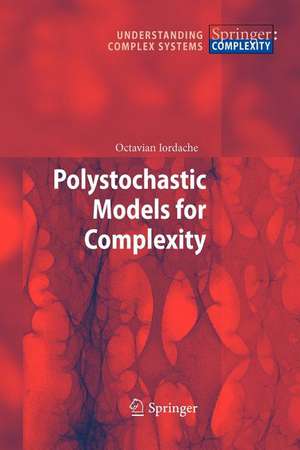
Polystochastic Models for Complexity: Understanding Complex Systems
Autor Octavian Iordacheen Limba Engleză Paperback – 28 mai 2012
| Toate formatele și edițiile | Preț | Express |
|---|---|---|
| Paperback (1) | 909.08 lei 6-8 săpt. | |
| Springer Berlin, Heidelberg – 28 mai 2012 | 909.08 lei 6-8 săpt. | |
| Hardback (1) | 914.83 lei 6-8 săpt. | |
| Springer Berlin, Heidelberg – 19 apr 2010 | 914.83 lei 6-8 săpt. |
Din seria Understanding Complex Systems
- 18%
 Preț: 1075.86 lei
 -
 Preț: 421.61 lei
 - 18%
 Preț: 911.64 lei
 - 18%
 Preț: 917.87 lei
 - 15%
 Preț: 621.03 lei
 - 18%
 Preț: 911.34 lei
 - 18%
 Preț: 907.25 lei
 - 15%
 Preț: 622.42 lei
 - 15%
 Preț: 618.83 lei
 - 18%
 Preț: 1330.32 lei
 - 15%
 Preț: 620.55 lei
 - 20%
 Preț: 613.47 lei
 - 18%
 Preț: 923.48 lei
 - 15%
 Preț: 616.45 lei
 - 15%
 Preț: 620.38 lei
 - 15%
 Preț: 627.14 lei
 - 15%
 Preț: 611.74 lei
 - 15%
 Preț: 621.80 lei
 - 18%
 Preț: 909.08 lei
 - 20%
 Preț: 618.97 lei
 - 24%
 Preț: 848.18 lei
 -
 Preț: 415.42 lei
 - 20%
 Preț: 615.89 lei
 - 20%
 Preț: 630.19 lei
 - 20%
 Preț: 645.05 lei
 - 20%
 Preț: 651.25 lei
 - 18%
 Preț: 1333.34 lei
 - 15%
 Preț: 624.63 lei
 -
 Preț: 373.03 lei
 - 15%
 Preț: 565.69 lei
 - 18%
 Preț: 918.47 lei
 - 15%
 Preț: 614.60 lei
 - 15%
 Preț: 627.79 lei
 - 15%
 Preț: 618.34 lei
 - 18%
 Preț: 902.84 lei
 - 18%
 Preț: 906.17 lei
 - 18%
 Preț: 1069.81 lei
 - 18%
 Preț: 907.54 lei
 - 15%
 Preț: 613.80 lei
 - 18%
 Preț: 912.85 lei
 - 18%
 Preț: 906.03 lei
 - 15%
 Preț: 622.42 lei
 - 18%
 Preț: 972.73 lei
Preț: 909.08 lei
Preț vechi: 1108.63 lei
-18%
Puncte Express: 1364
Preț estimativ în valută:
160.79€ • 186.61$ • 138.79£
160.79€ • 186.61$ • 138.79£
Carte tipărită la comandă
Livrare economică 24 aprilie-08 mai
Specificații
ISBN-13: 9783642263132
ISBN-10: 3642263135
Pagini: 320
Ilustrații: XX, 298 p. 94 illus.
Dimensiuni: 155 x 235 x 17 mm
Greutate: 0.45 kg
Ediția:2010
Editura: Springer Berlin, Heidelberg
Colecția Springer
Seria Understanding Complex Systems
Locul publicării:Berlin, Heidelberg, Germany
ISBN-10: 3642263135
Pagini: 320
Ilustrații: XX, 298 p. 94 illus.
Dimensiuni: 155 x 235 x 17 mm
Greutate: 0.45 kg
Ediția:2010
Editura: Springer Berlin, Heidelberg
Colecția Springer
Seria Understanding Complex Systems
Locul publicării:Berlin, Heidelberg, Germany
V-ar putea interesa
-
 The Designer's Guide to VHDLPeter J. Ashenden-35%Preț: 356.50 lei549.07 lei
 -
 Deep SimplicityJohn GribbinPreț: 75.16 lei
 -
 Evolution of Networks: From Biological Nets to the Internet and WWWS. N. Dorogovtsev-23%Preț: 392.52 lei507.61 lei
 -
 -8%Preț: 419.78 lei456.28 lei
 -
 Optimal Estimation of Dynamic SystemsJohn L. Crassidis-18%Preț: 1429.65 lei1743.48 lei
 -
 -15%Preț: 564.91 lei664.60 lei
 -
 Switching in Systems and ControlDaniel Liberzon-15%Preț: 560.43 lei659.33 lei
 -
 Perturbation Analysis of Optimization ProblemsJ.Frederic Bonnans-18%Preț: 1341.26 lei1635.67 lei
 -
 Stochastic Networked Control SystemsSerdar Yüksel-18%Preț: 915.16 lei1116.05 lei
 -
 Stochastic Networked Control SystemsSerdar Yüksel-18%Preț: 909.87 lei1109.60 lei
 -
 -18%Preț: 918.59 lei1120.23 lei
 -
 Modeling and Control of Discrete-Event Dynamic SystemsBranislav Hrúz-15%Preț: 457.00 lei537.65 lei
 -
 Model-Based Control of Networked SystemsEloy Garcia-15%Preț: 624.12 lei734.25 lei
 -
 Introduction to Time-Delay Systems: Analysis and ControlEmilia Fridman-46%Preț: 496.69 lei913.95 lei
Public țintă
ResearchCuprins
Methods.- Physical and Chemical Systems.- Biosystems and Bioinspired Systems.- Systems Sciences and Cognitive Systems.- Perspectives.- Appendices.
Textul de pe ultima copertă
This book is devoted to complexity understanding and management, considered as the main source of efficiency and prosperity for the next decades.Divided into six chapters, the book begins with a presentation of basic concepts as complexity, emergence and closure. The second chapter looks to methods and introduces polystochastic models, the wave equation, possibilities and entropy.The third chapter focusing on physical and chemical systems analyzes flow-sheet synthesis, cyclic operations of separation, drug delivery systems and entropy production. Biomimetic systems represent the main objective of the fourth chapter. Case studies refer to bio-inspired calculation methods, to the role of artificial genetic codes, neural networks and neural codes for evolutionary calculus and for evolvable circuits as biomimetic devices. The fifth chapter, taking its inspiration from systems sciences and cognitive sciences looks to engineering design, case base reasoning methods, failure analysis, and multi-agent manufacturing systems. Perspectives and integrative points of view are discussed in the sixth chapter with reference to the classification of sciences, cybernetics and its extensions, and to transdisciplinarity and categorification. Written for: engineers, researchers, and students in chemical, biochemical, computing and systems science engineering, in neuroscience, psychology, philosophy and mathematics
Caracteristici
Interdisciplinary valuable reference for engineers, system scientists, mathematicians, entrepreneurs and investors facing complexity challenge Presents theoretical and practical aspects of the Polystochastic methodology incl case studies