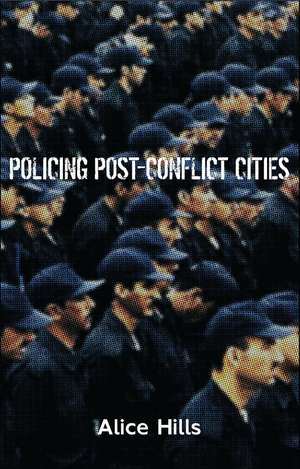
Policing Post-Conflict Cities
Autor Alice Hillsen Limba Engleză Hardback – 15 dec 2008
In this book, Alice Hills discusses the interface between order and security. While analysts and donors emphasise security, Hills argues that order is much more meaningful for people's lives. Focusing on the police as both providers of order and a measure of its success, the book shows that order depends more on what has gone before than on reconstruction efforts and that tension is inevitable as donors attempt to reform brutal local policing.
Policing Post-Conflict Cities provides a powerful critique of the failure of liberal orthodoxy to understand the meaning of order.
Preț: 560.16 lei
Preț vechi: 739.55 lei
-24%
Puncte Express: 840
Carte tipărită la comandă
Livrare economică 23 noiembrie-07 decembrie
Livrare prin curier în România Termenul estimat este afișat lângă disponibilitate.
Transport gratuit pentru acest produs Plată online sau ramburs, în funcție de opțiunile comenzii.
Retur gratuit în 14 zile Comandă securizată și suport în română.
Specificații
ISBN-13: 9781842779699
ISBN-10: 1842779699
Pagini: 272
Dimensiuni: 138 x 216 x 20 mm
Greutate: 0.5 kg
Editura: Bloomsbury Publishing
Colecția Zed Books
Locul publicării:London, United Kingdom
ISBN-10: 1842779699
Pagini: 272
Dimensiuni: 138 x 216 x 20 mm
Greutate: 0.5 kg
Editura: Bloomsbury Publishing
Colecția Zed Books
Locul publicării:London, United Kingdom
V-ar putea interesa
-
 Armies Of GodDominic GreenPreț: 116.95 lei
 -
 Brazil on the RiseLarry RohterPreț: 123.35 lei
 -
 Origins of Political OrderFrancis FukuyamaPreț: 136.55 lei
 -
 The Big ShortMichael LewisPreț: 94.01 lei
 -
 The Politics of Military OccupationPeter M R Stirk-16%Preț: 207.74 lei248.44 lei
 -
 Border PoliticsNick Vaughan-Williams-16%Preț: 183.02 lei219.07 lei
 -
 Zizek and Communist StrategyChris Mcmillan-25%Preț: 597.80 lei794.21 lei
 -
 Addicted to ProfitStuart Sim-24%Preț: 270.04 lei354.48 lei
 -
 The Radical Imagination: Social Movement Research in the Age of AusterityDoctor Alex Khasnabish-22%Preț: 140.32 lei180.72 lei
 -
 -20%Preț: 118.55 lei149.01 lei
 -
 South Africa, Settler Colonialism and the Failures of Liberal DemocracyDoctor Thiven Reddy-26%Preț: 165.43 lei223.24 lei
 -
 -11%Preț: 129.61 lei145.43 lei
 -
 A Kingdom in Crisis: Thailand's Struggle for Democracy in the Twenty-First CenturyAndrew MacGregor Marshall-21%Preț: 116.32 lei147.41 lei
 -
 -22%Preț: 124.13 lei158.95 lei
Cuprins
Acknowledgments
Abbreviations & Acronyms
1. Order in an Urban Century
2. Controlling Cities
3. International Policing
4. Ghetto Security
5. Social Continuities and the Production of Order
6. Making Their Own Rules
7. Re-emergent Order
8. Challenging Orthodoxy
Bibliography
Notes
Index
Abbreviations & Acronyms
1. Order in an Urban Century
2. Controlling Cities
3. International Policing
4. Ghetto Security
5. Social Continuities and the Production of Order
6. Making Their Own Rules
7. Re-emergent Order
8. Challenging Orthodoxy
Bibliography
Notes
Index
Recenzii
Policing Post Conflict Cities is an engaging and provocative enquiry into the most basic of political challenges - the recontruction of "order" and the provision of "security" in post conflict urban locales. Here Alice Hills invites us to think way beyond current orthodoxies and to base our theories instead on the fluid and ambigious practices emerging from Bagdad, Basra, Kinshasa, Kigali and others. Policing Post-Conflict Cities will appeal to an audience who values critical scholarship.
Through this magisterial analysis of policing in post-conflict cities, Alice Hills challenges the "cargo cult" status of police reform and the uncritical assumptions about democratic policing that are embedded in the liberal peace.
Through this magisterial analysis of policing in post-conflict cities, Alice Hills challenges the "cargo cult" status of police reform and the uncritical assumptions about democratic policing that are embedded in the liberal peace.