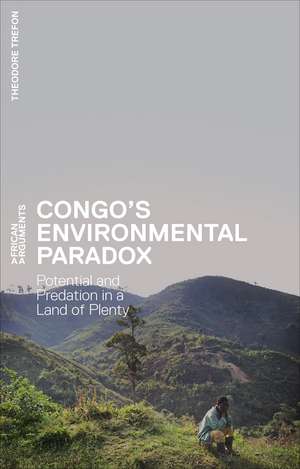
Congo's Environmental Paradox: Potential and Predation in a Land of Plenty: African Arguments
Autor Theodore Trefonen Limba Engleză Paperback – 15 mai 2016
Congo's Environmental Paradox analyses the new dynamics in the country's forest, mineral, land, water and oil sectors, revealing the interactions between these sectors. Connecting the dots, it shows how we need to fundamentally rethink power, politics and resource management in Congo today.
Din seria African Arguments
- 41%
 Preț: 76.96 lei
 - 17%
 Preț: 136.27 lei
 - 17%
 Preț: 147.03 lei
 -
 Preț: 215.93 lei
 - 18%
 Preț: 142.25 lei
 - 17%
 Preț: 135.68 lei
 - 35%
 Preț: 89.10 lei
 -
 Preț: 236.47 lei
 -
 Preț: 231.27 lei
 -
 Preț: 236.36 lei
 - 18%
 Preț: 141.88 lei
 - 17%
 Preț: 148.52 lei
 - 18%
 Preț: 141.20 lei
 - 18%
 Preț: 128.24 lei
 - 18%
 Preț: 129.04 lei
 - 11%
 Preț: 123.32 lei
 - 17%
 Preț: 130.44 lei
 - 24%
 Preț: 557.39 lei
 - 17%
 Preț: 157.73 lei
 - 16%
 Preț: 122.67 lei
 - 18%
 Preț: 129.04 lei
 - 15%
 Preț: 123.32 lei
 - 16%
 Preț: 122.23 lei
 - 20%
 Preț: 140.45 lei
 - 16%
 Preț: 132.87 lei
 - 25%
 Preț: 161.11 lei
 - 15%
 Preț: 89.24 lei
 - 23%
 Preț: 129.77 lei
 - 30%
 Preț: 523.45 lei
 - 24%
 Preț: 550.53 lei
 - 30%
 Preț: 525.31 lei
 - 17%
 Preț: 157.73 lei
 - 38%
 Preț: 447.91 lei
 - 18%
 Preț: 129.63 lei
 - 34%
 Preț: 529.38 lei
 - 25%
 Preț: 526.56 lei
 - 26%
 Preț: 524.46 lei
 - 17%
 Preț: 158.93 lei
Preț: 129.61 lei
Preț vechi: 145.43 lei
-11%
Puncte Express: 194
Carte tipărită la comandă
Livrare economică 30 noiembrie-14 decembrie
Livrare prin curier în România Termenul estimat este afișat lângă disponibilitate.
Transport gratuit de la 400.00 lei Plată online sau ramburs, în funcție de opțiunile comenzii.
Retur gratuit în 14 zile Comandă securizată și suport în română.
Specificații
ISBN-13: 9781783602438
ISBN-10: 1783602430
Pagini: 210
Ilustrații: Tables, black and white 7 ; Maps 1 ; Figures 2
Dimensiuni: 138 x 214 x 14 mm
Greutate: 0.27 kg
Editura: Bloomsbury Publishing
Colecția Zed Books
Seria African Arguments
Locul publicării:London, United Kingdom
ISBN-10: 1783602430
Pagini: 210
Ilustrații: Tables, black and white 7 ; Maps 1 ; Figures 2
Dimensiuni: 138 x 214 x 14 mm
Greutate: 0.27 kg
Editura: Bloomsbury Publishing
Colecția Zed Books
Seria African Arguments
Locul publicării:London, United Kingdom
V-ar putea interesa
-
 -18%Preț: 1116.57 lei1361.67 lei
 -
 -25%Preț: 178.84 lei238.72 lei
 -
 New MaterialismsDiana CoolePreț: 199.54 lei
 -
 IDRCBruce MuirheadPreț: 336.80 lei
 -
 Paying Our Way: Transforming Transportation FinanceSimon D Bartha-26%Preț: 1085.48 lei1476.07 lei
 -
 -26%Preț: 908.67 lei1232.39 lei
 -
 Keeping Foreign Corruption out of the U.S.Louise M Petit-27%Preț: 1934.40 lei2636.18 lei
 -
 Contested Powers: The Politics of Energy and Development in Latin AmericaJohn-Andrew McNeish-25%Preț: 176.89 lei234.83 lei
 -
 Goma: Stories of Strength and Sorrow from Eastern CongoTheodore Trefon-10%Preț: 146.09 lei162.81 lei
 -
 Refusenik!: Israel's Soldiers of ConsciencePeretz Kidron-24%Preț: 257.85 lei338.46 lei
 -
 -16%Preț: 274.18 lei325.64 lei
 -
 -23%Preț: 261.86 lei340.91 lei
 -
 Preț: 387.15 lei
 -
 Lebanon: A Model of Consociational ConflictTobias SchwernaPreț: 339.74 lei
Cuprins
1. Introduction: Potential in a Land of Plenty
2. Forests of Wealth and Mystery
3. Food and Agriculture
4. Water: An Uncertain Ebb and Flow
5. Oil: Plenty for Some, Nothing for Most
6. Mining: Rise, Decline and Renaissance
7. Conclusion: Uncertainty and Predation in a Land of Plenty
2. Forests of Wealth and Mystery
3. Food and Agriculture
4. Water: An Uncertain Ebb and Flow
5. Oil: Plenty for Some, Nothing for Most
6. Mining: Rise, Decline and Renaissance
7. Conclusion: Uncertainty and Predation in a Land of Plenty
Recenzii
An unusual, fascinating and important book . While there is often a tendency to sensationalize the country, the author takes a more balanced approach, demonstrating deep insight, engagement and knowledge.'
A sharp and well informed argument that shows that Congo's environmental paradox is also at the heart of the world's environmental paradox.
An excellent overview of the major ecological resources in the Democratic Republic of Congo . reading this book is essential for understanding the many environmental paradoxes.
An invaluable contribution - a truly remarkable synthesis of the pathways to Congolese economic improvement and the many roadblocks along the way - the succinct and sparkling summation of the key elements of the political economy is most useful. The author's capacity to convey a rich treasure chest of information and acute analytical skills make this a landmark work.
A fascinating read, giving a no-nonsense view of the multitude of problems besetting Congo's natural resource sectors, how they affect ordinary people's daily lives, and how well-meaning donor initiatives are often intrinsically flawed. The book puts today's problems into historical perspective and will serve as a reality-check to politicians and activists.
Most studies of natural resources and development delve into the details sector by sector. Linkages to violence, politics and state-building are treated separately for different resources. This eloquent and richly documented book focuses attention on the connections, and on the global forces adding complexity to these interactions and altering the political economy of possible change.
This remarkable, fact-filled study will undoubtedly rank as required reading for anyone with an interest in the DRC - whether for specialists or for the general reader. Following his Congo Masquerade, this should confirm Trefon's standing as one of the most perceptive observers and analysts of that central African giant.
The first successful attempt to take stock of emerging trends in Congo's natural resource sectors. Well-written, clearly structured and thoroughly documented, Trefon offers fresh analysis on the gap between resource potential and socio-economic development.
A remarkable guide to the tangled relationships between minerals, water and other sectors of the political economy in the Congo. It goes beyond slogans such as "rich land, poor people" to explain how the rich get richer while the poor struggle to survive. Indispensable reading for humanitarians and human rights advocates, both Congolese and international
A sharp and well informed argument that shows that Congo's environmental paradox is also at the heart of the world's environmental paradox.
An excellent overview of the major ecological resources in the Democratic Republic of Congo . reading this book is essential for understanding the many environmental paradoxes.
An invaluable contribution - a truly remarkable synthesis of the pathways to Congolese economic improvement and the many roadblocks along the way - the succinct and sparkling summation of the key elements of the political economy is most useful. The author's capacity to convey a rich treasure chest of information and acute analytical skills make this a landmark work.
A fascinating read, giving a no-nonsense view of the multitude of problems besetting Congo's natural resource sectors, how they affect ordinary people's daily lives, and how well-meaning donor initiatives are often intrinsically flawed. The book puts today's problems into historical perspective and will serve as a reality-check to politicians and activists.
Most studies of natural resources and development delve into the details sector by sector. Linkages to violence, politics and state-building are treated separately for different resources. This eloquent and richly documented book focuses attention on the connections, and on the global forces adding complexity to these interactions and altering the political economy of possible change.
This remarkable, fact-filled study will undoubtedly rank as required reading for anyone with an interest in the DRC - whether for specialists or for the general reader. Following his Congo Masquerade, this should confirm Trefon's standing as one of the most perceptive observers and analysts of that central African giant.
The first successful attempt to take stock of emerging trends in Congo's natural resource sectors. Well-written, clearly structured and thoroughly documented, Trefon offers fresh analysis on the gap between resource potential and socio-economic development.
A remarkable guide to the tangled relationships between minerals, water and other sectors of the political economy in the Congo. It goes beyond slogans such as "rich land, poor people" to explain how the rich get richer while the poor struggle to survive. Indispensable reading for humanitarians and human rights advocates, both Congolese and international
Notă biografică
Dr Theodore Trefon was educated at Boston University. He is an independent researcher and consultant currently based at the Free University of Brussels. He is also President of the Brussels Centre of African Studies. His research focuses on state-society relations, urban anthropology and environmental governance in the Democratic Republic of the Congo.