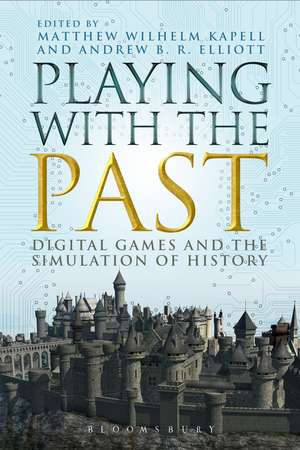
Playing with the Past: Digital Games and the Simulation of History
Editat de Matthew Wilhelm Kapell, Andrew B.R. Elliotten Limba Engleză Paperback – 19 dec 2013
Deși domeniul Game Studies a cunoscut o expansiune rapidă, literatura academică a suferit multă vreme de o lipsă de focalizare, tratând jocurile video prin lentile teoretice generale. Remarcăm modul în care Playing with the Past, editat de Matthew Wilhelm Kapell și Andrew B.R. Elliott, vine să umple acest gol, oferind prima analiză detaliată și aplicată asupra modului în care mediul digital simulează, subvertește și reconstruiește trecutul istoric. Volumul nu se limitează la a evalua acuratețea faptelor, ci investighează modul în care jucătorii interacționează cu narațiunile istorice pentru a înțelege prezentul.
Structura cărții este riguros organizată în secțiuni care ghidează cititorul de la fundamentele teoretice ale cauzalității și determinismului tehnologic, până la analize critice ale ideologiilor coloniale. În prima parte, capitolele semnate de cercetători precum Adam Chapman explorează conceptul de „affordance” în jocurile istorice, în timp ce a doua parte deconstruiește perspectiva occidentală, analizând modul în care jocuri precum Colonization modelează populațiile indigene. Această abordare continuă preocupările anterioare ale lui Kapell din Strictly Fantasy privind originile imaginative ale jocurilor de rol, dar cu o rigoare academică sporită aplicată mediului digital.
Apreciem acest volum ca fiind o alternativă necesară la Digital Games as History pentru cursurile de studii media sau istorie publică. Dacă lucrarea lui Chapman pune bazele terminologice, Playing with the Past aduce avantajul unei perspective colective, multidisciplinare, oferind o varietate de studii de caz pe titluri precum Total War sau Age of Empires. Este o resursă esențială care demonstrează că jocurile video nu sunt doar divertisment, ci instrumente complexe de modelare a conștiinței istorice.
Preț: 282.64 lei
Preț vechi: 332.05 lei
-15%
Carte tipărită la comandă
Livrare economică 30 noiembrie-14 decembrie
Specificații
ISBN-10: 1623567289
Pagini: 400
Ilustrații: 25
Dimensiuni: 150 x 228 x 24 mm
Greutate: 0.57 kg
Editura: Bloomsbury Publishing
Colecția Bloomsbury Academic
Locul publicării:New York, United States
V-ar putea interesa
-
 What Sport Tells Us About LifeEd SmithPreț: 92.11 lei
 -
 Sport and Society in the Global AgeTimothy Marjoribanks-25%Preț: 285.57 lei379.24 lei
 -
 Q & A for KidsBetsy FrancoPreț: 95.43 lei
 -
 Preț: 467.11 lei
 -
 Video GamersGarry CrawfordPreț: 471.81 lei
 -
 97 Ways to Make a Baby LaughJack Moore-24%Preț: 43.92 lei57.94 lei
 -
 Calm KidsLorraine E MurrayPreț: 72.83 lei
 -
 Geek DadKen DenmeadPreț: 114.51 lei
 -
 The Tourist Gaze 3.0John Urry-11%Preț: 494.98 lei556.15 lei
 -
 The Storytellers WaySue HollingsworthPreț: 145.39 lei
 -
 Try Something NewLovebookPreț: 89.16 lei
De ce să citești această carte
Recomandăm această carte studenților și cercetătorilor din domeniile istoriei, sociologiei și studiilor media. Cititorul va câștiga un cadru critic de analiză a modului în care jocurile de strategie și simulările istorice ne influențează percepția asupra trecutului. Este un instrument valoros pentru a înțelege cum mecanicile de joc pot perpetua sau chestiona viziunile tradiționale asupra lumii, transformând consumul pasiv de istorie într-o experiență participativă și reflexivă.
Descriere
What can World War Two strategy games teach us about the reality of this complex and multifaceted period? Do the possibilities of playing with the past change the way we understand history? If we embody a colonialist's perspective to conquer 'primitive' tribes in Colonization, does this privilege a distinct way of viewing history as benevolent intervention over imperialist expansion? The fusion of these two fields allows the editors to pose new questions about the ways in which gamers interact with their game worlds. Drawing these threads together, the collection concludes by asking whether digital games - which represent history or historical change - alter the way we, today, understand history itself.
Cuprins
1. Introduction: To Build a Past that Will "Stand the Test of Time": Discovering Historical Facts, Assembling Historical Narratives, Andrew B.R. Elliott and Matthew Wilhelm Kapell
Part I: History as a Process: Teleology, Causation and Technological Determinism
2. The Same River Twice: Historical Representation and the Value of Exploring Societal Concepts in the Total War, Civilization, and Age of Empires Franchises, Rolfe Daus Peterson, Andrew Miller and Sean Joseph Fedorko
3. What is "Old" in Videogames? Dan Reynolds
4. "Affording History": Applying the Ecological Approach to Historical Videogames, Adam Chapman
Part II: History written by the West: Self, Other and Non-Western History
5. Phantasms of Rome: Video Games and Cultural Identity, Emily Joy Bembeneck
6. Modeling Indigenous Peoples: Unpacking Ideology in Sid Meier's Colonization, Rebecca Mir and Trevor Owens
7. Dominance and The Aztec Empire: Representations in Age of Empires II and Medieval Total War II, Joshua D. Holdenried with Nicolas Trépanier
8. From History to Literature to Game: Three Kingdoms and the Cultural Significance of Asian History, Hyuk-chan Kwon
9. Falling in Love with History: Japanese Girls and Otome Games, Kazumi Hasegawa
Part III: User-Generated History: Realism, Authenticity and the Playable Past
10. Selective Authenticity and the Playable Past, Andrew J. Salvati and Jonathan M. Bullinger
11. The Promise of Simulation: Realism, Authenticity, Virtuality, Josef Köstlbauer
12. Modding the Historians' Code: Historical Verisimilitude and the Counterfactual Imagination, Tom Apperley
13. Modding as Historical Reenactment: A Case Study of the Battlefield Series, Gareth Crabtree
Part IV: The Politics of Representation: Authenticity and Realism
14. Historical Veneers: Anachronism, Simulation and History in Assassin's Creed II, Douglas N. Dow
15. Air Power vs. Processing Power: Technology and Narrative Possibilities in WWI Video Gaming, Andrew Wackerfuss
16. Videogames in the popular Culture of Remembrance of the Cold War: A Case Study of Call of Duty: Black Ops, Clemens Reisner
17. Refighting the Cold War: Video Games and Speculative History, Marcus Schulzke
Part V: Looking Back on the End of the World: History as Utopian Possibility
18. Strategic Digital Defense: Video Games and Reagan's 'Star Wars' Program, 1980-1987, William M. Knoblauch
19. Fallout and the History of Yesterday's Impossible Tomorrow, Joseph A. November
20. History Out of Time: Fallout's Ironic America, Tom Cutterham
21. The Historical Conception of Biohazard in Biohazard, Robert Mejia and Ryuta Komaki
22. The Struggle with Gnosis: Ancient Religion and Future Technology in the Xenosaga Series, Erin Evans
23. Conclusion: Playing at True Myths, Engaging with Authentic Histories, Matthew Wilhelm Kapell and Andrew B.R. Elliott
Index
Recenzii
Elliott and Kapell have gathered a remarkable collection of contributions-engaging deep issues about what history IS, and how one can present its issues in a vital contribution within contemporary studies. The scope is compendious, from Rome to Native America, from Japan to Colonial America; this book just might become the basis for up-to-the-minute narrative/historical/digital mediations, and should be of interest in the many fields of the superior college or university.
Playing with the Past is an innovative, lucid and engaging collection that strikes a number of carefully constructed and rewarding balances. The tone is both serious and playful. Its analysis and findings are simultaneously rigorous, illuminating and entertaining. Playing with the Past provides a neat summation of the previous work which has explored the relationship between digital games and their interaction with history as a foundation to establish, with great sophistication and clarity, the critical and conceptual terrain for the current and future debates.
Playing with the Past is a far-reaching volume, guiding readers through ancient civilizations, modern wars, and futures premised upon counterfactual pasts. In this reflexively-organized array of essays, game scholars will find both a primer on historiographic inquiry and a series of cogent analyses that are not simply conversant with issues driving the field but also bring new depth and insight to their examination.
The individual contributors handle their parts in this ambitious program well. Each chapter involves a kind of ethnographic exploration of its particular game space, often with first-person reports (though not always) about the game, coupled with close readings of the code itself [.] the chapters fall easily within the narratology or ludology folds as understood from game studies.
Playing with the Past is accessible for general readers, especially since it provides a wide range of examples of games and how they simulate history. It is also a good choice as a textbook in introductory courses on games engaging with history and in courses in public history.