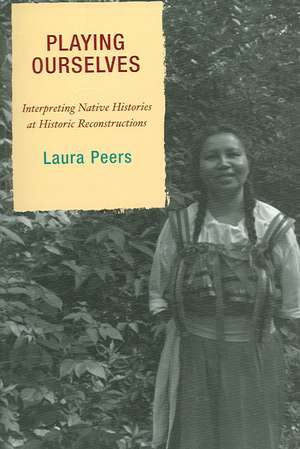
Playing Ourselves: Interpreting Native Histories at Historic Reconstructions: American Association for State and Local History
Autor Laura Peersen Limba Engleză Paperback – 15 mar 2007
Drawing on anthropology, history, cultural performance, cross-cultural encounters, material culture theory, and public history, author Laura Peers examines "living history" sites as locations of cultural performance where core beliefs about society, cross-cultural relationships, and history are performed. In the process, she emphasizes how choices made in the communication of history can both challenge these core beliefs about the past and improve cross-cultural relations in the present.
Din seria American Association for State and Local History
- 32%
 Preț: 832.56 lei
 - 21%
 Preț: 214.67 lei
 - 22%
 Preț: 325.02 lei
 - 19%
 Preț: 316.09 lei
 - 11%
 Preț: 398.39 lei
 - 30%
 Preț: 355.61 lei
 - 19%
 Preț: 331.43 lei
 - 23%
 Preț: 286.27 lei
 - 24%
 Preț: 255.41 lei
 - 27%
 Preț: 501.00 lei
 - 25%
 Preț: 216.46 lei
 - 24%
 Preț: 254.02 lei
 - 19%
 Preț: 320.78 lei
 - 34%
 Preț: 951.06 lei
 - 19%
 Preț: 322.24 lei
 - 24%
 Preț: 391.91 lei
 - 31%
 Preț: 569.03 lei
 - 18%
 Preț: 334.84 lei
 - 24%
 Preț: 222.59 lei
 - 24%
 Preț: 283.12 lei
 -
 Preț: 421.53 lei
 - 21%
 Preț: 312.33 lei
 - 20%
 Preț: 373.68 lei
 - 30%
 Preț: 576.05 lei
 - 19%
 Preț: 323.58 lei
 - 25%
 Preț: 286.61 lei
 - 21%
 Preț: 365.17 lei
 - 23%
 Preț: 276.66 lei
 - 35%
 Preț: 633.94 lei
 - 31%
 Preț: 534.98 lei
 - 24%
 Preț: 255.02 lei
 - 31%
 Preț: 569.81 lei
 - 29%
 Preț: 522.70 lei
 - 19%
 Preț: 322.03 lei
 - 19%
 Preț: 322.16 lei
Preț: 314.41 lei
Preț vechi: 388.92 lei
-19%
Puncte Express: 472
Carte tipărită la comandă
Livrare economică 04-18 decembrie
Livrare prin curier în România Termenul estimat este afișat lângă disponibilitate.
Transport gratuit de la 400.00 lei Plată online sau ramburs, în funcție de opțiunile comenzii.
Retur gratuit în 14 zile Comandă securizată și suport în română.
Specificații
ISBN-13: 9780759110625
ISBN-10: 075911062X
Pagini: 207
Dimensiuni: 155 x 232 x 13 mm
Greutate: 0.35 kg
Editura: Bloomsbury Publishing
Colecția Rowman & Littlefield
Seria American Association for State and Local History
Locul publicării:New York, United States
ISBN-10: 075911062X
Pagini: 207
Dimensiuni: 155 x 232 x 13 mm
Greutate: 0.35 kg
Editura: Bloomsbury Publishing
Colecția Rowman & Littlefield
Seria American Association for State and Local History
Locul publicării:New York, United States
V-ar putea interesa
-
 The Burlesque HandbookJo WeldonPreț: 109.36 lei
 -
 Museums and Source Communities: A Routledge ReaderAlison K. Brown-18%Preț: 1121.80 lei1368.04 lei
 -
 John FordTag GallagherPreț: 318.91 lei
 -
 Pursuits of HappinessStanley CavellPreț: 251.84 lei
 -
 Preț: 173.78 lei
 -
 Ojibwa of Western Canada: 1780 to 1870Laura PeersPreț: 125.33 lei
 -
 Preț: 133.53 lei
 -
 Learning Magic: The Fundamentals of Performing MagicKambiz MostofizadehPreț: 148.52 lei
 -
 The Cultural Politics of One-to-One PerformanceRachel Zerihan-15%Preț: 662.48 lei779.39 lei
 -
 The Famous Charisma LabelNeil PriddeyPreț: 336.32 lei
 -
 -26%Preț: 521.66 lei703.90 lei
 -
 Women’s Dance Traditions of Uzbekistan: Legacy of the Silk RoadLaurel Victoria Gray-11%Preț: 408.30 lei458.76 lei
 -
 Preț: 102.32 lei
 -
 Discours Au Vray Du Ballet Dansé (Éd.1617)Étienne DurandPreț: 90.38 lei
 -
 La vie parisienneÉmile BlavetPreț: 208.11 lei
 -
 Le Théâtre En Savoie: Les Vieux Spectacles, (Éd.1887)François MugnierPreț: 175.16 lei
 -
 Théâtre Choisi de Favart. Tome 1 (Éd.1809)Justine FavartPreț: 199.48 lei
 -
 Preț: 198.47 lei
 -
 Théâtre Choisi de Favart. Tome 2 (Éd.1809)Justine FavartPreț: 208.09 lei
 -
 Preț: 247.56 lei
 -
 Preț: 198.86 lei
 -
 Preț: 183.95 lei
 -
 Théâtre de Eugène Scribe (Éd.1856)Eugène ScribePreț: 185.03 lei
 -
 Théâtre, Saynètes Et Récits, (Éd.1886)Gnafron FilsPreț: 161.92 lei
 -
 Preț: 166.69 lei
 -
 Preț: 112.93 lei
 -
 -15%Preț: 506.58 lei595.98 lei
 -
 Perspectives on Jewish Thought and MysticismAlfred L Ivry-18%Preț: 738.11 lei900.13 lei
Cuprins
Chapter 1 Vignette: Ruth Christie
Chapter 2 Introduction
Chapter 3 1. Landscapes
Chapter 4 2. Cosmologies
Chapter 5 Vignette: Nokie
Chapter 6 3. Anishinaabeg
Chapter 7 Vignette: "What's This?"
Chapter 8 4. Authenticities and Materialities
Chapter 9 Vignette: Bob and Betty Visit Fort William
Chapter 10 5. Visitors
Chapter 11 6. Encounters and Borderlands
Chapter 12 Vignette: Angelique
Chapter 13 7. The Living and the Dead: Conclusions
Chapter 15 References Cited
Chapter 2 Introduction
Chapter 3 1. Landscapes
Chapter 4 2. Cosmologies
Chapter 5 Vignette: Nokie
Chapter 6 3. Anishinaabeg
Chapter 7 Vignette: "What's This?"
Chapter 8 4. Authenticities and Materialities
Chapter 9 Vignette: Bob and Betty Visit Fort William
Chapter 10 5. Visitors
Chapter 11 6. Encounters and Borderlands
Chapter 12 Vignette: Angelique
Chapter 13 7. The Living and the Dead: Conclusions
Chapter 15 References Cited
Recenzii
The inclusion of Native American interpreters and their perspective has the potential to make significant changes to the manner in which First Nations/Native History is presented, and to the public's understanding of Native-white relations at fur trade and mission sites. . . . Peers' study captures the complexities of how these histories are negotiated and produced, and provides insights on their impact at shaping the public's understanding of Native American history.
Playing Ourselves offers a lively, sophisticated, and trenchant account of the movement to include Native interpreters and perspectives in living history museums in the U.S. and Canada. Focusing on five historical sites in the Great Lakes region, Peers reveals how stereotypes are both reproduced and subverted in encounters between visitors and Native interpreters. In its emphasis on the agency of indigenous interpreters, this book is a welcome contribution to the scholarly literature on cultural tourism, cultural performance, museum representation, and contemporary indigenous life. I look forward to sharing Playing Ourselves with my students in anthropology, performance studies, museum studies, and Native American Studies.
...the subject of the work is so fascinating and Peers' arguments so cogent that it needs to be on the "must read" list of anyone involved, however peripherally, in historic reconstructions.
Peer's extensive archival research and interviews with staff and visitors give us a better understanding of how Native histories are produced and negotiated....Playing Ourselves should be required reading for all museum studies students and professionals...
The author's methodology is consistent with the highest standards of anthropological practices. We are impessed with Peer's commitment to long-term analysis. This is one of the book's strengths. Peer's rapport with her informants, established through years of follow-up fieldwork, directly benefits the research and reader alike and helps create a sense of confidence in the content. This book is academic yet accessible, and we highly recommended it.
A much-needed analysis of the difficult tensions involved in cultural exchange, interpretation, and in our understanding of authority and power as they relate to ethnic and historic representation.
Peers' work is a valuable contribution to the literature on the representation of Native peoples. . . . Peers' work is well-balanced, and readers from a variety of fields . . . will find much here to appreciate.
This is essentially a book about encounters: encounters between Native interpreters and visitors at historic sites, of course-but also encounters between differing preconceptions of history, between ways of life, between people and things, and between the present and the past. Laura Peers succeeds in exploring a number of questions concerning the development, aims, politics, agency, and multiple contexts and interpretations of the historical representations negotiated at these sites. A greatly enjoyable and very readable book.
Peers has produced a very important analysis..There can be no question that Laura Peers' Playing Ourselves is worthy of serious attention from a wide range of material culture, historic site, museum, tourism, and both Native and non-Native practitioners.
Playing Ourselves speaks to the contemporary politics of representation across cultural divides.. This book is mandatory reading for anyone interested in the complex negotiations that take place during processes of representing 'the Other' at cultural tourism sites and their implications for shifting power relationships.
Playing Ourselves offers a lively, sophisticated, and trenchant account of the movement to include Native interpreters and perspectives in living history museums in the U.S. and Canada. Focusing on five historical sites in the Great Lakes region, Peers reveals how stereotypes are both reproduced and subverted in encounters between visitors and Native interpreters. In its emphasis on the agency of indigenous interpreters, this book is a welcome contribution to the scholarly literature on cultural tourism, cultural performance, museum representation, and contemporary indigenous life. I look forward to sharing Playing Ourselves with my students in anthropology, performance studies, museum studies, and Native American Studies.
...the subject of the work is so fascinating and Peers' arguments so cogent that it needs to be on the "must read" list of anyone involved, however peripherally, in historic reconstructions.
Peer's extensive archival research and interviews with staff and visitors give us a better understanding of how Native histories are produced and negotiated....Playing Ourselves should be required reading for all museum studies students and professionals...
The author's methodology is consistent with the highest standards of anthropological practices. We are impessed with Peer's commitment to long-term analysis. This is one of the book's strengths. Peer's rapport with her informants, established through years of follow-up fieldwork, directly benefits the research and reader alike and helps create a sense of confidence in the content. This book is academic yet accessible, and we highly recommended it.
A much-needed analysis of the difficult tensions involved in cultural exchange, interpretation, and in our understanding of authority and power as they relate to ethnic and historic representation.
Peers' work is a valuable contribution to the literature on the representation of Native peoples. . . . Peers' work is well-balanced, and readers from a variety of fields . . . will find much here to appreciate.
This is essentially a book about encounters: encounters between Native interpreters and visitors at historic sites, of course-but also encounters between differing preconceptions of history, between ways of life, between people and things, and between the present and the past. Laura Peers succeeds in exploring a number of questions concerning the development, aims, politics, agency, and multiple contexts and interpretations of the historical representations negotiated at these sites. A greatly enjoyable and very readable book.
Peers has produced a very important analysis..There can be no question that Laura Peers' Playing Ourselves is worthy of serious attention from a wide range of material culture, historic site, museum, tourism, and both Native and non-Native practitioners.
Playing Ourselves speaks to the contemporary politics of representation across cultural divides.. This book is mandatory reading for anyone interested in the complex negotiations that take place during processes of representing 'the Other' at cultural tourism sites and their implications for shifting power relationships.