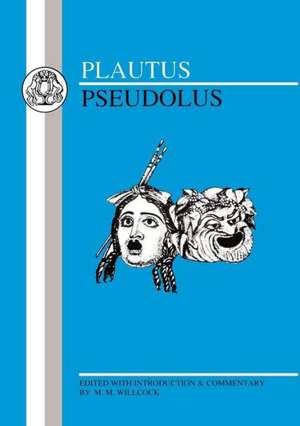
Plautus: Pseudolus: Latin Texts
Autor Titus Maccius Plautus M.M. Willcocken Limba Engleză Paperback – iun 1991
M.M. Willcock's edition, the first in English for over fifty years, remains one of the most concise yet thorough editions of Plautine work available to students coming to a Roman play for the first time.
This book contains the Latin text of Plautus's Pseudolus, with a detailed introduction which provides all the basic information needed to tackle the text. It includes sections on Greek new comedy, figures of language and thought and the presentation of the text. The commentary helps with content and language. It also includes a bibliography, extensive notes and a metrical appendix.
.
Din seria Latin Texts
- 17%
 Preț: 176.72 lei
 - 17%
 Preț: 162.48 lei
 - 17%
 Preț: 185.44 lei
 - 10%
 Preț: 176.63 lei
 - 17%
 Preț: 162.67 lei
 - 17%
 Preț: 162.91 lei
 - 17%
 Preț: 161.85 lei
 - 17%
 Preț: 179.15 lei
 - 17%
 Preț: 213.46 lei
 - 21%
 Preț: 164.50 lei
 -
 Preț: 167.73 lei
 - 17%
 Preț: 161.97 lei
 - 19%
 Preț: 169.79 lei
 - 5%
 Preț: 161.22 lei
 - 16%
 Preț: 216.16 lei
 - 21%
 Preț: 143.32 lei
 - 17%
 Preț: 177.79 lei
 - 17%
 Preț: 161.85 lei
 - 16%
 Preț: 167.70 lei
 - 17%
 Preț: 162.07 lei
 - 17%
 Preț: 162.07 lei
 -
 Preț: 183.88 lei
 - 16%
 Preț: 216.26 lei
 - 16%
 Preț: 189.58 lei
 - 10%
 Preț: 216.91 lei
 - 22%
 Preț: 136.31 lei
 - 17%
 Preț: 178.27 lei
 - 20%
 Preț: 182.60 lei
Preț: 163.34 lei
Preț vechi: 196.37 lei
-17%
Puncte Express: 245
Carte tipărită la comandă
Livrare economică 27 noiembrie-11 decembrie
Livrare prin curier în România Termenul estimat este afișat lângă disponibilitate.
Transport gratuit de la 400.00 lei Plată online sau ramburs, în funcție de opțiunile comenzii.
Retur gratuit în 14 zile Comandă securizată și suport în română.
Specificații
ISBN-13: 9780862920890
ISBN-10: 0862920892
Pagini: 170
Dimensiuni: 144 x 208 x 12 mm
Greutate: 0.24 kg
Editura: Bloomsbury Publishing
Colecția Bristol Classical Press
Seria Latin Texts
Locul publicării:London, United Kingdom
ISBN-10: 0862920892
Pagini: 170
Dimensiuni: 144 x 208 x 12 mm
Greutate: 0.24 kg
Editura: Bloomsbury Publishing
Colecția Bristol Classical Press
Seria Latin Texts
Locul publicării:London, United Kingdom
V-ar putea interesa
-
 The Rope and Other PlaysPlautusPreț: 94.52 lei
 -
 The Oxford Anthology of Roman LiteraturePeter E. Knox-9%Preț: 406.63 lei446.93 lei
 -
 -31%Preț: 934.53 lei1356.79 lei
 -
 Plautine Elements in PlautusEduard Fraenkel-33%Preț: 1490.10 lei2217.84 lei
 -
 -31%Preț: 707.55 lei1032.90 lei
 -
 -31%Preț: 727.03 lei1054.51 lei
 -
 -14%Preț: 660.59 lei768.13 lei
 -
 Hysterical Laughter: Four Ancient Comedies About WomenDavid Christenson-21%Preț: 299.27 lei378.80 lei
 -
 -34%Preț: 659.96 lei1005.82 lei
 -
 Ethics, Identity, and Community in Later Roman DeclamationNeil W. Bernstein-35%Preț: 626.06 lei960.03 lei
 -
 Poetics of AristotleStephen Halliwell-15%Preț: 175.30 lei206.70 lei
 -
 Romane Memento: Vergil in the Fourth CenturyRoger Rees-28%Preț: 1025.27 lei1432.23 lei
 -
 Becoming Female: The Male Body in Greek TragedyKatrina Cawthorn-25%Preț: 645.15 lei863.26 lei
 -
 Aeschylean TragedyAlan H. SommersteinPreț: 335.66 lei
 -
 The Roman BookRex Winsbury-11%Preț: 257.34 lei287.83 lei
 -
 Writing Ancient PersiaDr Thomas Harrison-15%Preț: 167.17 lei195.74 lei
 -
 MenaechmiClara M. KnightPreț: 233.23 lei
 -
 Selections from PlautusPlautusPreț: 176.89 lei
 -
 A Handbook to the Reception of Greek DramaBetine van Zyl Smit-23%Preț: 1182.97 lei1536.33 lei
 -
 Chaucer the AlchemistAlexander N Gabrovsky-18%Preț: 812.40 lei990.73 lei
 -
 Menaechmi; Or, The Twin-BrothersPlautusPreț: 51.18 lei
 -
 Ovid on Cosmetics: Medicamina Faciei Femineae and Related TextsMarguerite Johnson-25%Preț: 192.15 lei256.52 lei
 -
 AmphitryoPlautus-17%Preț: 142.08 lei171.87 lei
 -
 Bacchylides: The Victory PoemsArthur S. McDevitt-21%Preț: 212.59 lei268.46 lei
 -
 KomödienPlautusPreț: 276.92 lei
Cuprins
Preface
Introduction
The First Performance of Plautus' Pseudolus
2 Greek New Comedy
3 Roman Comedy
4 The Pseudolus
5 Figures of Language and Thought
6 The Transmission of the Text
7 Presentation of the Text
Bibliography
The Manuscripts
T. MACCI PLAvTI PSEVDOLVS
Commentary
Appendix: The Scansion of Plautine Verse
Metrical Synopsis
Indexes
1 Latin
2 General
Introduction
The First Performance of Plautus' Pseudolus
2 Greek New Comedy
3 Roman Comedy
4 The Pseudolus
5 Figures of Language and Thought
6 The Transmission of the Text
7 Presentation of the Text
Bibliography
The Manuscripts
T. MACCI PLAvTI PSEVDOLVS
Commentary
Appendix: The Scansion of Plautine Verse
Metrical Synopsis
Indexes
1 Latin
2 General
Notă biografică
Plautus, Titus Maccius (254-184 BC) was a Roman playwright, whose comedies were the most popular dramatic works of their day. He was originally an actor or clown. Twenty-one of his 130 plays survive, revealing his theatrical craftsmanship and total mastery of farce. Although his works were palliata, adaptations of Greek new comedy originals now lost, he shifted the scene to Rome and based much of the humour on Roman manners and customs. His comedy, which was broader than that of Terence, still works today. Stock characters of Plautus's plays include the bragging soldier, the miser, the old man in love, the parasite, identical twins, the wily slave, and the courtesan. Later European dramatists influenced by Plautus include Shakespeare, Jonson, Dryden, and Molière. His comedy was often based on disguises and mistaken identities; Shakespeare's The Comedy of Errors (1592) was based on Plautus's Menaechmi, about the confusions caused by a pair of long-separated identical twins. Several of his plays were combined for Stephen Sondheim's 1962 Broadway musical A Funny Thing Happened on the Way to the Forum (although only one line from Plautus was retained: "I am a parade"). Plautus was eventually forced to work in a grain mill after losing most of his theatrical earnings in unsuccessful business ventures.