
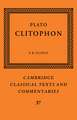
Plato: Clitophon: Cambridge Classical Texts and Commentaries, cartea 37
Autor Plato Editat de S. R. Slingsen Limba Engleză Hardback – 17 noi 1999
Din seria Cambridge Classical Texts and Commentaries
-
 Preț: 498.17 lei
 - 23%
 Preț: 839.18 lei
 -
 Preț: 382.11 lei
 - 23%
 Preț: 1028.18 lei
 -
 Preț: 375.37 lei
 -
 Preț: 402.73 lei
 -
 Preț: 284.50 lei
 - 19%
 Preț: 476.55 lei
 -
 Preț: 459.13 lei
 - 19%
 Preț: 546.18 lei
 - 23%
 Preț: 732.03 lei
 - 23%
 Preț: 889.09 lei
 - 19%
 Preț: 586.17 lei
 - 19%
 Preț: 439.58 lei
 -
 Preț: 411.59 lei
 - 19%
 Preț: 485.16 lei
 -
 Preț: 288.69 lei
 -
 Preț: 242.77 lei
 - 19%
 Preț: 644.21 lei
 -
 Preț: 432.46 lei
 - 19%
 Preț: 440.00 lei
 -
 Preț: 349.25 lei
 - 19%
 Preț: 623.58 lei
 -
 Preț: 441.87 lei
 - 23%
 Preț: 715.33 lei
 - 19%
 Preț: 427.09 lei
 - 23%
 Preț: 768.40 lei
 - 19%
 Preț: 524.10 lei
 - 23%
 Preț: 1025.70 lei
 -
 Preț: 498.51 lei
 -
 Preț: 358.17 lei
 - 23%
 Preț: 1028.40 lei
 -
 Preț: 459.13 lei
Preț: 971.61 lei
Preț vechi: 1261.83 lei
-23%
Puncte Express: 1457
Carte tipărită la comandă
Livrare economică 11-25 iulie
Livrare prin curier în România Termenul estimat este afișat lângă disponibilitate.
Transport gratuit pentru acest produs Plată online sau ramburs, în funcție de opțiunile comenzii.
Retur gratuit în 14 zile Comandă securizată și suport în română.
Specificații
ISBN-13: 9780521623681
ISBN-10: 0521623685
Pagini: 380
Dimensiuni: 140 x 216 x 25 mm
Greutate: 0.63 kg
Editura: Cambridge University Press
Colecția Cambridge University Press
Seria Cambridge Classical Texts and Commentaries
Locul publicării:Cambridge, United Kingdom
ISBN-10: 0521623685
Pagini: 380
Dimensiuni: 140 x 216 x 25 mm
Greutate: 0.63 kg
Editura: Cambridge University Press
Colecția Cambridge University Press
Seria Cambridge Classical Texts and Commentaries
Locul publicării:Cambridge, United Kingdom
V-ar putea interesa
-
 The PrinceNiccolo MachiavelliPreț: 28.43 lei
 -
 XSYMPOSIUM_CLASSICS PBPlatoPreț: 23.87 lei
 -
 Behavior in Public PlacesErving GoffmanPreț: 116.68 lei
 -
 The Lost Duke of WyndhamJulia QuinnPreț: 50.63 lei
 -
 The Secret Diaries of Miss Miranda CheeverJulia QuinnPreț: 50.76 lei
 -
 Ten Things I Love about YouJulia QuinnPreț: 50.13 lei
 -
 Because of Miss BridgertonJulia QuinnPreț: 54.52 lei
 -
 The Sickness Unto DeathSøren Kierkegaard-28%Preț: 55.49 lei77.10 lei
 -
 The RepublicPlato-31%Preț: 64.41 lei93.01 lei
 -
 Language, Truth and LogicA. J. Ayer-21%Preț: 71.60 lei91.01 lei
 -
 The Communist ManifestoFriedrich Engels-40%Preț: 16.85 lei28.05 lei
 -
 Preț: 181.40 lei
 -
 Theories of EthicsPhilippa Foot-15%Preț: 304.21 lei357.22 lei
 -
 Contemporary Political Philosophy: An IntroductionWill Kymlicka-22%Preț: 394.06 lei503.55 lei
 -
 AeneidVirgil-18%Preț: 59.82 lei72.87 lei
 -
 The Oxford Handbook of Philosophy of TimeCraig Callender-24%Preț: 295.15 lei390.32 lei
 -
 Problems of the SelfBernard WilliamsPreț: 192.46 lei
 -
 The Philosophy of Mind: An IntroductionPeter SmithPreț: 216.25 lei
 -
 Hume: Dialogues Concerning Natural Religion: And Other WritingsDorothy ColemanPreț: 324.29 lei
 -
 Preț: 327.44 lei
 -
 Introduction to Contemporary EpistemologyJonathan DancyPreț: 272.38 lei
 -
 A Kant DictionaryHoward CaygillPreț: 284.22 lei
 -
 From a Logical Point of View – Nine Logical Philosophical Essays Rev (Paper)Willard Van Orm QuinePreț: 232.72 lei
 -
 Preț: 64.01 lei
 -
 Escaping from EdenPaul WallisPreț: 73.95 lei
 -
 Scars of Eden, ThePaul WallisPreț: 77.42 lei
 -
 The Uses of PessimismRoger Scruton-32%Preț: 60.30 lei88.68 lei
Cuprins
Preface; Abbreviations; Introduction; Part I. Prolegomena to the Dialogue: 1. Introduction; 2. Summary and analysis of composition; 3. Is the Clitophon unfinished?; 4. The Clitophon as a Short Dialogue; 5. The characters of the dialogue; Part II. Meaning and Authenticity: 6. Philosophical protreptic in the fourth century BCE; 7. Protreptic in the Clitophon; 8. Protreptic in Plato; 9. Elenchos in the Clitophon; 10. Justice in the Clitophon; 11. The meaning of the Clitophon; 12. Date and authenticity; Text and translation; Commentary; Appendices: I. The ending of Aristotle's Protrepticus; II. Note on the text; Bibliography; Indexes.
Recenzii
"This book is an important and original work of scholarship, well and thoroughly done." Bryn Mawr Classical Review
Descriere
A text with translation, introduction and commentary of a dialogue ascribed to Plato, first published in 1999.
Notă biografică
Plato was an ancient Greek philosopher born in Athens during the Classical period in Ancient Greece. In Athens, Plato founded the Academy, a philosophical school where he taught the philosophical doctrines that would later become known as Platonism. Plato (or Platon) was a pen name derived, apparently, from the nickname given to him by his wrestling coach - allegedly a reference to his physical broadness. According to Alexander of Miletus quoted by Diogenes of Sinope his actual name was Aristocles, son of Ariston, of the deme Collytus (Collytus being a district of Athens).[2]Plato was an innovator of the written dialogue and dialectic forms in philosophy. He raised problems for what later became all the major areas of both theoretical philosophy and practical philosophy. His most famous contribution is the Theory of forms, which has been interpreted as advancing a solution to what is now known as the problem of universals. He is also the namesake of Platonic love and the Platonic solids.His own most decisive philosophical influences are usually thought to have been, along with Socrates, the pre-Socratics Pythagoras, Heraclitus, and Parmenides, although few of his predecessors' works remain extant and much of what we know about these figures today derives from Plato himself.[a]Along with his teacher, Socrates, and his student, Aristotle, Plato is a central figure in the history of philosophy.[b] Unlike the work of nearly all of his contemporaries, Plato's entire body of work is believed to have survived intact for over 2,400 years.[6] Although their popularity has fluctuated, Plato's works have consistently been read and studied.[7] Through Neoplatonism Plato also greatly influenced both Christian and Islamic philosophy (through e.g. Al-Farabi). In modern times, Alfred North Whitehead famously said: "the safest general characterization of the European philosophical tradition is that it consists of a series of footnotes to Plato