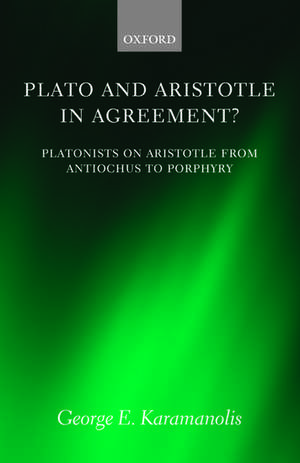
Plato and Aristotle in Agreement?: Platonists on Aristotle from Antiochus to Porphyry: Oxford Philosophical Monographs
Autor George E. Karamanolisen Limba Engleză Paperback – 15 aug 2013
| Toate formatele și edițiile | Preț | Express |
|---|---|---|
| Paperback (1) | 381.88 lei 42-47 zile | |
| OUP OXFORD – 15 aug 2013 | 381.88 lei 42-47 zile | |
| Hardback (1) | 678.57 lei 42-47 zile | |
| OUP OXFORD – 6 apr 2006 | 678.57 lei 42-47 zile |
Din seria Oxford Philosophical Monographs
- 31%
 Preț: 513.95 lei
 - 31%
 Preț: 498.03 lei
 - 21%
 Preț: 225.21 lei
 - 17%
 Preț: 174.53 lei
 - 31%
 Preț: 515.50 lei
 - 34%
 Preț: 887.40 lei
 - 34%
 Preț: 944.47 lei
 - 15%
 Preț: 357.29 lei
 - 34%
 Preț: 885.21 lei
 - 24%
 Preț: 377.69 lei
 - 20%
 Preț: 373.15 lei
 - 14%
 Preț: 323.66 lei
 - 34%
 Preț: 673.37 lei
 - 14%
 Preț: 360.61 lei
 - 31%
 Preț: 423.32 lei
 - 19%
 Preț: 380.93 lei
 - 14%
 Preț: 317.73 lei
 - 14%
 Preț: 350.65 lei
 - 28%
 Preț: 405.84 lei
 - 24%
 Preț: 365.18 lei
 - 15%
 Preț: 351.43 lei
 - 31%
 Preț: 356.19 lei
 - 34%
 Preț: 916.64 lei
 - 35%
 Preț: 764.38 lei
 - 34%
 Preț: 965.54 lei
 - 34%
 Preț: 888.09 lei
 - 15%
 Preț: 293.14 lei
 - 22%
 Preț: 345.20 lei
 - 22%
 Preț: 356.95 lei
 - 22%
 Preț: 678.45 lei
 - 6%
 Preț: 255.54 lei
 - 31%
 Preț: 453.56 lei
 - 13%
 Preț: 561.40 lei
 - 24%
 Preț: 244.06 lei
 - 11%
 Preț: 512.65 lei
 - 34%
 Preț: 545.18 lei
Preț: 381.88 lei
Preț vechi: 443.59 lei
-14% Nou
Puncte Express: 573
Preț estimativ în valută:
67.58€ • 78.81$ • 59.33£
67.58€ • 78.81$ • 59.33£
Carte tipărită la comandă
Livrare economică 16-21 ianuarie 26
Preluare comenzi: 021 569.72.76
Specificații
ISBN-13: 9780199684632
ISBN-10: 0199684634
Pagini: 430
Dimensiuni: 140 x 216 x 24 mm
Greutate: 0.5 kg
Editura: OUP OXFORD
Colecția OUP Oxford
Seria Oxford Philosophical Monographs
Locul publicării:Oxford, United Kingdom
ISBN-10: 0199684634
Pagini: 430
Dimensiuni: 140 x 216 x 24 mm
Greutate: 0.5 kg
Editura: OUP OXFORD
Colecția OUP Oxford
Seria Oxford Philosophical Monographs
Locul publicării:Oxford, United Kingdom
V-ar putea interesa
-
 -14%Preț: 358.02 lei415.98 lei
 -
 Pleasure, Mind, and Soul: Selected Papers in Ancient PhilosophyC. C. W. Taylor-14%Preț: 845.54 lei983.19 lei
 -
 -18%Preț: 461.96 lei565.43 lei
 -
 Truth, etc.: Six Lectures on Ancient LogicJonathan Barnes-17%Preț: 356.96 lei430.98 lei
 -
 Virtue and Happiness: Essays in Honour of Julia AnnasRachana Kamtekar-18%Preț: 463.19 lei566.14 lei
 -
 Essays on BeingCharles H. Kahn-12%Preț: 308.54 lei350.72 lei
 -
 -10%Preț: 269.69 lei301.21 lei
 -
 Neoplatonism and the Philosophy of NatureJames Wilberding-28%Preț: 691.99 lei964.92 lei
 -
 Conversation and Self-Sufficiency in PlatoA. G. Long-11%Preț: 472.68 lei531.10 lei
 -
 -11%Preț: 456.52 lei512.94 lei
 -
 Socrates-Arg PhilosophersGerasimos Xenophon Santas-15%Preț: 417.98 lei491.74 lei
 -
 Aristotle's Theory of ContrarietyJ.P. Anton-29%Preț: 331.98 lei466.38 lei
 -
 Plato's Cosmology: The Timaeus of PlatoFrancis MacDonald Cornford-19%Preț: 314.42 lei389.06 lei
 -
 Plato's Theory of KnowledgeFrancis MacDonald Cornford-28%Preț: 337.57 lei469.72 lei
 -
 The Law Most Beautiful and BestRandall Baldwin ClarkPreț: 387.57 lei
 -
 In Praise of Plato's Poetic ImaginationSonja TannerPreț: 385.63 lei
 -
 Contingency, Time, and PossibilityPascal Massie-18%Preț: 773.94 lei943.82 lei
 -
 AxiogenesisNicholas Rescher-18%Preț: 691.03 lei842.72 lei
 -
 Plato Versus ParmenidesRobert J. Roecklein-15%Preț: 671.99 lei790.59 lei
 -
 Visible and Invisible in Greek PhilosophyHideya YamakawaPreț: 429.81 lei
 -
 -27%Preț: 939.22 lei1286.59 lei
 -
 GorgiasPlatonPreț: 69.01 lei
 -
 Über Werden und VergehenAristotelesPreț: 123.68 lei
Recenzii
an excellent scholarly survey ... he examines an impressive amount of evidence and his investigation provides what will certainly be the standard treatment of the topic for many years to come ... [his] remarkable discussion sheds new light on the extant evidence.
a thoughtful book, itself a fertile garden of arguments and positions, rich in historical and linguistic detail
a thoughtful book, itself a fertile garden of arguments and positions, rich in historical and linguistic detail
Notă biografică
George E. Karamanolis is Assistant Professor in Ancient Philosophy at the University of Crete.