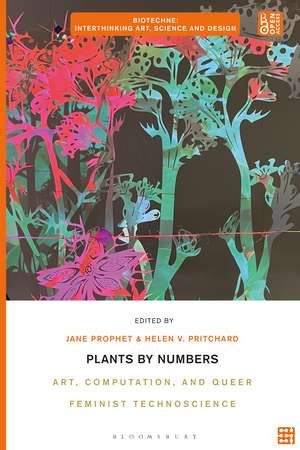
Plants by Numbers: Art, Computation, and Queer Feminist Technoscience: Biotechne: Interthinking Art, Science and Design
Editat de Dr. Jane Prophet, Dr. Helen V. Pritcharden Limba Engleză Hardback – 16 noi 2023
Organised around three key themes--techno-nature entanglements, plants as resistant agents, and becoming-with-plants--the volume provides a vital pathway through complex theoretical ideas that inform the practices of artists working in the fields of computation and ecology.
Fusing art theoretical and art practice approaches, the contributors describe how we might design, make and imagine computational processes differently, or otherwise, through the co-production of artworks with plants. Showing how these artworks might act as communicative media between the biological and technological, Plants by Numbers opens up new potential areas of research whilst producing new ethical-political engagements.
The eBook editions of this book are available open access under a CC BY 4.0 licence on bloomsburycollections.com. Open access was funded by the University of Michigan.




Preț: 588.66 lei
Preț vechi: 918.04 lei
-36%
Puncte Express: 883
Carte disponibilă
Livrare economică 16-27 octombrie
Livrare prin curier în România Termenul estimat este afișat lângă disponibilitate.
Transport gratuit pentru acest produs Plată online sau ramburs, în funcție de opțiunile comenzii.
Retur gratuit în 14 zile Comandă securizată și suport în română.
Specificații
ISBN-13: 9781350343252
ISBN-10: 1350343250
Pagini: 288
Ilustrații: 43 colour and 66 bw illus
Dimensiuni: 162 x 236 x 22 mm
Greutate: 0.8 kg
Editura: Bloomsbury Publishing
Colecția Bloomsbury Visual Arts
Seria Biotechne: Interthinking Art, Science and Design
Locul publicării:London, United Kingdom
ISBN-10: 1350343250
Pagini: 288
Ilustrații: 43 colour and 66 bw illus
Dimensiuni: 162 x 236 x 22 mm
Greutate: 0.8 kg
Editura: Bloomsbury Publishing
Colecția Bloomsbury Visual Arts
Seria Biotechne: Interthinking Art, Science and Design
Locul publicării:London, United Kingdom
V-ar putea interesa
-
 The Light EatersZoë SchlangerPreț: 77.62 lei
 -
 -19%Preț: 74.79 lei92.54 lei
 -
 Vegetal Entwinements in Philosophy and ArtGiovanni Aloi-16%Preț: 447.56 lei530.84 lei
 -
 Art + Science NowStephen Wilson-21%Preț: 155.99 lei196.91 lei
 -
 Against the MachinePaul KingsnorthPreț: 187.83 lei
 -
 Preț: 381.06 lei
 -
 -33%Preț: 581.93 lei864.07 lei
 -
 The Life of PlantsEmanuele CocciaPreț: 138.57 lei
 -
 Anthropocene FeminismRichard GrusinPreț: 207.88 lei
 -
 Arts of Living on a Damaged Planet: Ghosts and Monsters of the AnthropoceneAnna Lowenhaupt TsingPreț: 155.43 lei
 -
 The Nature of NatureVandana ShivaPreț: 102.92 lei
 -
 -20%Preț: 85.14 lei105.82 lei
 -
 -20%Preț: 214.43 lei267.62 lei
 -
 -20%Preț: 56.42 lei70.27 lei
 -
 Nature's GeniusDavid FarrierPreț: 142.56 lei
 -
 The Genius of TreesHarriet RixPreț: 122.14 lei
 -
 MicrocosmsJill PflugheberPreț: 345.27 lei
 -
 -17%Preț: 286.56 lei345.02 lei
 -
 Simnikiwe Buhlungu: besides Puleng; dontsa-ring and roving preoccupationsSimnikiwe BuhlunguPreț: 162.74 lei
Cuprins
Acknowledgements
List of Contributors
List of Plates
List of Figures
Introduction
Part One: Techno-nature entanglements
1. Afro-now-ist Stories of Resistance: A Conversation with Stephanie Dinkins, Stephanie Dinkins (Stony Brook University, USA) and Srimoyee Mitra (University of Michigan, USA)
2. The Compromised/Compromising Life of a Farmed Plant, Elaine Gan (Wesleyan University, USA)
3. As Children of Plants, we Play in our Machine Gardens, Amy Youngs (Ohio State University, USA)
4. Co-operating with Diatoms - queer fabulations of a world feeling computing, Helen V. Pritchard (HGK-FHNW University of Applied Sciences and Arts Northwestern Switzerland)
5. So-called Plants, Possible Bodies, Jara Rocha and Femke Snelting (Interdependent researchers, Barcelona and Brussels)
Part Two: Plants - resistance, regeneration and alliance
6. Forests that Compute, Jennifer Gabrys (University of Cambridge, UK)
7. Watered by Data and Other Bio-economic Thoughts: A Conversation Between Curator Belinda Kwan and Artist Stephanie Rothenberg, Belinda Kwan (Independent curator, Canada) and Stephanie Rothenberg (SUNY Buffalo, USA)
8. Tending to 2030m3: How to regenerate regeneration? How to unasphalt asphalt?, Helen V. Pritchard (HGK-FHNW University of Applied Sciences and Arts Northwestern Switzerland), Eric Snodgrass (Linnaeus University/Linköping, Sweden) Miranda Moss (Artist, South Africa), Daniel Gustafsson (Linnaeus University, Sweden
9. Decolonization, Computation, Propagation: Phyto-human alliances in the pathways towards generative justice, Ron Eglash, Audrey Bennett, Lionel Robert, Kwame Porter Robinson, Matthew Garvin, Mark Guzdial (all, University of Michigan, USA)
Part Three: Becoming-with-plants
10. Codely Phytographia: an artist's material history of writing code with trees, Jane Prophet (University of Michigan, USA)
11. Tehran of Trees, Sina Seifee (Artist, Belgium/Iran)
12. Writing in the Wind: Ecopoetics and geoengineering, Joel Ong (York University, Canada)
13. Sunbot Swarm: Absurdist Cyborg Systems for House Plants, Kathleen McDermott (NYU Tandon, USA)
14. Yellow Furry Lullaby, Breakwater, Youngsook Choi and Taey Iohe (Artists, UK/Korea)
Glossary
Index
List of Contributors
List of Plates
List of Figures
Introduction
Part One: Techno-nature entanglements
1. Afro-now-ist Stories of Resistance: A Conversation with Stephanie Dinkins, Stephanie Dinkins (Stony Brook University, USA) and Srimoyee Mitra (University of Michigan, USA)
2. The Compromised/Compromising Life of a Farmed Plant, Elaine Gan (Wesleyan University, USA)
3. As Children of Plants, we Play in our Machine Gardens, Amy Youngs (Ohio State University, USA)
4. Co-operating with Diatoms - queer fabulations of a world feeling computing, Helen V. Pritchard (HGK-FHNW University of Applied Sciences and Arts Northwestern Switzerland)
5. So-called Plants, Possible Bodies, Jara Rocha and Femke Snelting (Interdependent researchers, Barcelona and Brussels)
Part Two: Plants - resistance, regeneration and alliance
6. Forests that Compute, Jennifer Gabrys (University of Cambridge, UK)
7. Watered by Data and Other Bio-economic Thoughts: A Conversation Between Curator Belinda Kwan and Artist Stephanie Rothenberg, Belinda Kwan (Independent curator, Canada) and Stephanie Rothenberg (SUNY Buffalo, USA)
8. Tending to 2030m3: How to regenerate regeneration? How to unasphalt asphalt?, Helen V. Pritchard (HGK-FHNW University of Applied Sciences and Arts Northwestern Switzerland), Eric Snodgrass (Linnaeus University/Linköping, Sweden) Miranda Moss (Artist, South Africa), Daniel Gustafsson (Linnaeus University, Sweden
9. Decolonization, Computation, Propagation: Phyto-human alliances in the pathways towards generative justice, Ron Eglash, Audrey Bennett, Lionel Robert, Kwame Porter Robinson, Matthew Garvin, Mark Guzdial (all, University of Michigan, USA)
Part Three: Becoming-with-plants
10. Codely Phytographia: an artist's material history of writing code with trees, Jane Prophet (University of Michigan, USA)
11. Tehran of Trees, Sina Seifee (Artist, Belgium/Iran)
12. Writing in the Wind: Ecopoetics and geoengineering, Joel Ong (York University, Canada)
13. Sunbot Swarm: Absurdist Cyborg Systems for House Plants, Kathleen McDermott (NYU Tandon, USA)
14. Yellow Furry Lullaby, Breakwater, Youngsook Choi and Taey Iohe (Artists, UK/Korea)
Glossary
Index
Recenzii
A text that demonstrates the vital importance of observing and treating plants as our companion species, and as cohabitants of this planet to bend towards and learn from, as we ponder our own significance and survival, threatening the end of the anthropocene.
Plants by Numbers works through how coloniality shapes, but does not absolutely envelop, our queerly inter-human and inter-ecological worlds. Rethinking classificatory taxonomies, the book centres plant-life and its aesthetic-scientific possibilities in an eloquent intervention into studies of livingness, affect, and relationality.
This timely collection of accounts by artists, curators, technoscientists and theorists speculates on different modes of world-making and creating kinship with plants, establishing a rich ground for more-than human entanglements.
Growing from a simple prompt, to consider numbering-otherwise, this volume brings together artistic, academic and community-building studies and productions of co-constitutive life worlds of plants and soil, computation and simulation, humans and more-than-humans.
Rooted in anti-colonial, Black and Indigenous, trans-feminist and queer science and technology studies and poetics, shifting away from numbering as a method of control, and generously reimagining accounts, plots and digging as critical cultivating methods and creative practices, Plants By Numbers is essential reading (and experiencing) for artists, scholars, organizers, gardeners, farmers, teachers, observers, dreamers and anyone moved by the transformational and technocultural worlding of entangled plant lives.
In our data-driven world, this collection asks how we might articulate an ethico-politics of numbers with respect to the more-than-human world. Respect is key here, for the power of enumeration but also for its limits, and for the irreducible relationality of sustainable world-making.
Plants by Numbers works through how coloniality shapes, but does not absolutely envelop, our queerly inter-human and inter-ecological worlds. Rethinking classificatory taxonomies, the book centres plant-life and its aesthetic-scientific possibilities in an eloquent intervention into studies of livingness, affect, and relationality.
This timely collection of accounts by artists, curators, technoscientists and theorists speculates on different modes of world-making and creating kinship with plants, establishing a rich ground for more-than human entanglements.
Growing from a simple prompt, to consider numbering-otherwise, this volume brings together artistic, academic and community-building studies and productions of co-constitutive life worlds of plants and soil, computation and simulation, humans and more-than-humans.
Rooted in anti-colonial, Black and Indigenous, trans-feminist and queer science and technology studies and poetics, shifting away from numbering as a method of control, and generously reimagining accounts, plots and digging as critical cultivating methods and creative practices, Plants By Numbers is essential reading (and experiencing) for artists, scholars, organizers, gardeners, farmers, teachers, observers, dreamers and anyone moved by the transformational and technocultural worlding of entangled plant lives.
In our data-driven world, this collection asks how we might articulate an ethico-politics of numbers with respect to the more-than-human world. Respect is key here, for the power of enumeration but also for its limits, and for the irreducible relationality of sustainable world-making.