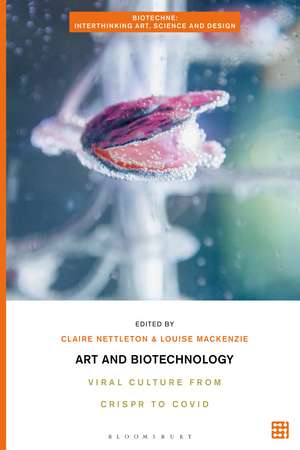
Art and Biotechnology: Viral Culture from CRISPR to COVID: Biotechne: Interthinking Art, Science and Design
Editat de Claire Correo Nettleton, Louise Mackenzieen Limba Engleză Paperback – 11 iul 2024
The book presents 21 essays, split across four parts, from a coterie of artists, theorists, historians and scientists which examine the symbiotic relationship between humans, animals, and viruses as well as the impossibility of germ-free existence.
The essays in this volume are urgent in their topicality, embodying the exhilarating yet alarming zeitgeist of contemporary nonhuman-to-human viral transmission and gene editing technologies. Ultimately, Art and Biotechnology reveals how art and biotechnology influence each other and how art has shaped the discussion around gene editing and the socio-cultural aspects of the Covid-19 pandemic. It is essential reading for students and researchers focussing on science and art, environmental humanities, and ethics.


Preț: 186.85 lei
Preț vechi: 243.84 lei
-23%
Puncte Express: 280
Carte disponibilă
Livrare economică 30 octombrie-10 noiembrie
Livrare express 20-24 octombrie pentru 101.34 lei
Livrare prin curier în România Termenul estimat este afișat lângă disponibilitate.
Transport gratuit de la 400.00 lei Plată online sau ramburs, în funcție de opțiunile comenzii.
Retur gratuit în 14 zile Comandă securizată și suport în română.
Specificații
ISBN-13: 9781350376021
ISBN-10: 1350376027
Pagini: 280
Ilustrații: 50 colour & 50 bw illus
Dimensiuni: 156 x 232 x 20 mm
Greutate: 0.7 kg
Editura: Bloomsbury Publishing
Colecția Bloomsbury Visual Arts
Seria Biotechne: Interthinking Art, Science and Design
Locul publicării:London, United Kingdom
ISBN-10: 1350376027
Pagini: 280
Ilustrații: 50 colour & 50 bw illus
Dimensiuni: 156 x 232 x 20 mm
Greutate: 0.7 kg
Editura: Bloomsbury Publishing
Colecția Bloomsbury Visual Arts
Seria Biotechne: Interthinking Art, Science and Design
Locul publicării:London, United Kingdom
Cuprins
Illustrations
Notes on Contributors
Acknowledgements
Introduction: CRISPR, COVID, Creativity and Control, Claire Correo Nettleton (The Benton Museum of Art at Pomona College, USA) and Louise Mackenzie (Duncan of Jordanstone College of Art and Design, Dundee University, UK)
Part I. Biotechnology and the Arts: Studies
1. Resurrecting the Woolly Mammoth and Muybridge's Horse: CRISPR, Cinema and Species Revival, Claire Correo Nettleton (The Benton Museum of Art at Pomona College, USA)
2. Autopoiesis in Contemporary Bioart - Rethinking Autonomy and Agency, Charissa N. Terranova (University of Texas at Dallas, USA)
3. The Exterminating Angels: Bio-Art/Thanatos-Art, Pablo Baler (California State University, Los Angeles, USA)
4. Viral Variation(s): Juan Eduardo Cirlot and the Poetics of Permutation, Paul Cahill (Pomona College, USA)
Part II. Biotechnology and the Arts: Practice
5. Baitul Ma'mur: DNA Manifolds and the House of Angels, Joe Davis (Department of Genetics, Blavatnik Institute, Harvard Medical School and Department of Biology, Massachusetts Institute of Technology, USA)
6. Gene Music: Biologically Motivated Musical Serialism, Ira Fleming (University of Colorado School of Medicine, USA)
7. Transformation - An Exercise in How to Relate to Lively Material, Louise Mackenzie (Duncan of Jordanstone College of Art and Design, Dundee University, UK)
8. Symbiogenesis Begins at the Mouth, Skin, and Genitalia, Ken Rinaldo (Artist Director, Emergent Systems, USA)
9. Aphrodisiac in the Machine, Stephanie Rothenberg (University at Buffalo, USA)
Part III. COVID and the Arts: Reflections
10. Art Worlds Evolving: Notes on Evolutionary Metaphors of Change and the Global Art System, Meredith Tromble (San Francisco Art Institute, USA)
11. Embracing Viral Uncertainty? It's Complicated, Roberta Buiani (University of Toronto, Canada)
12.The Anosmatic Symposium, Regine Rapp and Christian de Lutz (Art Laboratory Berlin, Germany)
13. FEMeeting: Making of an Antibodies Network, Dalila Honorato and Marta de Menezes (Cultivamos Cultura and Ectopia, Portugal / Ionian University, Greece)
14. COVID-19 and the Embodiment of Disruption: Assemblages of Agency and the Turducken of Chaos, WhiteFeather Hunter and Molly McKinney (The University of Western Australia, Australia)
15. Life in the Time of the Slow Hauling Knowledge, Dolores Steinman (University of Toronto, Canada)
Part IV. COVID and the Arts: Practice
16. Thermobiopolitics, Oron Catts and Ionat Zurr (The University of Western Australia, Australia)
17. Utter: On the Matter of Human Emissions, Paul Vanouse (University at Buffalo, USA)
18. Death Tool Kit: Practical and spiritual guidance from artists Adriene Jenik, IONE, Marne Lucas, Linda Mary Montano, and Kira O'Reilly, Kathy High (Rensselaer Polytechnic Institute, USA)
19. Creating and Exhibiting Artworks Embedded with SARS-CoV-2 Genetic Material During the COVID-19 Pandemic, Anna Dumitriu (Brighton and Sussex Medical School / University of Hertfordshire, UK)
20. Living in the Pandemic Panopticon - Who/What is Watching you While you Think You are Alone?, Karolina Zyniewicz (University of Warsaw, Poland)
21. Viruses as Testing Grounds for Speculations, Pei-Ying Lin (Eindhoven University of Technology, The Netherlands)
Index
Notes on Contributors
Acknowledgements
Introduction: CRISPR, COVID, Creativity and Control, Claire Correo Nettleton (The Benton Museum of Art at Pomona College, USA) and Louise Mackenzie (Duncan of Jordanstone College of Art and Design, Dundee University, UK)
Part I. Biotechnology and the Arts: Studies
1. Resurrecting the Woolly Mammoth and Muybridge's Horse: CRISPR, Cinema and Species Revival, Claire Correo Nettleton (The Benton Museum of Art at Pomona College, USA)
2. Autopoiesis in Contemporary Bioart - Rethinking Autonomy and Agency, Charissa N. Terranova (University of Texas at Dallas, USA)
3. The Exterminating Angels: Bio-Art/Thanatos-Art, Pablo Baler (California State University, Los Angeles, USA)
4. Viral Variation(s): Juan Eduardo Cirlot and the Poetics of Permutation, Paul Cahill (Pomona College, USA)
Part II. Biotechnology and the Arts: Practice
5. Baitul Ma'mur: DNA Manifolds and the House of Angels, Joe Davis (Department of Genetics, Blavatnik Institute, Harvard Medical School and Department of Biology, Massachusetts Institute of Technology, USA)
6. Gene Music: Biologically Motivated Musical Serialism, Ira Fleming (University of Colorado School of Medicine, USA)
7. Transformation - An Exercise in How to Relate to Lively Material, Louise Mackenzie (Duncan of Jordanstone College of Art and Design, Dundee University, UK)
8. Symbiogenesis Begins at the Mouth, Skin, and Genitalia, Ken Rinaldo (Artist Director, Emergent Systems, USA)
9. Aphrodisiac in the Machine, Stephanie Rothenberg (University at Buffalo, USA)
Part III. COVID and the Arts: Reflections
10. Art Worlds Evolving: Notes on Evolutionary Metaphors of Change and the Global Art System, Meredith Tromble (San Francisco Art Institute, USA)
11. Embracing Viral Uncertainty? It's Complicated, Roberta Buiani (University of Toronto, Canada)
12.The Anosmatic Symposium, Regine Rapp and Christian de Lutz (Art Laboratory Berlin, Germany)
13. FEMeeting: Making of an Antibodies Network, Dalila Honorato and Marta de Menezes (Cultivamos Cultura and Ectopia, Portugal / Ionian University, Greece)
14. COVID-19 and the Embodiment of Disruption: Assemblages of Agency and the Turducken of Chaos, WhiteFeather Hunter and Molly McKinney (The University of Western Australia, Australia)
15. Life in the Time of the Slow Hauling Knowledge, Dolores Steinman (University of Toronto, Canada)
Part IV. COVID and the Arts: Practice
16. Thermobiopolitics, Oron Catts and Ionat Zurr (The University of Western Australia, Australia)
17. Utter: On the Matter of Human Emissions, Paul Vanouse (University at Buffalo, USA)
18. Death Tool Kit: Practical and spiritual guidance from artists Adriene Jenik, IONE, Marne Lucas, Linda Mary Montano, and Kira O'Reilly, Kathy High (Rensselaer Polytechnic Institute, USA)
19. Creating and Exhibiting Artworks Embedded with SARS-CoV-2 Genetic Material During the COVID-19 Pandemic, Anna Dumitriu (Brighton and Sussex Medical School / University of Hertfordshire, UK)
20. Living in the Pandemic Panopticon - Who/What is Watching you While you Think You are Alone?, Karolina Zyniewicz (University of Warsaw, Poland)
21. Viruses as Testing Grounds for Speculations, Pei-Ying Lin (Eindhoven University of Technology, The Netherlands)
Index
Recenzii
This book is rich and insightful , engaging with both art and science; theory and practice. The unusual insights of support the central premise of the book, which is to explore how the humanities, in relation to science, and in particular, biotechnology, engage with important ethical and social issues affecting society at large.
This book unites a diverse range of pivotal thinkers who provide fascinating insights into the relationship with the tools and activities of the Covid-19 pandemic. Drawing attention to the lineages of biological and environmental art/design, it situates the arts as fundamental interlocutor in the unfolding story of human-viral entanglements both now and into the future.
This book is essential for artists entering biotech and science students embracing creativity in their fields. Amid global challenges surrounding environmental and global health crises, the book bridges disciplines and offers vital insights for art-sci collaboration.
This book unites a diverse range of pivotal thinkers who provide fascinating insights into the relationship with the tools and activities of the Covid-19 pandemic. Drawing attention to the lineages of biological and environmental art/design, it situates the arts as fundamental interlocutor in the unfolding story of human-viral entanglements both now and into the future.
This book is essential for artists entering biotech and science students embracing creativity in their fields. Amid global challenges surrounding environmental and global health crises, the book bridges disciplines and offers vital insights for art-sci collaboration.