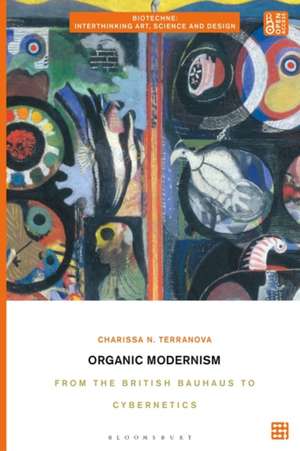
Organic Modernism: From the British Bauhaus to Cybernetics: Biotechne: Interthinking Art, Science and Design
Autor Dr. Charissa N. Terranovaen Limba Engleză Hardback – 28 noi 2024
The first book to trace the story of British "organic modernism", this ground-breaking open access study tells the story of a collective culture of artists, scientists, and designers in 20th century united by a holistic understanding of the organic world and devoted to collaboration, cooperation, and cross-pollination of the arts and biological sciences.
Tracing how artists, scientists, and designers cooperated in various capacities from the Great Depression to postwar cybernetics, this book follows the evolution of philosophical organicism from the British Bauhaus, modern architecture, and surrealism; through to post-war socialism, the welfare state, epigenetics, biology-based art exhibitions; robotic art and design, cybernetics and ecology in art. Reacting against blunt reductionism, organic modernists implemented organicist and emergentist philosophies in scientific labs, design studios, and art ateliers, embracing complexity to solve problems in various scales and arenas, from cells to socialism. Their actions offer a template for finding meaningful agency and problem solving in today's world fraught by global climate disaster, ever-expanding economic inequalities, and backsliding democracy
A sequel to Terranova's Art as Organism: Biology and the Evolution of the Digital Image (2016), Organic Modernism reveals the biological roots of cybernetics in the British context.
The ebook editions of this book are available open access under a CC BY-NC-ND 4.0 licence on bloomsburycollections.com. Open access was funded by the Edith O'Donnell Institute of Art History.




Preț: 611.87 lei
Preț vechi: 916.03 lei
-33%
Puncte Express: 918
Carte disponibilă
Livrare economică 19 octombrie-02 noiembrie
Livrare prin curier în România Termenul estimat este afișat lângă disponibilitate.
Transport gratuit pentru acest produs Plată online sau ramburs, în funcție de opțiunile comenzii.
Retur gratuit în 14 zile Comandă securizată și suport în română.
Specificații
ISBN-13: 9781350227538
ISBN-10: 1350227536
Pagini: 304
Ilustrații: 16 colour & 71 bw illus
Dimensiuni: 158 x 236 x 22 mm
Greutate: 0.78 kg
Editura: Bloomsbury Publishing
Colecția Bloomsbury Visual Arts
Seria Biotechne: Interthinking Art, Science and Design
Locul publicării:London, United Kingdom
ISBN-10: 1350227536
Pagini: 304
Ilustrații: 16 colour & 71 bw illus
Dimensiuni: 158 x 236 x 22 mm
Greutate: 0.78 kg
Editura: Bloomsbury Publishing
Colecția Bloomsbury Visual Arts
Seria Biotechne: Interthinking Art, Science and Design
Locul publicării:London, United Kingdom
V-ar putea interesa
-
 BlueprintsMarcus Du SautoyPreț: 121.99 lei
 -
 Modern Buildings in BritainOwen Hatherley-14%Preț: 277.08 lei324.03 lei
 -
 Think Tank AestheticsPamela M. Lee-16%Preț: 203.42 lei243.15 lei
 -
 Sussex ModernismHope WolfPreț: 319.01 lei
 -
 Art + Science NowStephen Wilson-21%Preț: 155.99 lei196.91 lei
 -
 Harris, A: Romantic ModernsAlexandra Harris-19%Preț: 87.85 lei108.19 lei
 -
 The Sources of Modern Architecture and DesignNikolaus Pevsner-21%Preț: 104.93 lei133.20 lei
 -
 The Real and the RomanticFrances Spalding-18%Preț: 229.49 lei279.15 lei
 -
 Notes on the Synthesis of FormChristopher AlexanderPreț: 228.57 lei
 -
 The Dehumanization of Art and Other Essays on Art, Culture, and LiteratureJosé Ortega Y. GassetPreț: 90.47 lei
 -
 Preț: 384.83 leiRecomandat
 -
 -23%Preț: 722.53 lei938.35 lei
 -
 Art as Organism: Biology and the Evolution of the Digital ImageDr. Charissa N. Terranova-27%Preț: 191.61 lei262.68 lei
 -
 Circles and Squares: The Lives and Art of the Hampstead ModernistsCaroline Maclean-56%Preț: 57.89 lei132.82 lei
 -
 Making MultiplicityGerald RaunigPreț: 84.56 lei
 -
 Natural ConnectionJoycelyn LongdonPreț: 135.31 lei
 -
 Neri Oxman: Material EcologyPaola Antonelli-19%Preț: 278.54 lei345.43 lei
 -
 Nature and the MindMarc BermanPreț: 120.67 lei
 -
 Studio LivesLouise CampbellPreț: 312.40 lei
 -
 The Shape of Things: Still Life in BritainSimon MartinPreț: 262.15 lei
 -
 The Organic LineIrene V. SmallPreț: 270.19 lei
 -
 How to Design a GardenJohn Brookes (landscape designer)-18%Preț: 118.03 lei143.63 lei
 -
 Designing the Computational Image, Imagining Computational DesignDaniel Cardoso Llach-20%Preț: 200.53 lei250.67 lei
Cuprins
List of Illustrations
Preface
Chapter 1 Organicism Abounds: British Intellectual Culture in the 1930s
Chapter 2 Biology and the British Bauhaus: From the Laboratory to Modern Design
Chapter 3 Romantic Genetics: Landscape Lived, Rendered, and Epigenetic
Chapter 4 Exhibition as Extended Organism: Three Shows in 1951
Chapter 5 The Eccentric Cybernetics of György Kepes and Organic Modernism
Conclusion Teachback and the Heuristics of Organic Modernism
Bibliography
Index
Preface
Chapter 1 Organicism Abounds: British Intellectual Culture in the 1930s
Chapter 2 Biology and the British Bauhaus: From the Laboratory to Modern Design
Chapter 3 Romantic Genetics: Landscape Lived, Rendered, and Epigenetic
Chapter 4 Exhibition as Extended Organism: Three Shows in 1951
Chapter 5 The Eccentric Cybernetics of György Kepes and Organic Modernism
Conclusion Teachback and the Heuristics of Organic Modernism
Bibliography
Index
Recenzii
A brilliant transdisciplinary study, Terranova's book invites us to explore the history of modernism in relation to systems thinking. Charting mutations of ideas in aesthetics, science, and politics, it shows how notions of complexity developed before the digital age, at the confluence of art and biology.
Invaluably tracing the origins of philosophical organicism in interwoven communities of art, science, design, and socialist politics in the early 20th century, Terranova excavates a germinal educational model for our own ecologically fragile moment.
A historical account that is also forward-looking, this book is a timely reintroduction to and redeployment of a modernist worldview that favors progressive-minded complexity over the refinements of reductionism.
Invaluably tracing the origins of philosophical organicism in interwoven communities of art, science, design, and socialist politics in the early 20th century, Terranova excavates a germinal educational model for our own ecologically fragile moment.
A historical account that is also forward-looking, this book is a timely reintroduction to and redeployment of a modernist worldview that favors progressive-minded complexity over the refinements of reductionism.