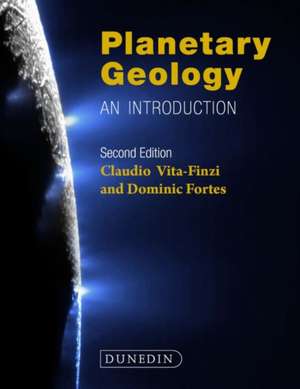
Planetary Geology
Autor Claudio Vita-Finzi, Andrew Dominic Fortesen Limba Engleză Paperback – 19 iun 2013
Observăm în literatura academică dedicată sistemului solar o tendință istorică de a trata corpurile cerești strict prin prisma astronomiei sau a fizicii teoretice, lăsând adesea o lacună în ceea ce privește analiza proceselor geologice concrete care modelează suprafețele planetare. Planetary Geology vine să completeze acest gol, propunând o perspectivă ancorată în geologia convențională. Această a doua ediție, semnată de Claudio Vita-Finzi și Andrew Dominic Fortes, subliniază faptul că disciplinele pământene și cele planetare au devenit interdependente, oferind un cadru unitar de studiu pentru planetele stâncoase și sateliții înghețați.
Descoperim aici o analiză riguroasă a modului în care structura internă și evoluția termică dictează trăsăturile de suprafață, de la văile de rift și dunele de pe Marte până la oceanele ascunse ale lunilor depărtate. Față de prima ediție, volumul a fost extins cu 20%, integrând rezultate de ultimă oră de la misiunile NASA și ESA, care demonstrează că multe corpuri planetare sunt mult mai active geologic decât se estimase anterior, prezentând dovezi de vulcanism recent și activitate seismică. Cititorii familiarizați cu Planetary Geoscience de Jr Harry Y. McSween vor aprecia aici abordarea mai aplicată a geologilor, care transpun concepte precum sedimentologia sau tectonica în context extraterestru, în timp ce McSween se concentrează pe o perspectivă comparativă de ansamblu.
Stilul este precis, specific unui manual universitar publicat de Dunedin Academic Press LTD, dar accesibil și amatorilor entuziaști. Ilustrațiile color, acum dispersate în text, și datele obținute din analiza meteoriților marțieni sau a fragmentelor lunare transformă această lucrare într-un instrument esențial pentru înțelegerea originilor sistemului solar.
Preț: 546.97 lei
Carte disponibilă
Livrare economică 09-23 noiembrie
Specificații
ISBN-10: 1780460155
Pagini: 206
Ilustrații: Colour
Dimensiuni: 198 x 257 x 13 mm
Greutate: 0.68 kg
Ediția:2 Rev ed.
Editura: Dunedin Academic Press LTD
V-ar putea interesa
-
 Vaccines: What Everyone Needs to Know®Kristen A. Feemster-24%Preț: 61.57 lei80.79 lei
 -
 -11%Preț: 198.48 lei222.44 lei
 -
 Universities and Colleges: A Very Short IntroductionDavid Palfreyman-20%Preț: 57.15 lei71.12 lei
 -
 The Confabulating Mind: How the Brain Creates RealityArmin SchniderPreț: 368.96 lei
 -
 -21%Preț: 214.54 lei272.76 lei
 -
 Linear Algebra for the 21st CenturyAnthony Roberts-20%Preț: 415.77 lei518.91 lei
 -
 The History of PhilosophyA. C. Grayling-17%Preț: 92.09 lei110.47 lei
 -
 -32%Preț: 62.29 lei91.80 lei
 -
 From Leningrad to Hungary: Notes of a Red Army Soldier, 1941-1946Evgenii D. Moniushko-15%Preț: 463.90 lei545.76 lei
 -
 How Fascism WorksJason Stanley-25%Preț: 85.43 lei113.45 lei
 -
 Post CoronaScott Galloway-21%Preț: 56.07 lei70.61 lei
 -
 The Story of MythSarah Iles JohnstonPreț: 405.43 lei
 -
 The Habsburg EmpirePieter M. JudsonPreț: 169.67 lei
 -
 A Theory of the AphorismAndrew HuiPreț: 164.29 lei
 -
 Covid-19: A Critical Care TextbookChris Carter-16%Preț: 311.07 lei368.83 lei
 -
 A Book of Book Lists: A Bibliophile's CompendiumAlex JohnsonPreț: 68.48 lei
 -
 Preț: 282.10 lei
 -
 Preț: 372.64 lei
 -
 Preț: 200.14 lei
 -
 Batman Vol. 1: I Am Gotham (Rebirth)Tom King-18%Preț: 88.66 lei108.44 lei
 -
 -24%Preț: 95.72 lei125.53 lei
 -
 Preț: 220.06 lei
 -
 Philosophy Before Socrates: An Introduction with Texts and CommentaryRichard D. McKirahan-21%Preț: 183.96 lei232.02 lei
 -
 The Cold WarBridget Kendall-18%Preț: 113.86 lei138.29 lei
 -
 MindhunterJohn E Douglas-24%Preț: 66.62 lei87.39 lei
 -
 Making up NumbersEkkehard KoppPreț: 257.54 lei
De ce să citești această carte
Recomandăm această ediție actualizată studenților la geologie și pasionaților de explorare spațială care doresc să înțeleagă mecanismele fizice din spatele peisajelor cosmice. Cititorul câștigă o perspectivă modernă asupra dinamismului planetar, învățând să recunoască procese familiare de pe Pământ în cele mai exotice colțuri ale sistemului solar, totul susținut de date recente de la misiunile NASA și ESA.
Descriere scurtă
The new data reveal that many of the supposedly inert planetary bodies were recently subject to earthquakes, landslides and climate change and that some of them display active volcanism. Moreover, our understanding of the very origins of the Solar System depends heavily on the composition of meteorites from Mars reaching the Earth and of rock fragments found on the Moon. Combining extensive use of imagery, the results of laboratory experiments and theoretical modelling, this comprehensively updated second edition of Planetary Geology presents fresh evidence that, to quote the first edition, planetary geology now embraces conventional geology and vice versa.
Claudio Vita-Finzi taught planetary geology at University College London (UCL) for a dozen years before moving to the Natural History Museum's Mineralogy Department, where he is a research associate. He works on solar history. Dominic Fortes is a Research Fellow at UCL, and where he has taught planetary geology for more than five years.
He works on the physical properties of icy planetary materials and their role in the geology of icy satellites