How to Read a Dress: A Guide to Changing Fashion from the 16th to the 21st Century
Autor Lydia Edwardsen Limba Engleză Paperback – 18 noi 2021
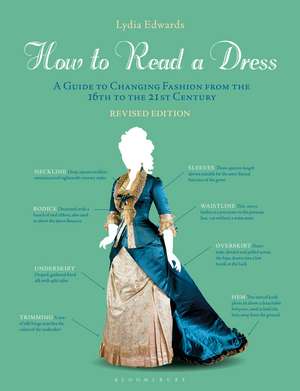
This new edition includes additional styles to illustrate and explain the journey between one style and another; larger images to allow closer investigation of details of dress; examples of lower and working-class, as well as middle-class, clothing; and a completely new chapter covering the 1980s to 2020. The latter demonstrates how the late 20th century and early 21st century firmly left the dress behind as a requirement, but retained it as a perennially popular choice and illustrates how far the traditional boundaries of 'the dress' have been pushed (even including reference to a newly non-binary appreciation of the garment), and the intellectual shifts in the way women's fashion is both inspired and inspires.
With these new additions, How to Read a Dress, revised edition, presents a complete and up-to-date picture of 'the dress' in all its forms, across the centuries, and taking into account different sartorial and social experiences. It is the ideal tool for anyone who has ever wanted to know their cartridge pleats from their Récamier ruffles. Equipping the reader with all the information they need to 'read' a dress, this is the ultimate guide for students, researchers, and anyone interested in historical fashion.
Preț: 202.16 lei
Puncte Express: 303
Carte disponibilă
Livrare economică 17 noiembrie-01 decembrie
Livrare express 03-07 noiembrie pentru 55.45 lei
Livrare prin curier în România Termenul estimat este afișat lângă disponibilitate.
Transport gratuit de la 400.00 lei Plată online sau ramburs, în funcție de opțiunile comenzii.
Retur gratuit în 14 zile Comandă securizată și suport în română.
Specificații
ISBN-13: 9781350172210
ISBN-10: 1350172219
Pagini: 280
Ilustrații: 225 color illus
Dimensiuni: 188 x 244 x 18 mm
Greutate: 0.79 kg
Ediția:Revizuită
Editura: Bloomsbury Publishing
Colecția Bloomsbury Visual Arts
Locul publicării:London, United Kingdom
ISBN-10: 1350172219
Pagini: 280
Ilustrații: 225 color illus
Dimensiuni: 188 x 244 x 18 mm
Greutate: 0.79 kg
Ediția:Revizuită
Editura: Bloomsbury Publishing
Colecția Bloomsbury Visual Arts
Locul publicării:London, United Kingdom
V-ar putea interesa
-
 Vaccines: What Everyone Needs to Know®Kristen A. Feemster-24%Preț: 61.57 lei80.79 lei
 -
 -9%Preț: 205.22 lei225.55 lei
 -
 Universities and Colleges: A Very Short IntroductionDavid Palfreyman-19%Preț: 57.46 lei71.12 lei
 -
 The Confabulating Mind: How the Brain Creates RealityArmin SchniderPreț: 368.96 lei
 -
 -20%Preț: 222.02 lei277.60 lei
 -
 Linear Algebra for the 21st CenturyAnthony Roberts-18%Preț: 430.10 lei526.10 lei
 -
 The History of PhilosophyA. C. Grayling-17%Preț: 92.09 lei110.47 lei
 -
 -32%Preț: 62.29 lei91.80 lei
 -
 From Leningrad to Hungary: Notes of a Red Army Soldier, 1941-1946Evgenii D. Moniushko-15%Preț: 463.90 lei545.76 lei
 -
 How Fascism WorksJason Stanley-19%Preț: 91.11 lei113.06 lei
 -
 Post CoronaScott Galloway-21%Preț: 56.07 lei70.61 lei
 -
 The Story of MythSarah Iles JohnstonPreț: 405.43 lei
 -
 The Habsburg EmpirePieter M. JudsonPreț: 169.67 lei
 -
 A Theory of the AphorismAndrew HuiPreț: 179.96 lei
 -
 Covid-19: A Critical Care TextbookChris Carter-16%Preț: 311.07 lei368.83 lei
 -
 A Book of Book Lists: A Bibliophile's CompendiumAlex JohnsonPreț: 68.48 lei
 -
 The Cambridge Handbook of the ImaginationAnna Abraham-11%Preț: 500.62 lei562.49 lei
 -
 Plant PhysiologyS L Kochhar-11%Preț: 615.35 lei691.41 lei
 -
 Preț: 282.10 lei
 -
 Hands on HackingMatthew Hickey-20%Preț: 237.78 lei297.22 lei
 -
 Preț: 372.64 lei
 -
 -24%Preț: 95.72 lei125.53 lei
 -
 Preț: 220.10 lei
 -
 Philosophy Before Socrates: An Introduction with Texts and CommentaryRichard D. McKirahan-20%Preț: 185.00 lei232.02 lei
 -
 The Cold WarBridget Kendall-18%Preț: 113.86 lei138.29 lei
 -
 Making up NumbersEkkehard KoppPreț: 257.54 lei
Cuprins
Acknowledgements
Preface
Introduction
1. 1550 - 1600
2. 1600 - 1699
3. 1710 - 1790
4. 1790 - 1837
5. 1837 - 1869
6. 1870 - 1889
7. 1890 - 1916
8. 1918 - 1929
9. 1930 - 1946
10. 1947 - 1959
11. 1960 - 1979
12. 1980 - 2020
Glossary of Terms
Notes
Bibliography
Photographic Credits
Index
List of Fashion Designers
Preface
Introduction
1. 1550 - 1600
2. 1600 - 1699
3. 1710 - 1790
4. 1790 - 1837
5. 1837 - 1869
6. 1870 - 1889
7. 1890 - 1916
8. 1918 - 1929
9. 1930 - 1946
10. 1947 - 1959
11. 1960 - 1979
12. 1980 - 2020
Glossary of Terms
Notes
Bibliography
Photographic Credits
Index
List of Fashion Designers
Recenzii
This comprehensive, inclusive and updated guide to dress history is richly illustrated in full colour and is supplemented with detailed annotations that identify the key stylistic trends from 1550 to 2020 - making it an essential text for the novice fashion historian.
Fashion lovers, students, and historians alike are all indebted to Edwards for teaching us how to interpret the meanings inscribed in the very clothes we wear and have worn for centuries. This new edition brings us into the 21st century with a potent reminder that not only can we all read a dress - we can all wear one too!
This updated and expanded edition is an invaluable resource in any costume history library. Dr. Lydia Edwards brings to life the evolution of the changing fashions, technological developments, and the social and material culture of the different decades.
For a knowledgeable introduction that has plenty of eye candy alongside its scholarship, Lydia Edwards' How to Read a Dress hits the spot.The curated collection, featuring everything from funeral finery to department-store finds, offers [a...] fascinating fashion primer that invites you to make connections across centuries, to wonder about the ways huge social shifts are reflected in everyday life, and tips you off about the placement of shoulder seams. Whether you're a costume nerd or just casually curious, How to Read a Dress will give you some insights into the language of dress.
The general principle of this book is excellent and provides a much-needed overview ... [It] is a perfect introduction to the world of dress history and provides a good stimulus for further study. For those with specialist knowledge of particular periods, it provides a quick and easily accessed reference for the main points of other periods.
This original, accessible take on fashion history is packed with color images, and each example garment annotated with terminology, key elements of the shape and construction, and other details of note.
Those looking for a detailed, object centered and carefully researched study of historic dress will find a satisfying, richly illustrated guide for looking at clothes.
Lydia Edwards's How to Read a Dress is a detailed, practical, and totally beautiful guide to the history of this particular form of clothing from the 16th to the 20th centuries.
Ultimately, this is an excellent book for scholars of fashion history, costume designers and makers, and really anyone looking to improve their ability to determine the period of a given dress.
This is a beautiful, well-written book. The photos are a joy to study, and I finished it wishing it were twice as long.
Sashays down the historical catwalk, examining women's costume from the 16th to the 20th century . It is fascinating to rifle through this pictorial dress-up box and see styles come and go, and then imagine what you might like to wear.
Using examples from lesser known international collections, this well-illustrated and informative book tracks the evolution of the dress through expert analysis and description. It will be an invaluable guide for anyone with an interest in dating and contextualizing the dress as a garment within the culture of fashion.
This appealing and accessible work offers a fresh perspective on fashion history from 1550 to 1970. Images of surviving garments from museums in Australia, Canada, Europe and the United States of America have been annotated to highlight and elucidate key fashionable details. This book would make an excellent companion to The Dress Detective.
This book explores the realities of what we can and cannot know about a garment, particularly in terms of the why and when of its creation. The author's concept of the fluidity of time is critical to our better understanding of how individuals approach dress.
Fashion lovers, students, and historians alike are all indebted to Edwards for teaching us how to interpret the meanings inscribed in the very clothes we wear and have worn for centuries. This new edition brings us into the 21st century with a potent reminder that not only can we all read a dress - we can all wear one too!
This updated and expanded edition is an invaluable resource in any costume history library. Dr. Lydia Edwards brings to life the evolution of the changing fashions, technological developments, and the social and material culture of the different decades.
For a knowledgeable introduction that has plenty of eye candy alongside its scholarship, Lydia Edwards' How to Read a Dress hits the spot.The curated collection, featuring everything from funeral finery to department-store finds, offers [a...] fascinating fashion primer that invites you to make connections across centuries, to wonder about the ways huge social shifts are reflected in everyday life, and tips you off about the placement of shoulder seams. Whether you're a costume nerd or just casually curious, How to Read a Dress will give you some insights into the language of dress.
The general principle of this book is excellent and provides a much-needed overview ... [It] is a perfect introduction to the world of dress history and provides a good stimulus for further study. For those with specialist knowledge of particular periods, it provides a quick and easily accessed reference for the main points of other periods.
This original, accessible take on fashion history is packed with color images, and each example garment annotated with terminology, key elements of the shape and construction, and other details of note.
Those looking for a detailed, object centered and carefully researched study of historic dress will find a satisfying, richly illustrated guide for looking at clothes.
Lydia Edwards's How to Read a Dress is a detailed, practical, and totally beautiful guide to the history of this particular form of clothing from the 16th to the 20th centuries.
Ultimately, this is an excellent book for scholars of fashion history, costume designers and makers, and really anyone looking to improve their ability to determine the period of a given dress.
This is a beautiful, well-written book. The photos are a joy to study, and I finished it wishing it were twice as long.
Sashays down the historical catwalk, examining women's costume from the 16th to the 20th century . It is fascinating to rifle through this pictorial dress-up box and see styles come and go, and then imagine what you might like to wear.
Using examples from lesser known international collections, this well-illustrated and informative book tracks the evolution of the dress through expert analysis and description. It will be an invaluable guide for anyone with an interest in dating and contextualizing the dress as a garment within the culture of fashion.
This appealing and accessible work offers a fresh perspective on fashion history from 1550 to 1970. Images of surviving garments from museums in Australia, Canada, Europe and the United States of America have been annotated to highlight and elucidate key fashionable details. This book would make an excellent companion to The Dress Detective.
This book explores the realities of what we can and cannot know about a garment, particularly in terms of the why and when of its creation. The author's concept of the fluidity of time is critical to our better understanding of how individuals approach dress.