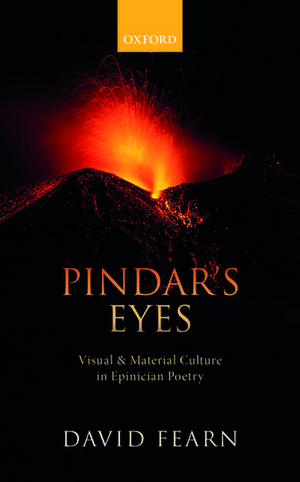
Pindar's Eyes: Visual and Material Culture in Epinician Poetry
Autor David Fearnen Limba Engleză Hardback – 21 sep 2017
Preț: 772.96 lei
Preț vechi: 1123.04 lei
-31%
Puncte Express: 1159
Carte tipărită la comandă
Livrare economică 27 noiembrie-08 decembrie
Livrare prin curier în România Termenul estimat este afișat lângă disponibilitate.
Transport gratuit pentru acest produs Plată online sau ramburs, în funcție de opțiunile comenzii.
Retur gratuit în 14 zile Comandă securizată și suport în română.
Specificații
ISBN-13: 9780198746379
ISBN-10: 0198746377
Pagini: 330
Dimensiuni: 143 x 222 x 25 mm
Greutate: 0.54 kg
Editura: OUP OXFORD
Colecția OUP Oxford
Locul publicării:Oxford, United Kingdom
ISBN-10: 0198746377
Pagini: 330
Dimensiuni: 143 x 222 x 25 mm
Greutate: 0.54 kg
Editura: OUP OXFORD
Colecția OUP Oxford
Locul publicării:Oxford, United Kingdom
V-ar putea interesa
-
 A Late Fifteenth-Century Dominical Sermon CycleStephen Morrison-32%Preț: 849.95 lei1251.31 lei
 -
 -13%Preț: 249.15 lei286.89 lei
 -
 -31%Preț: 445.85 lei646.39 lei
 -
 Gender, Violence, and the Past in Edda and SagaDavid Clark-31%Preț: 769.74 lei1121.10 lei
 -
 -22%Preț: 418.76 lei536.65 lei
 -
 Romance and the Gentry in Late Medieval EnglandMichael Johnston-31%Preț: 772.69 lei1122.89 lei
 -
 Love and Providence: Recognition in the Ancient NovelSilvia Montiglio-31%Preț: 693.21 lei1006.84 lei
 -
 The Elegiac Passion: Jealousy in Roman Love ElegyRuth Rothaus Caston-31%Preț: 691.37 lei1005.72 lei
 -
 Preț: 204.28 lei
 -
 A Guide to Old English 8eBruce MitchellPreț: 348.70 lei
 -
 The Cambridge Introduction to Anglo-Saxon LiteratureHugh MagennisPreț: 214.98 lei
 -
 Claudian and the Roman Epic TraditionCatherine Ware-14%Preț: 699.34 lei813.20 lei
 -
 Preț: 452.41 lei
 -
 Preț: 378.98 lei
 -
 -23%Preț: 2825.17 lei3669.06 lei
 -
 Sir Gawain and the Green KnightJoseph Glaser-18%Preț: 86.14 lei105.06 lei
 -
 -17%Preț: 74.34 lei89.78 lei
 -
 Ovid: Amores III, a Selection: 2, 4, 5, 14Jennifer Ingleheart-22%Preț: 154.23 lei196.48 lei
Recenzii
The engagement with Pindaric scholarship is thorough, often explained in lengthy footnotes. The readings derive from sound translations, arguments and interpretations, whatever will be thought of particular points. More importantly, these readings are exciting because they push our approach to Pindar beyond the rehash of scholarly quagmires and current trends. In many ways, these studies offer great value, individually and as a whole, that strives toward a new, art-historically informed approach to Pindar in which meaning derives from the poetics.
the book is rich in insightful and enjoyable analyses, such as the reading of Nemean 8, and some general observations about Pindar's poetic personality which makes Fearn's approach thought-provoking and ground-breaking in Pindaric scholarship... Fearn's book is a valuable study of the complex Pindaric attitude to visual culture.
This interdisciplinary work provides a new understanding of Pindar's difficult texts (Nemean 5, Nemean 8, and Pythian 1 are the examples chosen) and their effect on his audiences, illuminating also the ways in which Pindar was received, for example, by Herodotus. The book is rich in ideas about text and image, ritual and poetry, ekphrasis and the lyric "I," and many other Pindaric topics. But above all, Fearns convincingly demonstrates the continuities between lyric poetry and tragedy, and ritual and visual culture. ... Summing Up: Recommended. Upper-division undergraduates through faculty.
the book is rich in insightful and enjoyable analyses, such as the reading of Nemean 8, and some general observations about Pindar's poetic personality which makes Fearn's approach thought-provoking and ground-breaking in Pindaric scholarship... Fearn's book is a valuable study of the complex Pindaric attitude to visual culture.
This interdisciplinary work provides a new understanding of Pindar's difficult texts (Nemean 5, Nemean 8, and Pythian 1 are the examples chosen) and their effect on his audiences, illuminating also the ways in which Pindar was received, for example, by Herodotus. The book is rich in ideas about text and image, ritual and poetry, ekphrasis and the lyric "I," and many other Pindaric topics. But above all, Fearns convincingly demonstrates the continuities between lyric poetry and tragedy, and ritual and visual culture. ... Summing Up: Recommended. Upper-division undergraduates through faculty.
Notă biografică
David Fearn is Reader in Greek Literature at the University of Warwick. His research focuses on the poetics, aesthetics, and the socio-political contextualization and reception of archaic and classical Greek literature, and of lyric poetry in particular, though he is also interested in classical historiography, rhetoric, and ancient aesthetics more broadly. His first book, Bacchylides: Politics, Performance, Poetic Tradition (OUP, 2007), sought to rehabilitate the reputation of this underappreciated poet. He has also edited a collection of essays entitled Aegina: Contexts for Choral Lyric Poetry. Myth, History, and Identity in the Fifth Century BC (OUP, 2011) discussing the interrelation of poetry and culture on the Greek island of Aegina.
Cuprins
- Frontmatter
- List of Abbreviations
- 0: Introduction: Eyes and 'I's
- Eyes and 'I's: Deixis, Visuality, Ecphrasis, Referentiality
- Memorialization, Transmission, Material Culture, Cultural Value
- 1: Efficacy. Nemean 5 and Herodotus on Aeginetan Victors, Heroes, and Statues
- I. Static Statues, Departing Poems
- II. 'Pindar's Splendid Pictures': Craft Analogies and Beyond
- II.1 Aborted Myth: Lyric Story-Telling and Aesthetic Perception
- II.2 Narrative, Persuasion, Falsehood
- III. Encomiastic Conclusions
- III.1 Catalogues and Materialist Voices
- III.2 Lyric Architectonics
- IV. Herodotus on Aeginetan Efficacy: Heroes, Cult Statues, and Pindaric Reception
- IV.1 Moving Sculptures and Aeginetan Efficacy in Book 5
- IV.2 Cult Statues and Heroes at Salamis
- IV.3 Lampon and Pausanias
- V. Conclusion
- 2: Contact. Lyric Referentiality and Material Culture in Nemean 8
- I. Young Love: Pindar's Touching Overtures
- I.1 The Construction of Love
- I.2 Erotic Contextualizabilitya
- I.3 Sight, Touch, Desire, Imagination
- II. Contacting Aiakos
- II.1 Contextual Connectivity
- II.2 Votive Reliefs
- II.3 The First-Person Foregrounded
- II.4 Architecture for Aiakos
- II.5 The Aiakeion as a Lyric Model
- II.6 Pindar and Rituala
- II.7 Kleos and Subjectivity
- II.8 Ecphrasis, Deixis, Gesture
- II.9 The Epiphanic Voice
- III. Attitudes, Visions, Materialities
- III.1 Haptics, Gesture, Epic Rhetoric
- III.2 Past and Future; Monumentality and Memorialization
- IV. Conclusion
- Coda. The Alcmaeon Encounter: Pythian 8.56 60
- 3: Ecphrasis and the Politics of Time in Pythian 1
- I. Unity and Coherence
- II. Lyric and Hymnic Traditions: Framing Lyric Power
- III. Ecphrasis, Signification, and 'The Irruption of Time into Play'
- III.1 On Interpreting Portents
- III.2 Volcanic Noise
- IV. Time for Prayers
- V. Tensions
- VI. Revelation and Authority
- VII. Noise Revisited
- VIII. Conclusion: Monstrous Time
- 4: Language and Vision in the Epinician Poets
- I. The Decorative Box of Words: Simonides' Danae Fragment
- I.1 Ecphrastic Framing
- I.2 Vividness: Language, Imagery, Colour
- I.3 Aesthetics, Communication, and Response
- I.4 Conclusion
- II. Vision and Material Culture in Bacchylides and Pindar Compared
- II.1 'Look this way with your mind'
- II.2 The Passion Within: Ecphrasis and the Opacity of Bacchylidean Lyric Narrative
- II.3 Eyesight in Argos: Vision and Material Culture in Pindar, Nemean 10
- 5: Conclusion
- Endmatter
- Bibliography
- Index of Passages Cited
- General Index