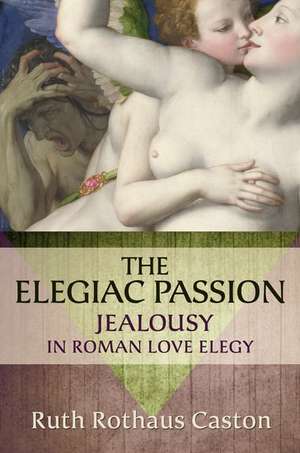
The Elegiac Passion: Jealousy in Roman Love Elegy: Emotions of the Past
Autor Ruth Rothaus Castonen Limba Engleză Hardback – 13 sep 2012
Preț: 714.70 lei
Preț vechi: 1023.51 lei
-30%
Puncte Express: 1072
Carte tipărită la comandă
Livrare economică 04-15 decembrie
Livrare prin curier în România Termenul estimat este afișat lângă disponibilitate.
Transport gratuit pentru acest produs Plată online sau ramburs, în funcție de opțiunile comenzii.
Retur gratuit în 14 zile Comandă securizată și suport în română.
Specificații
ISBN-13: 9780199925902
ISBN-10: 0199925909
Pagini: 192
Dimensiuni: 239 x 163 x 20 mm
Greutate: 0.4 kg
Editura: Oxford University Press
Colecția OUP USA
Seria Emotions of the Past
Locul publicării:New York, United States
ISBN-10: 0199925909
Pagini: 192
Dimensiuni: 239 x 163 x 20 mm
Greutate: 0.4 kg
Editura: Oxford University Press
Colecția OUP USA
Seria Emotions of the Past
Locul publicării:New York, United States
V-ar putea interesa
-
 -13%Preț: 249.15 lei286.89 lei
 -
 Oxford Student Texts: The Merchant's TaleSteven Croft-29%Preț: 79.33 lei111.93 lei
 -
 Satires and EpistlesHorace-18%Preț: 58.57 lei71.65 lei
 -
 -31%Preț: 445.85 lei646.39 lei
 -
 -20%Preț: 434.89 lei545.12 lei
 -
 Medieval Literature: A Very Short IntroductionElaine Treharne-20%Preț: 57.15 lei71.12 lei
 -
 Romance and the Gentry in Late Medieval EnglandMichael Johnston-30%Preț: 798.77 lei1142.73 lei
 -
![The [European] Other in Medieval Arabic Literature and Culture](https://i0.books-express.ro/bt/9780230109407/the-european-other-in-medieval-arabic-literature-and-culture.jpg) -15%Preț: 723.69 lei851.39 lei
-15%Preț: 723.69 lei851.39 lei -
 Preț: 400.30 lei
 -
 Dante's Style in His Lyric PoetryPatrick BoydePreț: 369.76 lei
 -
 The Mind of DanteU. LimentaniPreț: 300.63 lei
 -
 Preț: 330.10 lei
 -
 An Introduction to Wolframs 'Parzival'Sacker HughPreț: 302.30 lei
 -
 Plato's MenoR. S. Bluck-11%Preț: 419.35 lei471.17 lei
 -
 Hebrew Scholarship and the Medieval WorldNicholas De LangePreț: 337.66 lei
 -
 Preț: 253.98 lei
 -
 Preț: 233.70 lei
Recenzii
This is an engagingly written, creative, and frequently very persuasive book.
Caston handles some important issues in a wide-ranging discussion ... her inclusion of the views of modern psychologists and philosophers on jealousy makes for a welcome extra dimension.
This highly nuanced analysis is richly textured, accessible to a broad range of readers, and supported by an excellent, useful scholarly apparatus. Highly recommended.
Caston handles some important issues in a wide-ranging discussion ... her inclusion of the views of modern psychologists and philosophers on jealousy makes for a welcome extra dimension.
This highly nuanced analysis is richly textured, accessible to a broad range of readers, and supported by an excellent, useful scholarly apparatus. Highly recommended.
Notă biografică
Ruth Rothaus Caston is Assistant Professor at the University of Michigan.