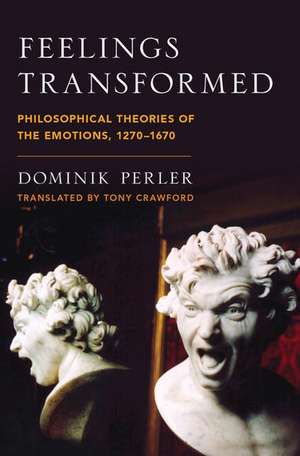
Feelings Transformed: Philosophical Theories of the Emotions, 1270-1670: Emotions of the Past
Autor Dominik Perler Traducere de Tony Crawforden Limba Engleză Hardback – 29 noi 2018
Preț: 516.07 lei
Preț vechi: 717.76 lei
-28%
Puncte Express: 774
Carte tipărită la comandă
Livrare economică 20 noiembrie-01 decembrie
Livrare express 17-23 octombrie pentru 309.28 lei
Livrare prin curier în România Termenul estimat este afișat lângă disponibilitate.
Transport gratuit pentru acest produs Plată online sau ramburs, în funcție de opțiunile comenzii.
Retur gratuit în 14 zile Comandă securizată și suport în română.
Specificații
ISBN-13: 9780199383481
ISBN-10: 0199383480
Pagini: 368
Dimensiuni: 239 x 163 x 33 mm
Greutate: 0.72 kg
Editura: Oxford University Press
Colecția OUP USA
Seria Emotions of the Past
Locul publicării:New York, United States
ISBN-10: 0199383480
Pagini: 368
Dimensiuni: 239 x 163 x 33 mm
Greutate: 0.72 kg
Editura: Oxford University Press
Colecția OUP USA
Seria Emotions of the Past
Locul publicării:New York, United States
V-ar putea interesa
-
 Fidelity of Heart: An Ethic of Christian VirtueJames E. Gilman-31%Preț: 677.97 lei983.98 lei
 -
 Morality, Normativity, and SocietyDavid Copp-22%Preț: 477.03 lei607.99 lei
 -
 -12%Preț: 319.60 lei362.04 lei
 -
 Morals from MotivesMichael Slote-21%Preț: 345.07 lei438.87 lei
 -
 Ethical Argument: Critical Thinking in EthicsHugh Mercer Curtler-23%Preț: 463.76 lei602.29 lei
 -
 Getting Even: Forgiveness and Its LimitsJeffrie G. Murphy-14%Preț: 246.75 lei285.65 lei
 -
 Morality and Self-InterestPaul Bloomfield-12%Preț: 304.51 lei347.86 lei
 -
 The Ethics of Care: Personal, Political, GlobalVirginia Held-12%Preț: 321.06 lei362.78 lei
 -
 -18%Preț: 250.07 lei306.44 lei
 -
 Equality and ResponsibilityChristopher Lake-30%Preț: 470.74 lei673.37 lei
 -
 Self-Governance and CooperationRobert H. Myers-21%Preț: 142.62 lei181.61 lei
 -
 The Problem of EvilMichael L. PetersonPreț: 284.64 lei
 -
 The Right to VegetarianismCarlo Prisco-28%Preț: 220.37 lei306.72 lei
 -
 Preț: 244.59 lei
 -
 The Code of the WarriorShannon E. French-21%Preț: 285.64 lei360.57 lei
 -
 The Evil of Banality: On The Life and Death Importance of ThinkingElizabeth K. MinnichPreț: 281.58 lei
 -
 The Ethics of Theory: Philosophy, History, LiteratureProfessor Robert Doran-17%Preț: 193.48 lei232.10 lei
 -
 Ethics and Politics After PoststructuralismMadeleine Fagan-17%Preț: 172.08 lei208.37 lei
 -
 -29%Preț: 343.17 lei482.74 lei
 -
 Tolerance and Modern Liberalism: From Paradox to Aretaic Moral IdealRené González de la Vega-33%Preț: 543.15 lei815.32 lei
 -
 Der propositionale Wahrheitsbegriff im 14. JahrhundertDominik Perler-23%Preț: 1230.93 lei1598.62 lei
 -
 BriefeNicolaus von AutrecourtPreț: 410.96 lei
Recenzii
The main aim of the book is to investigate how medieval theologians and philosophers of early modern period deal with the human emotions, in order to control, modify and even overcome them...Perler's thesis is that there are important points of correspondence between medieval, modern and contemporary speculations despite the apparent differences. For example, Thomas Aquinas, Ockham, Descartes and Spinoza unanimously agree, as do many present-day philosophers, that emotions are not simply feelings, but states with a cognitive content. This is why emotions can be modified and influenced by other cognitive states.
The result is historical philosophical analysis at its best. This is an impressive (albeit dense) and carefully reasoned tour de force. Essential.
Dominik Perler's study Feelings Transformed: Philosophical Theories of the Emotions, 1270-1670 offers perspective and insight to anyone seeking an understanding of how the emotions were theorised by late medieval and early modern philosophers.
The result is historical philosophical analysis at its best. This is an impressive (albeit dense) and carefully reasoned tour de force. Essential.
Dominik Perler's study Feelings Transformed: Philosophical Theories of the Emotions, 1270-1670 offers perspective and insight to anyone seeking an understanding of how the emotions were theorised by late medieval and early modern philosophers.
Notă biografică
Dominik Perler is Professor of Philosophy at Humboldt-Universität in Berlin. Tony Crawford is a freelance translator and editor in Berlin.
Cuprins
- Preface
- Preface to the English Edition
- Introduction
- 1. A Philosophical Approach to Emotions
- 2. Why Historical Analysis?
- 3. A Twofold Transformation
- I. Thomas Aquinas: Emotions as Sensual Movements
- 1. A Simple Explanation?
- 2. The Soul and Its Faculties
- 3. The Characterization and Classification of the Emotions
- 4. The Cognitive Content of Emotions: Fear and Anger
- 5. How Can Emotions Be Rationally Controlled?
- II. John Duns Scotus and William of Ockham: Emotions in the Will
- 1. Two Kinds of Emotions
- 2. Pain as a Sensual Suffering
- 3. Sadness and Free Will
- 4. The Separation of the Parts of the Soul and Its Consequences
- 5. Love , Enjoyment and Voluntary Control
- III. Michel de Montaigne: A Skeptical View of Emotions
- 1. A Theoretical Approach?
- 2. Dynamic Pyrrhonism
- 3. Applying the Skeptical Method: Sadness, Fear and Anger
- 4. Is A Systematic Order of the Emotions Possible?
- 5. Natural Moderation Instead of Control
- IV. René Descartes: A Dualist View of Emotions
- 1. A Mechanistic Theory of Feelings?
- 2. The Functional Unity of Body and Mind
- 3. Emotions as Representations
- 4. Wonder and the Taxonomy of Emotions
- 5. Self-control through Self-respect
- V. Baruch de Spinoza: Emotions as Psychophysical Units
- 1. A Naturalistic Approach
- 2. The Metaphysical Frame: Monism and Causal Order
- 3. Passive and Active Emotions
- 4. An Intellectualistic and Egoistic Error?
- 5. A Rationalistic Therapy
- Conclusion
- Bibliography
- Notes