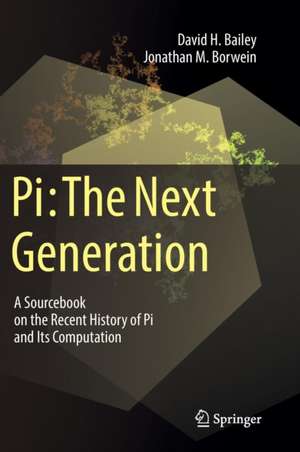
Pi: The Next Generation
Autor David H. Bailey, Jonathan M. Borweinen Limba Engleză Hardback – 5 aug 2016
Autorii David H. Bailey și Jonathan M. Borwein, figuri centrale în matematica experimentală, propun prin această lucrare o sinteză a cercetării moderne asupra celei mai faimoase constante matematice. Putem afirma că volumul fundamentează tranziția de la metodele clasice la cele computaționale, marcând începutul unei noi ere odată cu lucrările lui Salamin și Brent din 1976. Notăm cu interes modul în care autorii integrează evoluția hardware — de la primele supercomputere la sistemele actuale — în contextul algoritmilor de înaltă performanță. Comparabil cu Pi: A Source Book în rigoarea documentării, acest volum este însă actualizat pentru a reflecta salturile tehnologice din ultimele patru decenii. În timp ce sursa menționată anterior documenta patru milenii de istorie, Pi: The Next Generation se concentrează pe tehnici precum algoritmul BBP sau metode de vizualizare grafică utilizate pentru a verifica dacă pi este un „număr normal”. Structura este una de compendiu, unde cele 25 de articole sunt organizate progresiv, de la evaluarea funcțiilor elementare la expansiuni asimptotice și dovezi de iraționalitate. Această abordare este coerentă cu viziunea expusă în alte lucrări ale autorilor, precum Experimentation in Mathematics, unde experimentul numeric este tratat ca o componentă esențială a demonstrației matematice. Observăm o atenție deosebită acordată accesibilității: deși include cercetări avansate, multe secțiuni rămân deschise studenților de la nivel de licență, oferind un parcurs clar de la fundamentele lui Gauss și Ramanujan până la complexitatea modernă a analizei polilogaritmice.
Preț: 631.57 lei
Preț vechi: 743.02 lei
-15%
Carte tipărită la comandă
Livrare economică 30 noiembrie-14 decembrie
Specificații
ISBN-10: 331932375X
Pagini: 524
Ilustrații: XIV, 507 p.
Dimensiuni: 183 x 260 x 34 mm
Greutate: 1.11 kg
Ediția:1st edition 2016
Editura: Springer
Locul publicării:Cham, Switzerland
V-ar putea interesa
-
 -24%Preț: 208.03 lei273.64 lei
 -
 Guide to AnalysisMary Hart-31%Preț: 473.18 lei689.17 lei
 -
 Number Theory PBorwein-9%Preț: 1201.14 lei1319.93 lei
 -
 ACTA Numerica 1993Arieh IserlesPreț: 267.88 lei
 -
 Iterative Krylov Methods for Large Linear SystemsHenk A. van der Vorst-11%Preț: 462.00 lei519.10 lei
 -
 Spline FunctionsLarry Schumaker-11%Preț: 601.48 lei675.81 lei
 -
 Regularization of Inverse ProblemsHeinz Werner Engl-18%Preț: 1150.67 lei1403.26 lei
 -
 The Mathematics of Signal ProcessingSteven B. Damelin-11%Preț: 580.82 lei652.60 lei
 -
 Introduction to Numerical AnalysisJ. Stoer-15%Preț: 611.78 lei719.74 lei
 -
 Programming Finite Elements in Java(TM)Gennadiy P. Nikishkov-15%Preț: 617.58 lei726.56 lei
 -
 Mathematical Cardiac ElectrophysiologyPiero Colli Franzone-15%Preț: 676.20 lei795.53 lei
 -
 Geometric Numerical IntegrationErnst Hairer-18%Preț: 1448.72 lei1766.73 lei
 -
 Mathematical Aspects of Discontinuous Galerkin MethodsDaniele Antonio Di Pietro-18%Preț: 790.26 lei963.74 lei
 -
 Preț: 458.42 lei
 -
 The Concept of Stability in Numerical MathematicsWolfgang HackbuschPreț: 403.03 lei
 -
 Tensor Spaces and Numerical Tensor CalculusWolfgang Hackbusch-24%Preț: 759.08 lei998.80 lei
De ce să citești această carte
Recomandăm această carte cercetătorilor și studenților la matematică dornici să înțeleagă cum informatica a transformat teoria numerelor. Cititorul câștigă acces la lucrări fundamentale care au definit calculul modern, explicate și contextualizate de doi experți în domeniu. Este o resursă esențială pentru oricine este interesat de algoritmi de înaltă precizie și de istoria recentă a matematicii computaționale.
Despre autor
Jonathan M. Borwein a fost unul dintre cei mai prolifici matematicieni canadieni, cu un impact major în optimizare, analiză funcțională și matematică experimentală, având peste 300 de publicații și numeroase cărți de referință. David H. Bailey este un expert recunoscut în calculul de înaltă performanță și matematică numerică. Împreună, aceștia au promovat utilizarea computerului ca instrument de investigație matematică riguroasă, munca lor fiind citată de mii de cercetători la nivel global.