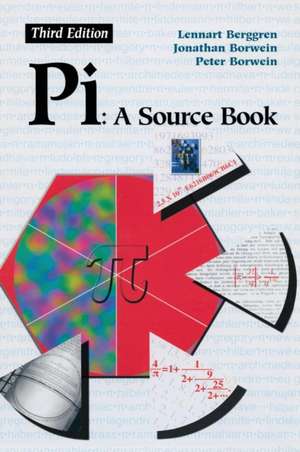
Pi: A Source Book
Autor J. L. Berggren, Jonathan Borwein, Peter Borweinen Limba Engleză Hardback – 17 iun 2004
În volumul Pi: A Source Book, găsim o explorare interdisciplinară care transcende granițele aritmeticii pure, atingând istoria culturii, analiza computațională și filologia. Această a treia ediție, revizuită și extinsă, nu este un simplu manual, ci o arhivă cronologică ce reunește texte fundamentale de peste patru milenii. Apreciem modul în care autorii au reușit să integreze documente tehnice, precum cele ale lui Arhimede sau Newton, cu elemente de curiozitate culturală, oferind o perspectivă completă asupra celui mai faimos număr din lume. Structura cărții urmărește o progresie cronologică riguroasă, debutând cu metodele antice din Egipt și China (Papirusul Rhind, metodele Banu Musa) și culminând cu algoritmii moderni de calcul al zecimalelor. Această ediție aduce noutăți editoriale semnificative, cum ar fi traducerile inedite din Viete și Huygens, alături de contribuția muzical-matematică a lui Kaplansky. Comparativ cu A History of Pi de Petr Beckmann, care oferă o narațiune istorică mai fluidă despre progresul uman, volumul de față servește ca o alternativă academică riguroasă pentru cursurile de istoria matematicii, având avantajul utilizării surselor primare traduse și comentate. Poziționată în contextul operei autorului J. L. Berggren, lucrarea continuă interesul acestuia pentru circulația ideilor matematice între culturi, temă explorată anterior în Episodes in the Mathematics of Medieval Islam. Dacă lucrările sale precedente se concentrau pe influența lumii islamice, aici perspectiva este universală. Față de Pi: The Next Generation, care se axează pe cercetări publicate după anii '70, această antologie oferă fundamentul istoric necesar pentru a înțelege evoluția conceptului de la primele aproximări babiloniene până la distribuția statistică modernă a cifrelor.
Preț: 1922.15 lei
Preț vechi: 2344.09 lei
-18%
Carte disponibilă
Livrare economică 07-21 noiembrie
Specificații
ISBN-10: 0387205713
Pagini: 820
Ilustrații: XIX, 797 p.
Dimensiuni: 183 x 260 x 50 mm
Greutate: 1.65 kg
Ediția:Third Edition 2004
Editura: Springer
Locul publicării:New York, NY, United States
V-ar putea interesa
-
 Turing's CathedralGeorge Dyson-23%Preț: 83.17 lei108.61 lei
 -
 -13%Preț: 171.83 lei197.67 lei
 -
 -17%Preț: 142.89 lei171.37 lei
 -
 -33%Preț: 1731.38 lei2575.61 lei
 -
 Hilbert-CourantConstance ReidPreț: 327.78 lei
 -
 Mathematics Without BordersOlli LehtoPreț: 329.74 lei
 -
 Stamping through MathematicsRobin J. WilsonPreț: 219.98 lei
 -
 -32%Preț: 128.87 lei188.71 lei
 -
 History Mathematics 3eCarl B. BoyerPreț: 263.04 lei
 -
 Mathematical DiscoveryGeorge Polya-27%Preț: 1547.42 lei2119.76 lei
 -
 Preț: 386.55 lei
 -
 -23%Preț: 577.85 lei750.46 lei
 -
 -23%Preț: 459.68 lei596.99 lei
 -
 Augustin-Louis CauchyBruno Belhoste-8%Preț: 607.31 lei660.13 lei
 -
 The Noether TheoremsYvette Kosmann-Schwarzbach-15%Preț: 583.04 lei685.92 lei
 -
 Computational and Analytical MathematicsDavid H. Bailey-18%Preț: 1007.27 lei1228.38 lei
 -
 Handbook on the History of Mathematics EducationAlexander Karp-18%Preț: 2198.61 lei2681.23 lei
 -
 A Dictionary of Real NumbersJonathan BorweinPreț: 416.67 lei
 -
 Turning Points in the History of MathematicsHardy GrantPreț: 380.04 lei
 -
 Preț: 482.44 lei
 -
 Episodes in the Mathematics of Medieval IslamJ. L. Berggren-15%Preț: 585.56 lei688.89 lei
 -
 Collected Papers Supplementary VolumeJack Carl KieferPreț: 493.31 lei
 -
 -20%Preț: 303.04 lei378.80 lei
 -
 The Scholar and the State: In Search of Van der WaerdenAlexander Soifer-15%Preț: 739.55 lei870.05 lei
 -
 Creators of Mathematical and Computational SciencesRavi P Agarwal-48%Preț: 442.67 lei843.73 lei
 -
 Experimentelle MathematikJonathan BorweinPreț: 211.49 lei
Public țintă
Popular/generalDe ce să citești această carte
Recomandăm această carte cercetătorilor, profesorilor și studenților la matematică care doresc să studieze direct sursele istorice care au definit disciplina. Cititorul câștigă acces la texte rare, traduse și adnotate, care explică nu doar „cum”, ci și „de ce” a evoluat calculul lui Pi. Este o resursă esențială pentru orice bibliotecă universitară, fiind un instrument de referință pentru proiecte de cercetare și disertații în istoria științei.
Despre autor
J. L. Berggren este un renumit istoric al matematicii, specializat în perioada medievală și antică, autor al unor lucrări de referință precum Episodes in the Mathematics of Medieval Islam. Jonathan Borwein și Peter Borwein sunt matematicieni de prestigiu, cunoscuți pentru contribuțiile lor în analiza matematică și teoria numerelor, fiind pionieri în utilizarea metodelor computaționale pentru calculul constantelor matematice. Colaborarea lor pentru acest volum sub egida Springer îmbină rigoarea istorică cu expertiza matematică modernă, oferind o perspectivă exhaustivă asupra evoluției gândirii științifice.
Descriere
For this new edition, the authors have updated the original material while adding new material of historical and cultural interest. There is a substantial exposition of the recent history of the computation of digits of pi, a discussion of the normality of the distribution of the digits, new translations of works by Viete and Huygen, as well as Kaplansky's never-before-published "Song of Pi."
From the reviews of earlier editions:
"Few mathematics books serve a wider potential readership than does a source book and this particular one is admirably designed to cater for a broad spectrum of tastes: professional mathematicians with research interest in related subjects, historians of mathematics, teachers at all levels searching out material for individual talks and student projects, and amateurs who will find much to amuse and inform them in this leafy tome. The authors are to be congratulated on their good taste in preparing such a rich and varied banquet with which to celebrate pi."
- Roger Webster for the Bulletin of the LMS
"The judicious representative selection makes this a useful addition to one's library as a reference book, an enjoyable survey of developments and a source of elegant and deep mathematics of different eras."
- Ed Barbeau for MathSciNet
"Full of useful formulas and ideas, it is a vast source of inspiration to any mathematician, A level and upwards-a necessity in any maths library."
- New Scientist
Cuprins
Recenzii
"Few mathematics books serve a wider potential readership than does a source book and this particular one is admirably designed to cater for a broad spectrum of tastes: professional mathematicians with research interest in related subjects, historians of mathematics, teachers at all levels searching out material for individual talks and student projects, and amateurs who will find much to amuse and inform them in this leafy tome. The authors are to be congratulated on their good taste in preparing such a rich and varied banquet with which to celebrate pi."
Roger Webster for the Bulletin of the LMS
"The judicious representative selection makes this a useful addition to one's library as a reference book, an enjoyable survey of developments and a source of elegant and deep mathematics of different eras."
Ed Barbeau for MathSciNet
"Full of useful formulas and ideas, it is a vast source of inspiration to any mathematician, A level and upwards—a necessity in any maths library."
New Scientist
"Should be on every mathematician’s coffee-table! … The seventy articles comprising the source-book proper range from historical articles and classic by such players as Wallis, Huyghens, Newton, and Euler, to the articles on irrationality and transcendence … . Pi: A source Book is truly an amazing book, irresistible in its own way, and filled with gems. And once it’s on your coffee-table, feel free to do more than just browse: it’s pretty well-suited for more in-depth study … . Obviously the book is highly recommended." (Michael Berg, MathDL, January, 2001)
From the reviews of the third edition:
"This is the third edition of the by now classical Pi: a source book. … contains some notes on the computation of individual (binary) digits of p, some considerations on the normality of the decimal expansion of p, and two more sections on the history of p. This book is still a classic work of reference for anyone with an interest in fascinating Pi.” (F. Beukers, Mathematical Reviews, 2005h)
"The book documents the history of pi from the dawn of mathematical time to the present. One of the beauties of the literature on pi is that it allows for the inclusion of very modern, yet accessible, mathematics. The articles on pi collected herein include selections from the mathematical and computational literature over four millennia, a variety of historical studies on the cultural significance of the number, and an assortment of anecdotal, fanciful, and simply amusing pieces." (Zentralblatt für Didaktik der Mathematik, November, 2004)
"This is the third edition of a comprehensive selection of about 70 articles on the number pi and related constants. … This edition contains a new supplement on the recent history of the computation of digits of pi … . Furthermore, new translations of articles by Viète and Huygens have been added. Altogether, this volume provides a fascinating overview of many hundred years of research and will delight and enlighten amateur lovers of pi and professional mathematicians alike." (Ch. Baxa, Monatshefte für Mathematik, Vol. 148 (1), 2006)
"This is a fascinating reference book, which consists almost entirely of facsimiles of 70 articles about pi, followed by appendices which look at its early history as well as much computational information. … it should be something to appear in any mathematical library, as it does contain so much material. … There is something for all levels of readers in this book, from the 14-year old who may wish to know a little of the history, to the professional mathematician seeking information … ." (Anthony C. Robin, The Mathematical Gazette, Vol. 90 (518), 2006)