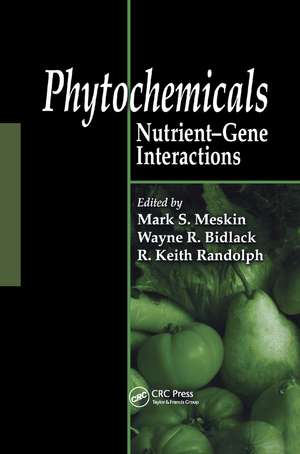
Phytochemicals: Nutrient-Gene Interactions
Editat de Mark S. Meskin, Wayne R. Bidlack, R. Keith Randolphen Limba Engleză Paperback – 19 sep 2019
Phytochemicals: Nutrient–Gene Interactions illustrates the growing role of nutrigenomics and nutrigenetics in disease prevention and in the responsible development of safe and effective phytochemical products within the food, pharmaceutical, and supplement industries.
Preț: 530.47 lei
Preț vechi: 624.09 lei
-15%
Puncte Express: 796
Carte tipărită la comandă
Livrare economică 18 noiembrie-02 decembrie
Livrare prin curier în România Termenul estimat este afișat lângă disponibilitate.
Transport gratuit pentru acest produs Plată online sau ramburs, în funcție de opțiunile comenzii.
Retur gratuit în 14 zile Comandă securizată și suport în română.
Specificații
ISBN-13: 9780367391119
ISBN-10: 0367391112
Pagini: 232
Dimensiuni: 156 x 234 x 15 mm
Greutate: 0.45 kg
Ediția:1
Editura: CRC Press
Colecția CRC Press
ISBN-10: 0367391112
Pagini: 232
Dimensiuni: 156 x 234 x 15 mm
Greutate: 0.45 kg
Ediția:1
Editura: CRC Press
Colecția CRC Press
V-ar putea interesa
-
 Mouse Genetics: Concepts and ApplicationsLee M. Silver-26%Preț: 1003.34 lei1358.90 lei
 -
 Human AgingPaul W. Foos-18%Preț: 1475.77 lei1799.72 lei
 -
 Reinterpreting Menopause: Cultural and Philosophical IssuesPaul Komesaroff-15%Preț: 437.03 lei514.15 lei
 -
 The Aging Individual: Physical and Psychological Perspectives, 2nd EditionSusan Krauss Whitbourne-5%Preț: 644.22 lei678.13 lei
 -
 The Book About Getting OlderLucy Pollock-18%Preț: 65.39 lei79.84 lei
 -
 Phytochemicals: Health Promotion and Therapeutic PotentialColleen Carkeet-18%Preț: 1415.98 lei1726.80 lei
 -
 The Age of Ageing Better?: A Manifesto For Our FutureDr. Anna Dixon-29%Preț: 76.22 lei107.47 lei
 -
 -26%Preț: 68.90 lei93.54 lei
 -
 The Essential Family Guide to Caring for Older PeopleDeborah Stone-26%Preț: 89.84 lei120.71 lei
 -
 -18%Preț: 896.67 lei1093.51 lei
 -
 Phytochemicals as Bioactive AgentsWayne R. Bidlack-18%Preț: 1693.40 lei2065.12 lei
 -
 -30%Preț: 476.17 lei676.53 lei
 -
 Clinical Approaches to Adult DevelopmentMichael L. Commons-16%Preț: 337.48 lei403.04 lei
 -
 Aging: Mental Aspects, Social Welfare & HealthJim P Heckles-23%Preț: 885.60 lei1153.15 lei
 -
 Health & Aging in the World's Largest DemocracyC Shanthi Johnson-23%Preț: 1530.19 lei1998.52 lei
 -
 Profiles of Older Americans 2010Gerald O Jackson-23%Preț: 1214.37 lei1584.31 lei
Public țintă
Academic and Professional ReferenceCuprins
Nutrigenomics: Opportunities and Challenges. Gene–Diet Interactions, Blood Lipids, and Cardiovascular Disease Risk: The Rise of Nutrigenetics. Diet–Disease Interactions at the Molecular Level: An Experimental Paradigm. Anti-Inflammatory Phytochemicals: In Vitro and Ex Vivo Evaluation. Lipid Peroxidation, Gene Expression, and Resveratrol: Implications in Atherosclerosis. Adipose Tissue Gene Expression in the Context of Inflammation and Obesity. Gene–Environment Interactions in Obesity: Implications for the Prevention and Treatment of Obesity. Saturated Fat Consumption in Ancestral Human Diets: Implications for Contemporary Intakes. Plant-Based Diets and Prevention of Cardiovascular Disease: Epidemiologic Evidence. Evolutionary Aspects of Diet, the Omega-6/Omega-3 Ratio, and Gene Expression. Beyond Fiber: Whole Grains and Health. Molecular Activities of Vitamin E.
Notă biografică
Mark S. Meskin, Wayne R. Bidlack, R. Keith Randolph
Descriere
This book analyzes the mechanisms of action and impact of phytochemical-gene interactions on health, aging, and disease. It covers experimental methodologies for identifying significant interactions between diet, genetic variants, and different markers of cardiovascular disease, inflammation, and obesity. It examines the role of resveratrol in cardiovascular health; the preventative mechanisms of whole grains and omega-3 fatty acids; epidemiological research on plant-based foods; the non-antioxidant cellular properties of vitamin E; and controlled clinical trials. It also explores the role of nutrigenomics in developing safe and effective phytochemical products.