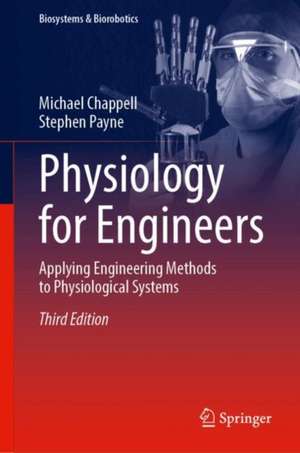
Physiology for Engineers: Biosystems & Biorobotics
Autor Stephen Payne, Michael Chappellen Limba Engleză Hardback – 13 iun 2025
| Toate formatele și edițiile | Preț | Express |
|---|---|---|
| Paperback (2) | 439.94 lei 38-44 zile | |
| Springer International Publishing – 29 mar 2019 | 439.94 lei 38-44 zile | |
| Springer International Publishing – 29 apr 2021 | 500.63 lei 6-8 săpt. | |
| Hardback (3) | 564.72 lei 3-5 săpt. | |
| Springer Nature Switzerland – 13 iun 2025 | 564.72 lei 3-5 săpt. | |
| Springer International Publishing – 28 apr 2020 | 688.98 lei 3-5 săpt. | |
| Springer International Publishing – 4 dec 2015 | 890.72 lei 38-44 zile |
Din seria Biosystems & Biorobotics
-
 Preț: 119.42 lei
 - 5%
 Preț: 2258.36 lei
 - 5%
 Preț: 696.35 lei
 - 5%
 Preț: 709.90 lei
 - 5%
 Preț: 687.93 lei
 - 15%
 Preț: 617.39 lei
 - 5%
 Preț: 3504.76 lei
 - 5%
 Preț: 1067.42 lei
 - 5%
 Preț: 1534.58 lei
 - 5%
 Preț: 808.97 lei
 - 5%
 Preț: 1253.82 lei
 - 15%
 Preț: 611.43 lei
 - 5%
 Preț: 1375.93 lei
 - 20%
 Preț: 627.51 lei
 - 18%
 Preț: 1165.66 lei
 - 5%
 Preț: 680.90 lei
 - 5%
 Preț: 1860.49 lei
 - 5%
 Preț: 2785.82 lei
 - 5%
 Preț: 1050.37 lei
 - 5%
 Preț: 686.00 lei
 - 18%
 Preț: 1168.22 lei
 - 5%
 Preț: 697.42 lei
 - 5%
 Preț: 694.25 lei
 - 5%
 Preț: 683.37 lei
Preț: 564.72 lei
Preț vechi: 664.38 lei
-15% Nou
Puncte Express: 847
Preț estimativ în valută:
99.93€ • 117.18$ • 87.76£
99.93€ • 117.18$ • 87.76£
Carte disponibilă
Livrare economică 17-31 ianuarie 26
Preluare comenzi: 021 569.72.76
Specificații
ISBN-13: 9783031776380
ISBN-10: 3031776380
Pagini: 204
Dimensiuni: 160 x 241 x 16 mm
Greutate: 0.51 kg
Ediția:Third Edition 2025
Editura: Springer Nature Switzerland
Seria Biosystems & Biorobotics
ISBN-10: 3031776380
Pagini: 204
Dimensiuni: 160 x 241 x 16 mm
Greutate: 0.51 kg
Ediția:Third Edition 2025
Editura: Springer Nature Switzerland
Seria Biosystems & Biorobotics
V-ar putea interesa
-
 -5%Preț: 858.17 lei903.34 lei
 -
 Proton and Carbon Ion TherapyC-M Charlie Ma-5%Preț: 1313.24 lei1382.36 lei
 -
 -18%Preț: 1178.28 lei1436.92 lei
 -
 Biomedical Signal and Image ProcessingKayvan Najarian-18%Preț: 1021.32 lei1245.52 lei
 -
 Assistive Technology for Blindness and Low VisionRoberto Manduchi-18%Preț: 1128.23 lei1375.89 lei
 -
 A Laboratory Course in Tissue EngineeringMelissa Kurtis Micou-15%Preț: 551.08 lei648.33 lei
 -
 -18%Preț: 1342.82 lei1637.58 lei
 -
 Introduction to Instrumentation in Life SciencesPrakash Singh Bisen-32%Preț: 515.46 lei763.47 lei
 -
 Introduction to Bioceramics, an (2nd Edition)Larry L. Hench-5%Preț: 583.37 lei614.07 lei
Cuprins
Cell Structure and Biochemical Reactions.- Cellular Homeostasis and Membrane Potential.- The Action Potential.- Cellular Transport and Communication.- Pharmacokinetics.- Tissue Mechanics.- Cardiovascular System I: The Heart.- Cardiovascular System II: The Vasculature.- Respiratory System.- Nervous System.
Notă biografică
Michael Chappell is an Associate Professor of Engineering Science at the Institute of Biomedical Engineering (IBME), Department of Engineering Science, University of Oxford. Michael also heads the Quantitative Biomedical Inference group, which combines together inference techniques from information engineering with mathematical models from physics and physiology to estimate quantitative information for biomedical, and especially clinical applications. His main interest is medical imaging of metabolism and haemodynamics. Michael read Engineering Science in Oxford at undergraduate level, specialising in information engineering topics and completing a project on the detection of landmines. He then completed a doctorate on SCUBA diving, primarily using mathematical models to explore the development of bubbles from dissolved gases under decompression in the body – the resulting sickness is commonly referred to as 'the bends'. Finally, he found his way into magnetic resonance imaging and now develops ways to measure blood flow and pH in the body with applications in stroke, cancer and dementia. Michael is the co-author of one book, and is a series editor for the Oxford Neuroimaging Primers and an author of two of the primers: Introduction to Neuroimaging Analysis, and Introduction to Perfusion Quantification using Arterial Spin Labelling.
Stephen Payne is an Professor of Engineering Science at the Institute of Biomedical Engineering (IBME), Department of Engineering Science, University of Oxford. Stephen heads the Cerebral Haemodynamics Group, focusing on modelling blood flow and metabolism in the brain, which is particularly important in the context of diseases such as stroke and dementia. Another of the group’s key areas is cerebral autoregulation – the mechanism that maintains blood flow almost constantly in response to changes in blood pressure. Stephen has worked in physiological modelling for over 15 years.Having entered the field of biomedical engineering before it was available even as an undergraduate option course, he has seen first-hand how difficult it can be to learn about physiology in a way that makes it amenable to mathematical treatment, such as mathematical modelling, without good introductory guides. Stephen is also the author of two related books on cerebral autoregulation and cerebral blood flow and metabolism.
Stephen Payne is an Professor of Engineering Science at the Institute of Biomedical Engineering (IBME), Department of Engineering Science, University of Oxford. Stephen heads the Cerebral Haemodynamics Group, focusing on modelling blood flow and metabolism in the brain, which is particularly important in the context of diseases such as stroke and dementia. Another of the group’s key areas is cerebral autoregulation – the mechanism that maintains blood flow almost constantly in response to changes in blood pressure. Stephen has worked in physiological modelling for over 15 years.Having entered the field of biomedical engineering before it was available even as an undergraduate option course, he has seen first-hand how difficult it can be to learn about physiology in a way that makes it amenable to mathematical treatment, such as mathematical modelling, without good introductory guides. Stephen is also the author of two related books on cerebral autoregulation and cerebral blood flow and metabolism.
Textul de pe ultima copertă
This book provides an introduction to qualitative and quantitative aspects of human physiology. It examines biological and physiological processes and phenomena, including a selection of mathematical models, showing how physiological problems can be mathematically formulated and studied. It also illustrates how a wide range of engineering and physics topics, such as electronics, fluid dynamics, solid mechanics and control theory can be used to describe and understand physiological processes and systems. Throughout the text, there are introductions to measuring and quantifying physiological processes using both signaling and imaging technologies. This new edition includes updated material on pathophysiology, metabolism and the TCA cycle, as well as more advanced worked examples.
This book describes the basic structure and models of cellular systems, the structure and function of the cardiovascular system, and the electrical and mechanical activity of the heart, and provides an overview of the structure and function of the respiratory and nervous systems. It also includes an introduction to the basic concepts and applications of reaction kinetics, pharmacokinetic modelling and tracer kinetics. It appeals to final year biomedical engineering undergraduates and graduates alike, as well as to practising engineers new to the fields of bioengineering or medical physics.
This book describes the basic structure and models of cellular systems, the structure and function of the cardiovascular system, and the electrical and mechanical activity of the heart, and provides an overview of the structure and function of the respiratory and nervous systems. It also includes an introduction to the basic concepts and applications of reaction kinetics, pharmacokinetic modelling and tracer kinetics. It appeals to final year biomedical engineering undergraduates and graduates alike, as well as to practising engineers new to the fields of bioengineering or medical physics.
Caracteristici
Provides a set of thoroughly classroom-tested exercises and worked examples for student readers Offers an accessible introduction to physiology for physical sciences and engineering students, building on concepts with which they are already familiar Focuses on engineering methods and their application to a range of physiological systems Includes supplementary material: sn.pub/extras