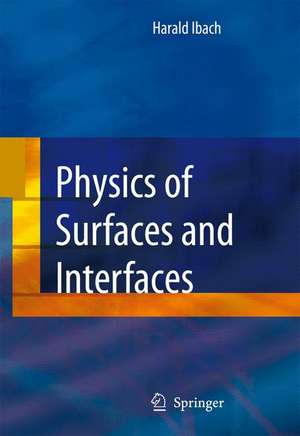
Physics of Surfaces and Interfaces
Autor Harald Ibachen Limba Engleză Hardback – 6 oct 2006
Prezentat sub formă de manual academic de referință, Physics of Surfaces and Interfaces de Harald Ibach reprezintă o sinteză riguroasă a fizicii materiei condensate, axată pe interfața dintre mediile solide și cele externe. Apreciem în mod deosebit efortul autorului de a unifica două lumi adesea tratate separat: fizica suprafețelor în vid și electrochimia interfețelor. Această ediție din 2006 reușește să clarifice terminologiile divergente, demonstrând că tensiunea superficială sau potențialul chimic pot fi înțelese printr-un cadru conceptual comun, indiferent de mediul de expunere. Structura volumului reflectă o progresie didactică impecabilă, pornind de la tehnicile de bază și termodinamica echilibrului, către subiecte complexe precum magnetismul, difuzia la suprafață și procesele de nucleație. Spre deosebire de Principles of Surface Physics de Friedhelm Bechstedt, care se concentrează masiv pe nanostructuri și semiconductori, lucrarea lui Ibach oferă o perspectivă mai largă, integrând studiul excitațiilor vibraționale și al termodinamicii statistice. De asemenea, aceasta completează perspectiva oferită de Interfacial Electrochemistry de Wolfgang Schmickler, aducând rigoarea fizicii atomiste în domenii dominate tradițional de abordări macroscopice. În contextul operei sale, acest manual este o evoluție naturală a textelor fundamentale Solid-State Physics și Festkörperphysik. Dacă lucrările anterioare stabileau bazele fizicii solidului, volumul de față rafinează analiza la nivelul interfețelor, folosind expertiza de decenii a autorului în spectroscopia de pierdere a energiei electronilor. Suntem de părere că rigoarea cu care sunt tratate proprietățile electronice și magnetice face din acest tratat un instrument indispensabil pentru cercetarea avansată.
Preț: 748.11 lei
Preț vechi: 880.12 lei
-15%
Carte tipărită la comandă
Livrare economică 28 noiembrie-12 decembrie
Specificații
ISBN-10: 3540347097
Pagini: 660
Ilustrații: XII, 646 p. 350 illus.
Dimensiuni: 160 x 241 x 41 mm
Greutate: 1.09 kg
Ediția:2006
Editura: Springer
Locul publicării:Berlin, Heidelberg, Germany
V-ar putea interesa
-
 Dislocations, Mesoscale Simulations and Plastic FlowLadislas Kubin-31%Preț: 793.05 lei1148.84 lei
 -
 -20%Preț: 504.08 lei632.97 lei
 -
 -12%Preț: 337.21 lei383.32 lei
 -
 Modern Theory of ThermoelectricityVeljko Zlatic-31%Preț: 713.31 lei1032.56 lei
 -
 Granular PatternsIgor Aranson-28%Preț: 365.62 lei504.71 lei
 -
 Excitations in Organic SolidsVladimir M. Agranovich-21%Preț: 537.82 lei680.31 lei
 -
 Novel Superfluids: Volume 2Karl-Heinz Bennemann-31%Preț: 1061.69 lei1528.97 lei
 -
 Advances in the Casimir EffectMichael Bordag-21%Preț: 520.35 lei661.43 lei
 -
 -27%Preț: 528.79 lei725.22 lei
 -
 Colossal Magnetoresistive ManganitesTapan Chatterji-15%Preț: 683.46 lei804.07 lei
 -
 FestkörperRainer Kassing-8%Preț: 661.46 lei718.98 lei
 -
 Tribology in Sheet Rolling TechnologyAkira Azushima-19%Preț: 649.16 lei801.43 lei
 -
 Natur-, Ingenieur- und WirtschaftswissenschaftenHarald IbachPreț: 458.05 lei
 -
 FestkörperphysikHarald Ibach-15%Preț: 522.57 lei614.78 lei
 -
 Solid-State PhysicsHarald Ibach-17%Preț: 410.54 lei494.64 lei
 -
 Electron Energy Loss SpectrometersHarald IbachPreț: 367.15 lei
Public țintă
ResearchDe ce să citești această carte
Recomandăm acest manual cercetătorilor și studenților la masterat care doresc să înțeleagă fizica suprafețelor dincolo de modelele simpliste. Cititorul câștigă o viziune unificată asupra fenomenelor de interfață, fiind capabil să facă legătura între experimentele în vid și cele în soluții electrolitice. Este o resursă esențială pentru cei care lucrează în cataliză, coroziune sau dezvoltarea de noi materiale, oferind fundamentul teoretic necesar pentru interpretarea datelor experimentale complexe.
Despre autor
Harald Ibach este o figură proeminentă în fizica stării solide, fiind director la Institutul de Fizică a Interfețelor și Cercetare în Vid din cadrul Forschungszentrum Jülich începând cu 1974. Expertiza sa în dezvoltarea spectroscopiei de înaltă rezoluție pentru pierderea energiei electronilor i-a adus distincții prestigioase, precum Medard W. Welch Award (1986) și Hewlett-Packard Europhysics Prize (1991). Cariera sa academică include poziții de profesor invitat la universități de elită precum UC Irvine și UC Berkeley. Opera sa, care include manuale de referință traduse internațional, reflectă o viață dedicată înțelegerii structurii fine a materiei și a proceselor de suprafață.
Descriere scurtă
Cuprins
Notă biografică
1986 Medard W. Welch Award of ther American Vacuum Society: "For the development of high-resolution electron energy-loss spectroscopy and its application to the characterization of surfaces and adsorbates"
1989 Regent's Professor, University of California, Irvine
1991 Hewlett-Packard Europhysics Prize for Outstanding Achievements in Solid State Physics (with G. Ertl und J.P. Toennies)
1993 Miller Research professor, University of California, Berkeley