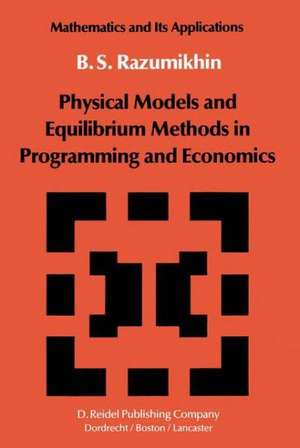
Physical Models and Equilibrium Methods in Programming and Economics: Mathematics and its Applications, cartea 2
Autor B.S. Razumikhinen Limba Engleză Hardback – 31 oct 1984
| Toate formatele și edițiile | Preț | Express |
|---|---|---|
| Paperback (1) | 377.68 lei 6-8 săpt. | |
| SPRINGER NETHERLANDS – 17 oct 2011 | 377.68 lei 6-8 săpt. | |
| Hardback (1) | 385.79 lei 6-8 săpt. | |
| SPRINGER NETHERLANDS – 31 oct 1984 | 385.79 lei 6-8 săpt. |
Din seria Mathematics and its Applications
- 18%
 Preț: 1066.82 lei
 - 15%
 Preț: 438.75 lei
 -
 Preț: 456.07 lei
 - 15%
 Preț: 461.15 lei
 -
 Preț: 444.72 lei
 - 15%
 Preț: 422.33 lei
 -
 Preț: 461.46 lei
 - 15%
 Preț: 413.59 lei
 -
 Preț: 463.45 lei
 - 15%
 Preț: 507.38 lei
 - 15%
 Preț: 447.14 lei
 -
 Preț: 420.21 lei
 - 15%
 Preț: 420.02 lei
 -
 Preț: 459.43 lei
 -
 Preț: 463.65 lei
 -
 Preț: 378.05 lei
 - 15%
 Preț: 626.52 lei
 - 15%
 Preț: 618.03 lei
 - 15%
 Preț: 671.45 lei
 - 15%
 Preț: 622.59 lei
 -
 Preț: 374.71 lei
 -
 Preț: 379.15 lei
 - 15%
 Preț: 627.01 lei
 - 20%
 Preț: 626.38 lei
 - 15%
 Preț: 625.09 lei
 -
 Preț: 367.85 lei
 -
 Preț: 409.96 lei
 - 15%
 Preț: 632.02 lei
 - 15%
 Preț: 632.96 lei
 -
 Preț: 376.17 lei
 -
 Preț: 411.21 lei
 -
 Preț: 373.98 lei
Preț: 385.79 lei
Puncte Express: 579
Preț estimativ în valută:
68.20€ • 80.76$ • 59.41£
68.20€ • 80.76$ • 59.41£
Carte tipărită la comandă
Livrare economică 02-16 aprilie
Specificații
ISBN-13: 9789027716446
ISBN-10: 9027716447
Pagini: 372
Ilustrații: XV, 351 p.
Dimensiuni: 155 x 235 x 26 mm
Greutate: 0.72 kg
Ediția:1984
Editura: SPRINGER NETHERLANDS
Colecția Springer
Seria Mathematics and its Applications
Locul publicării:Dordrecht, Netherlands
ISBN-10: 9027716447
Pagini: 372
Ilustrații: XV, 351 p.
Dimensiuni: 155 x 235 x 26 mm
Greutate: 0.72 kg
Ediția:1984
Editura: SPRINGER NETHERLANDS
Colecția Springer
Seria Mathematics and its Applications
Locul publicării:Dordrecht, Netherlands
V-ar putea interesa
-
 Hurricane Climatology: A Modern Statistical Guide Using RJames B. Elsner-34%Preț: 725.26 lei1091.83 lei
 -
 -18%Preț: 1261.64 lei1538.58 lei
 -
 Handbook in Monte Carlo SimulationPaolo Brandimarte-9%Preț: 920.89 lei1011.96 lei
 -
 -9%Preț: 660.61 lei725.94 lei
 -
 -14%Preț: 688.28 lei800.32 lei
 -
 -27%Preț: 772.19 lei1057.80 lei
 -
 Growth Curve ModelingMichael J Panik-9%Preț: 836.51 lei919.24 lei
 -
 -8%Preț: 611.35 lei664.51 lei
 -
 -9%Preț: 944.13 lei1037.51 lei
 -
 -9%Preț: 954.39 lei1048.78 lei
 -
 Systems Dependability AssessmentJean-Francois Aubry-9%Preț: 945.51 lei1039.02 lei
 -
 METHODS & APPL OF WHITE NOISE ANALY IN INTERDISCIPLIN SCIBernido Christopher C-15%Preț: 535.55 lei630.06 lei
Public țintă
ResearchCuprins
I: Equilibrium of mechanical systems with linear constraints and linear programming problems.- 1.1. Introduction.- 1.2. Linear equations and inequalities.- 1.3. Systems of linear equations and inequalities.- 1.4. Linear programming problems. Duality theorems.- II: Equilibrium of physical systems and linear programming problems.- 2.1. Introduction.- 2.2. Some concepts from thermodynamics.- 2.3. Physical models of dual pairs of systems of linear equations and inequalities. Alternative theorems.- 2.4. A physical model for linear programming problems. Equilibrium conditions.- 2.5. Penalty methods.- 2.6. Some properties of approximate solutions of dual problems of linear programming problems.- 2.7. Models for transport type problems.- III: The method of redundant constraints and iterative algorithms.- 3.1. Introduction.- 3.2. The method of redundant constraints.- 3.3. The first iterative algorithm for solving linear programming problems and for solving systems of linear equations and inequalities.- 3.4. The second algorithm.- 3.5. Reduction of the general linear programming problem to a sequence of inconsistent systems. The third algorithm.- IV: The principle of removing constraints.- 4.1. Introduction.- 4.2. The method of generalized coordinates.- 4.3. The method of multipliers.- 4.4. Elastic constraints. Penalty function methods.- 4.5. Discussion.- V: The hodograph method.- 5.1. Introduction.- 5.2. The hodograph method for linear programming problems.- 5.3. Solution of the dual problem.- 5.4. Results of numerical experiments.- VI: The method of displacement of elastic constraints.- 6.1. Introduction.- 6.2. The first algorithm.- 6.3 The second algorithm.- 6.4. Combining the algorithms.- VII: Decomposition methods for linear programming problems.- 7.1. Introduction.- 7.2. Decomposition algorithms.- 7.3. Allocation of resources problems.- VIII: Nonlinear programming.- 8.1. Introduction.- 8.2. The principle of virtual displacements and the Kuhn-Tucker theorem.- 8.3. Numerical methods for solving nonlinear programming problems.- IX: The tangent method.- 9.1. Introduction.- 9.2. Constrained minimization problems.- 9.3. Linear programming.- 9.4. Dynamic problems of optimal control.- X: Models for economic equilibrium.- 10.1. Introduction.- 10.2. Equilibrium problems for linear exchange models.- 10.3. An algorithm for solving numerically equilibrium problems for linear exchange economies.- 10.4. Discussion. The Boltzmann principle.- 10.5. Equilibrium of linear economic models.- 10.6 Physical models for economic equilibrium. The equilibrium theorem.- 10.7. An algorithm for solving equilibrium problems for linear economic models.- 10.8. A generalization of the economic equilibrium problem.- XI: Dynamic economic models.- 11.1. Introduction.- 11.2. The Von Neumann-Gale model. Growth rates and interest rates.- 11.3. A method for solving the problem of maximum growth rates.- 11.4. Duality and problems of growth rates and interest rates.- 11.5. The minimal time problem.- 11.6. A time optimal control problem economic growth.- 11.7. A physical model for solving optimal control problems.- 11.8. Decomposition for time optimal control problems.- 11.9. Optimal balanced growth problems.- XII: Optimal control problems.