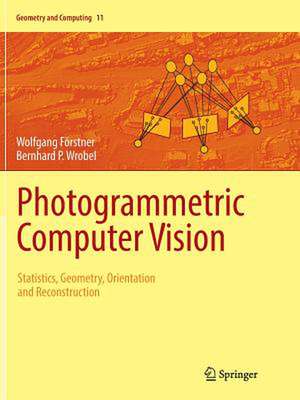
Photogrammetric Computer Vision: Geometry and Computing, cartea 11
Autor Wolfgang Förstner, Bernhard P. Wrobelen Limba Engleză Paperback – 14 iun 2018
Recomandăm Photogrammetric Computer Vision profesioniștilor care se confruntă cu provocarea de a reconstrui scene geometrice complexe din imagini, unde precizia metrologică este critică. Problema centrală abordată aici nu este doar recunoașterea obiectelor, ci calibrarea și orientarea riguroasă a camerelor pentru a obține modele 3D fidele, susținute de o analiză statistică a erorilor. Considerăm că forța acestui tratat de peste 800 de pagini rezidă în fuziunea dintre fotogrammetria clasică și vederea artificială modernă, oferind un fundament matematic solid acolo unde alte resurse se limitează la soluții euristice. Structura volumului reflectă o progresie logică de la teorie la aplicație. Prima parte stabilește cadrul pentru teoria estimării, acoperind estimarea bayesiană și diagnosticul statistic. Partea a doua introduce instrumentele pentru geometria proiectivă, în timp ce partea a treia se concentrează pe modelarea camerelor și reconstrucția suprafețelor din nori de puncte. Cititorul care a aplicat ideile din Multiple View Geometry in Computer Vision de Richard Hartley va găsi aici completarea necesară prin accentul pus pe certitudinea statistică și metrologie, elemente vitale în mediile de producție industrială sau GIS. Această lucrare reprezintă apogeul cercetării autorilor, Wolfgang Förstner continuând explorarea analizei de date complexe începută în Mustererkennung 1999. Dacă în lucrările anterioare, precum Semantic Modeling for the Acquisition of Topographic Information from Images and Maps, accentul era pus pe achiziția de date topografice, volumul de față rafinează procesul prin algoritmi de ajustare a fasciculelor (bundle adjustment) și reconstrucție de suprafețe, oferind o rigoare matematică ce transformă vederea artificială într-o disciplină de măsurare precisă.




Preț: 471.11 lei
Preț vechi: 588.89 lei
-20%
Carte tipărită la comandă
Livrare economică 01-15 decembrie
Specificații
ISBN-10: 3319791702
Pagini: 836
Ilustrații: XVII, 816 p. 281 illus., 59 illus. in color.
Dimensiuni: 210 x 279 x 45 mm
Greutate: 1.84 kg
Ediția:Softcover reprint of the original 1st edition 2016
Editura: Springer
Colecția Geometry and Computing
Seria Geometry and Computing
Locul publicării:Cham, Switzerland
V-ar putea interesa
-
 Virtual Testing and Predictive ModelingBahram Farahmand-18%Preț: 963.34 lei1174.80 lei
 -
 Bourdieu for ArchitectsHelena WebsterPreț: 283.47 lei
 -
 Derrida for ArchitectsRichard CoynePreț: 321.60 lei
 -
 Foucault for ArchitectsGordana Fontana-GiustiPreț: 312.25 lei
 -
 -14%Preț: 835.29 lei971.26 lei
 -
 Fundamentals of Earthquake EngineeringAmr S. Elnashai-23%Preț: 657.97 lei854.51 lei
 -
 -27%Preț: 828.89 lei1135.46 lei
 -
 -9%Preț: 1153.77 lei1267.88 lei
 -
 Limit States of Materials and StructuresDieter Weichert-15%Preț: 671.93 lei790.51 lei
 -
 Split Hopkinson (Kolsky) BarWeinong W. Chen-18%Preț: 1610.60 lei1964.15 lei
 -
 Mechatronic HandsPaul H Chappell-18%Preț: 952.08 lei1161.07 lei
 -
 Active and Assisted Living: Technologies and ApplicationsFrancisco Flórez-Revuelta-5%Preț: 1124.07 lei1183.24 lei
 -
 Autodesk Revit 2017 (R1) Bim Management: Template and Family Creation - Metric: Autodesk Authorized PublisherAscent - Center for Technical Knowledge-20%Preț: 457.83 lei572.28 lei
 -
 -18%Preț: 924.84 lei1127.86 lei
 -
 Automotive TransmissionsHarald Naunheimer-18%Preț: 1629.39 lei1987.07 lei
 -
 Plasticity and Creep of MetalsAndrew Rusinko-18%Preț: 914.52 lei1115.26 lei
 -
 -15%Preț: 645.11 lei758.95 lei
De ce să citești această carte
Pentru inginerii și dezvoltatorii software din industriile fotogrammetriei și GIS, această carte este resursa definitivă pentru stăpânirea vederii artificiale bazate pe geometrie statistică. Câștigați acces la algoritmi verificați pentru calibrarea camerelor și reconstrucția 3D, beneficiind de expertiza unor autori care definesc standardele în domeniu. Este un instrument esențial pentru oricine dorește să treacă de la simple vizualizări la măsurători spațiale de înaltă precizie.
Despre autor
Wolfgang Förstner și Bernhard P. Wrobel sunt figuri proeminente în comunitatea științifică, având un fundament solid în geodezie și decenii de experiență în cercetarea vederii artificiale. Förstner este recunoscut pentru contribuțiile sale în recunoașterea formelor și interpretarea scenelor naturale, fiind implicat activ în dezvoltarea unor instrumente de analiză a datelor pentru geoinformații. Expertiza lor combinată a permis crearea acestui manual de referință care unifică rigurozitatea matematică a fotogrammetriei cu inovația algoritmică din computer vision, publicat sub egida prestigioasă a editurii Springer.
Descriere scurtă
Part I of the book provides an introduction to estimation theory, covering aspects such as Bayesian estimation, variance components, and sequential estimation, with a focus on the statistically sound diagnostics of estimation results essential in vision metrology. Part II provides tools for 2D and 3D geometric reasoning using projective geometry. This includes oriented projective geometry and tools for statistically optimal estimation and test of geometric entities and transformations and their relations, tools that are useful also in the context of uncertain reasoning in point clouds. Part III is devoted to modelling the geometry of single and multiple cameras, addressing calibration and orientation, including statistical evaluation and reconstruction of corresponding scene features and surfaces based on geometric image features. The authors provide algorithms for various geometric computation problems in vision metrology, together with mathematical justifications and statistical analysis, thus enabling thorough evaluations. The chapters are self-contained with numerous figures and exercises, and they are supported by an appendix that explains the basic mathematical notation and a detailed index.
The book can serve as the basis for undergraduate and graduate courses in photogrammetry, computer vision, and computer graphics. It is also appropriate for researchers, engineers, and software developers in the photogrammetry and GIS industries, particularly those engaged with statistically based geometric computer vision methods.
Cuprins
Recenzii
Notă biografică
Prof. Dr.-Ing. Bernhard P. Wrobel received his Ph.D. (Dr.-Ing) in theoretical geodesy from the University of Bonn. From 1975 to 1981 he was professor for close-range photogrammetry and from 1981 to 2001 for photogrammetry at Darmstadt University of Technology, and also head of the Institute for Photogrammetry and Cartography. He was closely involved with the International Society for Photogrammetry and Remote Sensing, and he coauthored three book chapters for the ASPRS Manual of Photogrammetry. Besides his work related to precise mensuration tasks in industry, his research interests cover the mathematical fundamentals of photogrammetry such as the digital inversion of image formation for reconstruction of 3D surfaces and reflectance from multiple images.
Authors' website (code, lecture slides) at http://www.ipb.uni-bonn.de/book-pcv/)