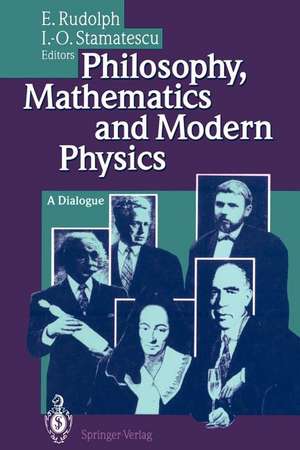
Philosophy, Mathematics and Modern Physics
Editat de Enno Rudolph, Ion-Olimpiu Stamatescuen Limba Engleză Paperback – 30 dec 2011
Preț: 292.34 lei
Puncte Express: 439
Carte disponibilă
Livrare economică 29 octombrie-12 noiembrie
Livrare prin curier în România Termenul estimat este afișat lângă disponibilitate.
Transport gratuit de la 400.00 lei Plată online sau ramburs, în funcție de opțiunile comenzii.
Retur gratuit în 14 zile Comandă securizată și suport în română.
Specificații
ISBN-13: 9783642788109
ISBN-10: 3642788106
Pagini: 256
Ilustrații: VIII, 244 p.
Dimensiuni: 155 x 235 x 15 mm
Greutate: 0.39 kg
Ediția:Softcover reprint of the original 1st ed. 1994
Editura: Springer
Locul publicării:Berlin, Heidelberg, Germany
ISBN-10: 3642788106
Pagini: 256
Ilustrații: VIII, 244 p.
Dimensiuni: 155 x 235 x 15 mm
Greutate: 0.39 kg
Ediția:Softcover reprint of the original 1st ed. 1994
Editura: Springer
Locul publicării:Berlin, Heidelberg, Germany
V-ar putea interesa
-
 -28%Preț: 407.28 lei567.13 lei
 -
 -21%Preț: 391.64 lei498.28 lei
 -
 Atom: Journey Across the Subatomic CosmosIsaac AsimovPreț: 158.44 lei
 -
 In Search of Schrodinger's CatJohn GribbinPreț: 99.39 lei
 -
 The Road to RealityRoger PenrosePreț: 192.80 lei
 -
 Mathematical PhysicsSadri Hassani-17%Preț: 569.82 lei686.52 lei
 -
 Towards the Mathematics of Quantum Field TheoryFrédéric Paugam-18%Preț: 1128.57 lei1376.31 lei
 -
 Basic Health Physics – Problems and Solutions 2eJJ Bevelacqua-14%Preț: 960.34 lei1116.67 lei
 -
 DecoherenceMaximilian A. Schlosshauer-15%Preț: 656.81 lei772.72 lei
 -
 Quantum ChromodynamicsWalter Greiner-18%Preț: 774.34 lei944.31 lei
 -
 Advances in Meteorology, Climatology and Atmospheric PhysicsCostas G. Helmis-24%Preț: 1845.69 lei2428.54 lei
 -
 Atmospheric PhysicsUlrich Schumann-18%Preț: 1218.84 lei1486.39 lei
 -
 Atmospheric PhysicsJulio V. IribarnePreț: 374.23 lei
 -
 Atmospheric AerosolsOlivier Boucher-15%Preț: 681.10 lei801.29 lei
Public țintă
Popular/generalCuprins
On the Dialogue Between Physics and Philosophy.- Questions Concerning Theory and Experience and the Role of Mathematics in Physical Science.- I Space and Time, Cosmology and Quantum Theory.- Is Conscious Awareness Consistent with Space-Time Descriptions?.- Space and Time: a Privileged Ground for Misunderstandings Between Physics and Philosophy.- On Renormalization in Quantum Field Theory and the Structure of Space-Time.- Quantum Theory — a Window to the World Beyond Physics.- Quantum Cosmology and the Emergence of a Classical World.- On the Origin of Structure in the Universe.- Galaxy Creation in a Non-Big-Bang Universe.- What Kind of Science is Cosmology?.- II Philosophical Concepts and the Mathematics of Physics.- On the Assumption That Our Concepts ‘Structure the Material of Our Experience’.- On the Mathematical Overdetermination of Physics.- The Mathematical Frame of Quantum Field Theory.- The Role of Mathematics in Contemporary Theoretical Physics.- A Most General Principle of Invariance.- Kant and the Straight Biangle.- Substance as Function: Ernst Cassirer’s Interpretation of Leibniz as Criticism of Kant.