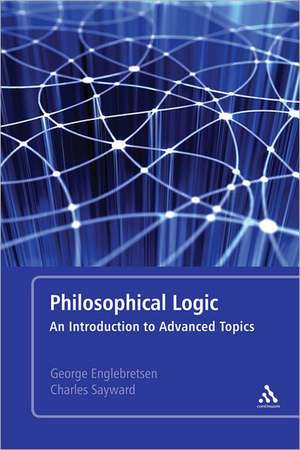
Philosophical Logic: An Introduction to Advanced Topics
Autor Professor George Englebretsen, Professor Charles Saywarden Limba Engleză Hardback – 20 ian 2011
Starting by contrasting familiar classical logic with constructivist or intuitionist logic, the book goes on to offer concise but easy-to-read introductions to such subjects as quantificational and syllogistic logic, modal logic and set theory.
Chapters include:
. Sentential Logic
. Quantificational Logic
. Sentential Modal Logic
. Quantification and Modality
. Set Theory
. Incompleteness
. An Introduction to Term Logic
. Modal Term Logic
In addition, the book includes a list of symbols and a glossary of terms for ease of reference and exercises throughout help students master the topics covered in the book. Philosophical Logic is an essential, student-friendly guide for anyone studying these difficult topics as part of their Logic course.
Preț: 709.10 lei
Preț vechi: 937.40 lei
-24%
Puncte Express: 1064
Carte tipărită la comandă
Livrare economică 08-22 decembrie
Livrare prin curier în România Termenul estimat este afișat lângă disponibilitate.
Transport gratuit pentru acest produs Plată online sau ramburs, în funcție de opțiunile comenzii.
Retur gratuit în 14 zile Comandă securizată și suport în română.
Specificații
ISBN-13: 9781441173850
ISBN-10: 1441173854
Pagini: 208
Dimensiuni: 156 x 234 x 20 mm
Greutate: 0.5 kg
Ediția:New.
Editura: Bloomsbury Publishing
Colecția Continuum
Locul publicării:London, United Kingdom
ISBN-10: 1441173854
Pagini: 208
Dimensiuni: 156 x 234 x 20 mm
Greutate: 0.5 kg
Ediția:New.
Editura: Bloomsbury Publishing
Colecția Continuum
Locul publicării:London, United Kingdom
V-ar putea interesa
-
 Wittgenstein: A Very Short IntroductionA. C. Grayling-19%Preț: 57.66 lei71.23 lei
 -
 -36%Preț: 476.47 lei747.73 lei
 -
 -27%Preț: 501.26 lei689.77 lei
 -
 -22%Preț: 481.15 lei619.74 lei
 -
 The Worlds of Possibility: Modal Realism and the Semantics of Modal LogicCharles S. Chihara-27%Preț: 441.49 lei605.55 lei
 -
 Ludwig Wittgenstein: A MemoirNorman Malcolm-12%Preț: 337.88 lei384.00 lei
 -
 Papers on Time and TenseArthur N. Prior-27%Preț: 439.08 lei604.16 lei
 -
 -27%Preț: 375.32 lei512.11 lei
 -
 Descriptions and BeyondMarga Reimer-27%Preț: 565.06 lei770.78 lei
 -
 VaguenessTimothy WilliamsonPreț: 418.49 lei
 -
 Logical Investigations Volume 1Edmund HusserlPreț: 367.39 lei
 -
 What I BelieveBertrand RussellPreț: 133.78 lei
 -
 -23%Preț: 455.51 lei591.57 lei
 -
 Preț: 360.44 lei
 -
 The Bloomsbury Companion to Philosophical LogicProfessor Leon Horsten-22%Preț: 272.05 lei350.25 lei
 -
 The Bloomsbury Companion to LeibnizBrandon C. Look-20%Preț: 274.55 lei342.57 lei
 -
 The Bloomsbury Companion to the Philosophy of ScienceSteven French-16%Preț: 286.89 lei340.30 lei
 -
 How to Win Every Argument: The Use and Abuse of LogicDr Madsen Pirie-35%Preț: 114.42 lei174.98 lei
 -
 Origins of Analytical PhilosophyMichael Dummett-22%Preț: 137.58 lei176.76 lei
Cuprins
Recenzii
"Englebretsen and Sayward's book fills a gap in the current array of logic textbooks available. It starts from the beginning, thus allowing students to gain the first rudiments of symbolization; yet, it covers areas usually neglected in introductory logic textbook such as set theory and modal logic. Finally, it presents a constructivist approach in contrast to the point of view of classical logic usually tacitly assumed in logic textbooks and a substitutional rather than an objectual interpretation of quantification. This is truly a logic textbook for philosophers." - Pieranna Garavaso, University of Minnesota, Morris, USA
Notă biografică
George Englebretsen is Professor Emeritus at Bishop's University, Canada. He is the author of a large number of works dealing with topics in the philosophy of logic and language, metaphysics and the history of logic.