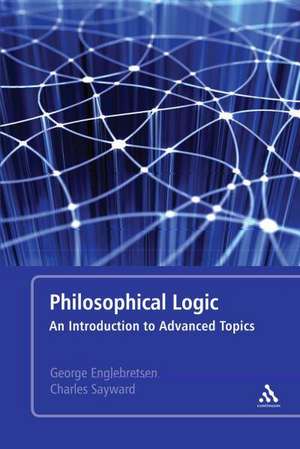
Philosophical Logic: An Introduction to Advanced Topics
Autor Professor George Englebretsen, Professor Charles Saywarden Limba Engleză Paperback – 20 ian 2011
Starting by contrasting familiar classical logic with constructivist or intuitionist logic, the book goes on to offer concise but easy-to-read introductions to such subjects as quantificational and syllogistic logic, modal logic and set theory.
Chapters include:
. Sentential Logic
. Quantificational Logic
. Sentential Modal Logic
. Quantification and Modality
. Set Theory
. Incompleteness
. An Introduction to Term Logic
. Modal Term Logic
In addition, the book includes a list of symbols and a glossary of terms for ease of reference and exercises throughout help students master the topics covered in the book. Philosophical Logic is an essential, student-friendly guide for anyone studying these difficult topics as part of their Logic course.
Preț: 200.84 lei
Preț vechi: 254.91 lei
-21%
Puncte Express: 301
Carte tipărită la comandă
Livrare economică 08-22 decembrie
Livrare prin curier în România Termenul estimat este afișat lângă disponibilitate.
Transport gratuit de la 400.00 lei Plată online sau ramburs, în funcție de opțiunile comenzii.
Retur gratuit în 14 zile Comandă securizată și suport în română.
Specificații
ISBN-13: 9781441119117
ISBN-10: 1441119116
Pagini: 210
Dimensiuni: 154 x 232 x 12 mm
Greutate: 0.39 kg
Ediția:New.
Editura: Bloomsbury Publishing
Colecția Continuum
Locul publicării:London, United Kingdom
ISBN-10: 1441119116
Pagini: 210
Dimensiuni: 154 x 232 x 12 mm
Greutate: 0.39 kg
Ediția:New.
Editura: Bloomsbury Publishing
Colecția Continuum
Locul publicării:London, United Kingdom
V-ar putea interesa
-
 Wittgenstein: A Very Short IntroductionA. C. Grayling-19%Preț: 57.66 lei71.23 lei
 -
 -36%Preț: 476.47 lei747.73 lei
 -
 -27%Preț: 501.26 lei689.77 lei
 -
 -22%Preț: 481.15 lei619.74 lei
 -
 The Worlds of Possibility: Modal Realism and the Semantics of Modal LogicCharles S. Chihara-27%Preț: 441.49 lei605.55 lei
 -
 Ludwig Wittgenstein: A MemoirNorman Malcolm-12%Preț: 337.88 lei384.00 lei
 -
 Papers on Time and TenseArthur N. Prior-27%Preț: 439.08 lei604.16 lei
 -
 -27%Preț: 375.32 lei512.11 lei
 -
 Descriptions and BeyondMarga Reimer-27%Preț: 565.06 lei770.78 lei
 -
 VaguenessTimothy WilliamsonPreț: 418.49 lei
 -
 Logical Investigations Volume 1Edmund HusserlPreț: 367.39 lei
 -
 What I BelieveBertrand RussellPreț: 133.78 lei
 -
 -23%Preț: 455.51 lei591.57 lei
 -
 Preț: 360.44 lei
 -
 The Bloomsbury Companion to Philosophical LogicProfessor Leon Horsten-22%Preț: 272.05 lei350.25 lei
 -
 The Bloomsbury Companion to LeibnizBrandon C. Look-20%Preț: 274.55 lei342.57 lei
 -
 The Bloomsbury Companion to the Philosophy of ScienceSteven French-16%Preț: 286.89 lei340.30 lei
 -
 How to Win Every Argument: The Use and Abuse of LogicDr Madsen Pirie-35%Preț: 114.42 lei174.98 lei
 -
 Origins of Analytical PhilosophyMichael Dummett-22%Preț: 137.58 lei176.76 lei
Cuprins
1. Introduction
Sentences
Truth and Falsity
Defense and Refutation
Inference, Form and Implication
Formally Valid Inference
Conjunctions
Inference with Conjunctions
Negation
Inference with Negation
Truth-Functionality and Negation
Grouping
2. Sentential Logic
Simple Sentences
Sentences
Derivations: A First Look
A Note on Sets
Lines
Derivations Again
Theorems
Truth Sets
Soundness
Completeness
Extensions of SL
Conditionalization
Model Sets
Syntax and Semantics
3. Quantificational Logic
Singular Terms
Predicates
Some Symbolic Conventions
Some
The Language QL
Derivations
Truth Sets
All
Further Extensions of QL
Model Sets
Identity
Model Sets for QL
4. Sentential Modal Logic
Non-Truth-Functional Sentential Operators
Sentential Modal Operators
Derivations
S5, S4, T, and B
Possible Worlds
At a World and In a World
Model Sets and Model Systems
Deontic Logic and Model Sets
5. Quantification and Modality
Some Derivations
Model Sets and Systems
An Alternative
6. Set Theory
The Axiom of Extensionality
Axioms of Separation
Pairing Axiom and Rule U
The Restriction on the A2 Axiom
The Null Set
An Interpretation
More Axioms
General Intersection Operation
Order and Relations
Functions
Sizes of Sets
The Power Set Axiom
A Basic Theorem
7. Incompleteness
The Language of Arithmetic
Three Key Concepts
Three Key Theorems
The Core Argument
Concluding Observations
8. An Introduction to Term Logic
Syllogistic
The Limits of Syllogistic
Term Functor Logic
Singular Terms and Identity in TFL
Relationals in TFL
The Logic of Sentences in TFL
Rules of Inference for Derivations in TFL
Derivation in TFL
The Bridge to TFL
9. Modal Term Logic
Modal Operators on Terms
Modal Operators on Sentences
Rules of Derivation for Modal TFL
Modal Inference in TFL
Rules, Axioms and Principles
List of Symbols
Glossary
Index
Sentences
Truth and Falsity
Defense and Refutation
Inference, Form and Implication
Formally Valid Inference
Conjunctions
Inference with Conjunctions
Negation
Inference with Negation
Truth-Functionality and Negation
Grouping
2. Sentential Logic
Simple Sentences
Sentences
Derivations: A First Look
A Note on Sets
Lines
Derivations Again
Theorems
Truth Sets
Soundness
Completeness
Extensions of SL
Conditionalization
Model Sets
Syntax and Semantics
3. Quantificational Logic
Singular Terms
Predicates
Some Symbolic Conventions
Some
The Language QL
Derivations
Truth Sets
All
Further Extensions of QL
Model Sets
Identity
Model Sets for QL
4. Sentential Modal Logic
Non-Truth-Functional Sentential Operators
Sentential Modal Operators
Derivations
S5, S4, T, and B
Possible Worlds
At a World and In a World
Model Sets and Model Systems
Deontic Logic and Model Sets
5. Quantification and Modality
Some Derivations
Model Sets and Systems
An Alternative
6. Set Theory
The Axiom of Extensionality
Axioms of Separation
Pairing Axiom and Rule U
The Restriction on the A2 Axiom
The Null Set
An Interpretation
More Axioms
General Intersection Operation
Order and Relations
Functions
Sizes of Sets
The Power Set Axiom
A Basic Theorem
7. Incompleteness
The Language of Arithmetic
Three Key Concepts
Three Key Theorems
The Core Argument
Concluding Observations
8. An Introduction to Term Logic
Syllogistic
The Limits of Syllogistic
Term Functor Logic
Singular Terms and Identity in TFL
Relationals in TFL
The Logic of Sentences in TFL
Rules of Inference for Derivations in TFL
Derivation in TFL
The Bridge to TFL
9. Modal Term Logic
Modal Operators on Terms
Modal Operators on Sentences
Rules of Derivation for Modal TFL
Modal Inference in TFL
Rules, Axioms and Principles
List of Symbols
Glossary
Index
Recenzii
Englebretsen and Sayward's book fills a gap in the current array of logic textbooks available. It starts from the beginning, thus allowing students to gain the first rudiments of symbolization; yet, it covers areas usually neglected in introductory logic textbook such as set theory and modal logic. Finally, it presents a constructivist approach in contrast to the point of view of classical logic usually tacitly assumed in logic textbooks and a substitutional rather than an objectual interpretation of quantification. This is truly a logic textbook for philosophers.
Notă biografică
George Englebretsen is Professor Emeritus at Bishop's University, Canada. He is the author of a large number of works dealing with topics in the philosophy of logic and language, metaphysics and the history of logic.