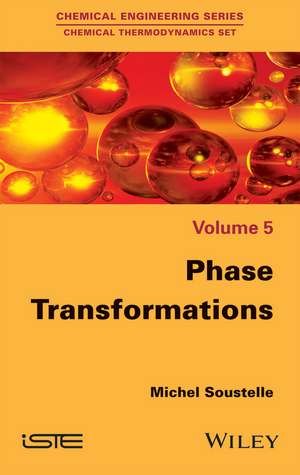
Phase Transformations
Autor Michel Soustelleen Limba Engleză Hardback – 7 iun 2016
Al cincilea volum din seria semnată de Michel Soustelle aduce o rigoare matematică sporită în studiul echilibrelor, fiind conceput special pentru a integra corelația constantă între modelele macroscopice și cele microscopice. În literatura de specialitate, această lucrare se distinge prin tratarea sistematică a transformărilor de fază pură de ordinul întâi și al doilea, oferind instrumente de caracterizare esențiale pentru ingineria proceselor și chimia fizică. Considerăm că punctul forte al acestui volum este analiza aprofundată a sistemelor binare și ternare, unde conceptele de azeotropie, demixare și reacții peritectice sunt demonstrate cu o precizie tehnică ridicată. Phase Transformations acoperă o arie tematică similară cu Phase Transitions in Materials de Brent Fultz, însă abordarea lui Soustelle este mai pregnant orientată către chimia fizică și termodinamica soluțiilor, în timp ce lucrarea lui Fultz pune accent pe explicații la nivel de atomi și electroni specifice științei materialelor. De asemenea, spre deosebire de Phase Diagrams and Heterogeneous Equilibria de Bruno Predel, care se concentrează pe aplicațiile practice și intuitive ale diagramelor, volumul de față prioritizează fundamentarea teoretică și rigoarea derivărilor matematice. Apreciem în mod deosebit modul în care sunt tratate sistemele solide-lichide și compușii definiți cu sau fără topire congruentă, oferind cercetătorilor din laboratoarele de cercetare fundamentală un suport teoretic solid pentru interpretarea fenomenelor de suprafață și a fazelor de dimensiuni mici.
Preț: 963.58 lei
Preț vechi: 1058.88 lei
-9%
Carte tipărită la comandă
Livrare economică 05-19 septembrie
Specificații
ISBN-10: 1848218680
Pagini: 250
Dimensiuni: 161 x 240 x 18 mm
Greutate: 0.55 kg
Ediția:1
Editura: Wiley
Locul publicării:Hoboken, United States
V-ar putea interesa
-
 -9%Preț: 1225.20 lei1346.37 lei
 -
 -9%Preț: 1983.87 lei2180.07 lei
 -
 -9%Preț: 1667.72 lei1832.65 lei
 -
 Carbocation ChemistryGeorge A Olah-23%Preț: 1096.51 lei1424.04 lei
 -
 Solid-Phase ExtractionE Michael Thurman-9%Preț: 1083.68 lei1190.86 lei
 -
 Chemical KineticsKenneth A Connors-9%Preț: 1813.91 lei1993.30 lei
 -
 Integrated Circuit Failure AnalysisFriedrich Beck-9%Preț: 1363.05 lei1497.86 lei
 -
 -9%Preț: 4882.47 lei5365.35 lei
 -
 -9%Preț: 2715.80 lei2984.40 lei
 -
 RELEASE Predict Aerosol RainouDavid W Johnson-9%Preț: 1897.09 lei2084.71 lei
 -
 Handbook of Heterogenous KineticsMichel Soustelle-23%Preț: 2176.57 lei2826.70 lei
 -
 Modeling of Liquid PhasesMichel Soustelle-9%Preț: 985.28 lei1082.73 lei
 -
 Thermodynamic Modeling of Solid PhasesMichel Soustelle-9%Preț: 964.49 lei1059.88 lei
 -
 Chemical EquilibriaMichel Soustelle-9%Preț: 982.54 lei1079.71 lei
 -
 Ionic and Electrochemical EquilibriaMichel Soustelle-9%Preț: 967.88 lei1063.60 lei
 -
 Thermodynamics of Surfaces and Capillary SystemsMichel Soustelle-9%Preț: 964.49 lei1059.88 lei
 -
 Perkutane Absorption von PCDD und PCDF aus Textilien in den MenschenAnneke Mühlebach-19%Preț: 435.92 lei538.17 lei
Public țintă
This set of books is written for an audience of engineering undergraduates and Masters students and doctoral candidates in the disciplines of chemistry, physical chemistry and process engineering. It would also be useful for researchers at fundamental or applied research labs, dealing with issues in thermodynamics during the course of their work.De ce să citești această carte
Recomandăm această lucrare studenților avansați și cercetătorilor care au nevoie de un fundament matematic riguros în studiul termodinamicii. Cititorul câștigă o înțelegere profundă a echilibrelor de fază în sisteme multicomponent, fiind un instrument esențial pentru cei care activează în ingineria proceselor sau chimia fizică, unde corelația dintre scara microscopică și cea macroscopică este critică pentru succesul experimentelor.