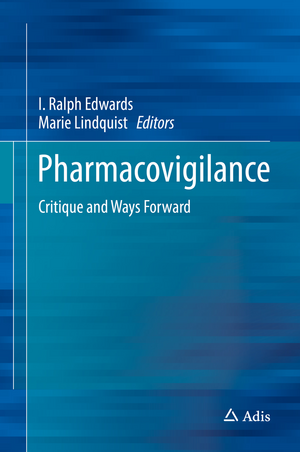
Pharmacovigilance
Editat de I. Ralph Edwards, Marie Lindquisten Limba Engleză Hardback – 10 noi 2016
Ne-a atras atenția Pharmacovigilance: Critique and Ways Forward, un volum academic în format hardback ce reunește perspectivele experților din cadrul Societății Internaționale de Farmacovigilență (ISoP). Structura celor 17 capitole este concepută pentru a provoca status quo-ul actual, trecând de la o analiză a proceselor de învățare și a barierelor legislative („Lost in Regulation”), către teme de avangardă precum ecofarmacovigilența și monitorizarea produselor naturiste. Credem că organizarea logică a cuprinsului facilitează o tranziție clară de la diagnosticul problemelor sistemice la soluții practice pentru viitor. Această primă ediție publicată de Springer International Publishing sub amprenta Adis se distinge prin tonul critic și constructiv. Spre deosebire de manualele tehnice standard, autorii analizează factorii „tăcuți” care influențează deciziile de siguranță și pledează pentru o comunicare mai eficientă în domeniu. Este un manual de referință comparabil cu An Introduction to Pharmacovigilance 2e de P Waller, dar actualizat conform ghidurilor și dezbaterilor din 2017, punând un accent mult mai mare pe integrarea farmacovigilenței în îngrijirea cotidiană a pacientului decât pe simpla raportare administrativă. Merită menționat că volumul nu se limitează la baze de date clinice, ci explorează și impactul procedurilor de referință asupra planurilor de management al riscului (RMP). Analiza cuprinde inclusiv rolul serviciului de monitorizare a literaturii medicale al EMA, oferind o viziune de ansamblu asupra ecosistemului european de reglementare. Stilul clinic și argumentația riguroasă fac din această lucrare un instrument esențial pentru recalibrarea modului în care înțelegem siguranța terapeutică.
Preț: 724.26 lei
Preț vechi: 762.38 lei
-5%
Carte disponibilă
Livrare economică 26 octombrie-09 noiembrie
Specificații
ISBN-10: 3319403990
Pagini: 240
Ilustrații: XXXI, 205 p. 16 illus., 3 illus. in color.
Dimensiuni: 160 x 241 x 18 mm
Greutate: 0.57 kg
Ediția:1st edition 2017
Editura: Springer
Locul publicării:Cham, Switzerland
V-ar putea interesa
-
 The Frailty ModelLuc Duchateau-15%Preț: 651.53 lei766.50 lei
 -
 Bioconductor Case StudiesFlorian Hahne-15%Preț: 702.45 lei826.42 lei
 -
 Design and Analysis Healthvan Belle-8%Preț: 425.01 lei461.97 lei
 -
 Qualitative Research Methods iThompson-5%Preț: 367.34 lei386.68 lei
 -
 Research Skills for Medical StudentsAnn K. Allen-5%Preț: 580.33 lei610.88 lei
 -
 Designing and Conducting Gender, Sex, and Health ResearchJohn L. Oliffe-27%Preț: 790.45 lei1082.82 lei
 -
 Qualitative and Mixed Methods in Public HealthDeborah K Padgett-5%Preț: 764.60 lei804.84 lei
 -
 Bone-Implant Interface in Orthopedic SurgeryTheofilos Karachalios-5%Preț: 1099.83 lei1157.72 lei
 -
 Preț: 361.70 lei
 -
 Perspectives on Nursing TheoryPamela G. Reed RN, PhD, FAAN-21%Preț: 498.59 lei631.16 lei
 -
 Testing TreatmentsHazel Thornton-16%Preț: 60.88 lei72.31 lei
 -
 Pharmacological Basis of Acute CareYoo Kuen Chan-5%Preț: 788.38 lei829.87 lei
 -
 -5%Preț: 848.73 lei893.39 lei
 -
 -5%Preț: 363.23 lei382.34 lei
 -
 -5%Preț: 1081.08 lei1137.98 lei
De ce să citești această carte
Această carte se adresează specialiștilor din industria farmaceutică, reglementatorilor și clinicienilor care doresc să depășească etapa birocratică a farmacovigilenței. Cititorul câștigă o perspectivă strategică asupra modului în care datele de siguranță pot îmbunătăți decizia terapeutică la patul bolnavului. Este un motiv concret pentru a regândi siguranța medicamentului nu ca pe o obligație legală, ci ca pe o componentă vitală a actului medical modern.
Despre autor
I. Ralph Edwards și Marie Lindquist sunt figuri proeminente în comunitatea științifică internațională, având o legătură strânsă cu International Society of Pharmacovigilance (ISoP). Ralph Edwards este recunoscut pentru contribuțiile sale de lungă durată în monitorizarea reacțiilor adverse, fiind fost director al centrului de monitorizare Uppsala al OMS. Marie Lindquist a coordonat numeroase proiecte de cercetare axate pe dezvoltarea metodelor de detectare a semnalelor de siguranță. Expertiza lor combinată transformă acest volum într-o resursă autoritară pentru înțelegerea evoluției farmacovigilenței globale.
Descriere scurtă
Pharmacovigilance of the future must be an active and integral part of health care delivery, and focus more on science and practices that support health professionals and patients in day-to-day care situations. To achieve this, a dynamic and sustainable development of vigilance must take precedence over the current excessive preoccupations with data processing and regulations; all aspects of medicines use and their effects need to be considered; and all stakeholders must be involved and engaged in an open and constructive debate.
The work is essential reading for anyone who has an interest in safer use of medicines. It is intended to be equally challenging and rewarding, and sets out to stimulate a continuous debate on how pharmacovigilance can better meet the needs of health professionals and patients to achieve the aim of wise therapeutic decision making.
Cuprins
Notă biografică
Marie Lindquist is Director and CEO of the Uppsala Monitoring Centre and heads the Foundation WHO Collaborating Centre for International Drug Monitoring. She has served as Vice President of the International Society of Pharmacovigilance and is a Board Member of the International Society of Pharmacoepidemiology. Her research interests are in clinical epistemiology and ontology with data quality management and analysis of big data, as well as development of problem solving methodology. She has published 57 peer reviewed papers and completed work on 4 books. She has been an expert member of WHO, ISO, CIOMS and ICH working groups, and serves as a member of the editorial board of Drug Safety and the International Journal of Risk and Safety in Medicine. She is a PhD (cum laude) in Medical Science, University of Nijmegen and Honorary Fellow of the Royal College of Physicians (London).
Caracteristici
Proposals for a more comprehensive approach to vigilance in health care give readers a framework for linking pharmacovigilance to outcomes research in health care
Argues the need to cut out unnecessary bureaucracy, encouraging the reader to consider the needs of individual patients, as well as broader public health matters
Includes supplementary material: sn.pub/extras