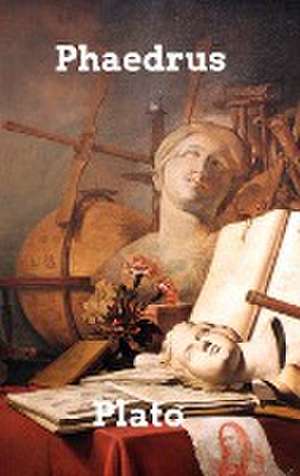
Phaedrus
Autor Platoen Limba Engleză Hardback – 29 ian 2026
Preț: 191.31 lei
Puncte Express: 287
Carte tipărită la comandă
Livrare economică 27 noiembrie-11 decembrie
Livrare prin curier în România Termenul estimat este afișat lângă disponibilitate.
Transport gratuit de la 400.00 lei Plată online sau ramburs, în funcție de opțiunile comenzii.
Retur gratuit în 14 zile Comandă securizată și suport în română.
Specificații
V-ar putea interesa
-
 RepublicPlatoPreț: 30.76 lei
 -
 SymposiumPlatoPreț: 27.61 lei
 -
 -25%Preț: 215.40 lei289.00 lei
 -
 -25%Preț: 218.86 lei290.91 lei
 -
 -20%Preț: 383.68 lei477.09 lei
 -
 The First Philosophers: The Presocratics and SophistsRobin Waterfield-18%Preț: 65.53 lei79.80 lei
 -
 -20%Preț: 51.39 lei63.99 lei
 -
 -19%Preț: 52.70 lei64.76 lei
 -
 -18%Preț: 65.53 lei79.80 lei
 -
 TheaetetusPlato-20%Preț: 73.93 lei92.24 lei
 -
 Preț: 84.27 lei
 -
 Great Dialogues of PlatoPlatoPreț: 54.11 lei
 -
 Six Great DialoguesPlatoPreț: 50.88 lei
 -
 Preț: 229.26 lei
 -
 -14%Preț: 515.26 lei599.14 lei
 -
 -18%Preț: 141.30 lei171.41 lei
 -
 -33%Preț: 550.36 lei818.90 lei
 -
 The Pocket Book of PlatoMichael MoorePreț: 72.54 lei
 -
 ParmenidesPlatoPreț: 43.40 lei
 -
 SophistPlatoPreț: 41.26 lei
 -
 PhilebusPlatoPreț: 45.99 lei
 -
 PhaedoPlatoPreț: 43.59 lei
 -
 -21%Preț: 205.76 lei259.14 lei
 -
 Preț: 58.13 lei
Notă biografică
Plato was an ancient Greek philosopher born in Athens during the Classical period in Ancient Greece. In Athens, Plato founded the Academy, a philosophical school where he taught the philosophical doctrines that would later become known as Platonism. Plato (or Platon) was a pen name derived, apparently, from the nickname given to him by his wrestling coach - allegedly a reference to his physical broadness. According to Alexander of Miletus quoted by Diogenes of Sinope his actual name was Aristocles, son of Ariston, of the deme Collytus (Collytus being a district of Athens).Plato was an innovator of the written dialogue and dialectic forms in philosophy. He raised problems for what later became all the major areas of both theoretical philosophy and practical philosophy. His most famous contribution is the Theory of forms, which has been interpreted as advancing a solution to what is now known as the problem of universals. He is also the namesake of Platonic love and the Platonic solids.His own most decisive philosophical influences are usually thought to have been, along with Socrates, the pre-Socratics Pythagoras, Heraclitus, and Parmenides, although few of his predecessors' works remain extant and much of what we know about these figures today derives from Plato himself.Along with his teacher, Socrates, and his student, Aristotle, Plato is a central figure in the history of philosophy.[b] Unlike the work of nearly all of his contemporaries, Plato's entire body of work is believed to have survived intact for over 2,400 years. Although their popularity has fluctuated, Plato's works have consistently been read and studied. Through Neoplatonism Plato also greatly influenced both Christian and Islamic philosophy (through e.g. Al-Farabi). In modern times, Alfred North Whitehead famously said: "the safest general characterization of the European philosophical tradition is that it consists of a series of footnotes to Plato
Descriere
Descriere de la o altă ediție sau format:
'Some of our greatest blessings come from madnessPhaedrus is widely recognized as one of Plato's most profound and beautiful works. It takes the form of a dialogue between Socrates and Phaedrus and its ostensible subject is love, especially homoerotic love. Socrates reveals it to be a kind of divine madness that can allow our souls to grow wings and soar to their greatest heights. Then the conversation changes direction and turns to a discussion of rhetoric, which must be based on truth passionately sought, thus allying it to philosophy. The dialogue closes by denigrating the value of the written word in any context, compared to the living teaching of a Socratic philosopher.The shifts of topic and register have given rise to doubts about the unity of the dialogue, doubts which are addressed in the introduction to this volume. Full explanatory notes also elucidate issues throughout the dialogue that might puzzle a modern reader. ABOUT THE SERIES: For over 100 years Oxford World's Classics has made available the widest range of literature from around the globe. Each affordable volume reflects Oxford's commitment to scholarship, providing the most accurate text plus a wealth of other valuable features, including expert introductions by leading authorities, helpful notes to clarify the text, up-to-date bibliographies for further study, and much more.
'Some of our greatest blessings come from madnessPhaedrus is widely recognized as one of Plato's most profound and beautiful works. It takes the form of a dialogue between Socrates and Phaedrus and its ostensible subject is love, especially homoerotic love. Socrates reveals it to be a kind of divine madness that can allow our souls to grow wings and soar to their greatest heights. Then the conversation changes direction and turns to a discussion of rhetoric, which must be based on truth passionately sought, thus allying it to philosophy. The dialogue closes by denigrating the value of the written word in any context, compared to the living teaching of a Socratic philosopher.The shifts of topic and register have given rise to doubts about the unity of the dialogue, doubts which are addressed in the introduction to this volume. Full explanatory notes also elucidate issues throughout the dialogue that might puzzle a modern reader. ABOUT THE SERIES: For over 100 years Oxford World's Classics has made available the widest range of literature from around the globe. Each affordable volume reflects Oxford's commitment to scholarship, providing the most accurate text plus a wealth of other valuable features, including expert introductions by leading authorities, helpful notes to clarify the text, up-to-date bibliographies for further study, and much more.
Recenzii
This is a fine translation, both fluent and accurate. It captures the range of tonalities of the original in elegant English that is neither stiffly formal nor cheaply colloquial….The supplementary matter is appropriate and useful. The introduction is crisp and clear, the interpretive essay illuminating…Scully has done a sound and serious job of translating and annotating for the general reader. Above all, his translation is excellent in respect to style and clarity: really a pleasure to read.
-- David Konstan, Brown University
Translation in English with introduction, notes, glossary, appendices, interpretive essay and introduction. The text includes new insights into the nature of Greek love, including rarely seen illustrations (stone carving and vase painting).