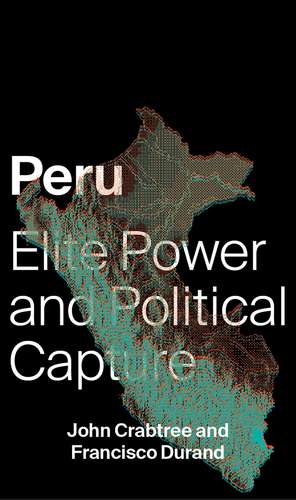
Peru
Autor John Crabtree, Francisco Duranden Limba Engleză Hardback – 15 mai 2017
Post the 2016 elections, John Crabtree and Francisco Durand look at the ways in which these elites have been able to consolidate their position at the expense of genuine democracy, with a particular focus on the role of mining and other extractive industries, where extensive privatization and deregulation has contributed to extreme disparities in wealth and power. In the process, Crabtree and Durand provide a unique case study of state development, by revealing the mechanisms used by elites to dominate political discussion and marginalize their opponents, as well as the role played by external actors such as international financial institutions and foreign investors. The significance of Crabtree's findings therefore extends far beyond Peru, and illuminates the wider issue of why mineral-rich countries so often struggle to attain meaningful democracy.
Preț: 568.00 lei
Preț vechi: 738.42 lei
-23%
Puncte Express: 852
Carte tipărită la comandă
Livrare economică 21 decembrie 26 - 04 ianuarie 27
Livrare prin curier în România Termenul estimat este afișat lângă disponibilitate.
Transport gratuit pentru acest produs Plată online sau ramburs, în funcție de opțiunile comenzii.
Retur gratuit în 14 zile Comandă securizată și suport în română.
Specificații
ISBN-13: 9781783609048
ISBN-10: 1783609044
Pagini: 218
Dimensiuni: 145 x 222 x 17 mm
Greutate: 0.39 kg
Editura: BLOOMSBURY 3PL
ISBN-10: 1783609044
Pagini: 218
Dimensiuni: 145 x 222 x 17 mm
Greutate: 0.39 kg
Editura: BLOOMSBURY 3PL
V-ar putea interesa
-
 -15%Preț: 484.40 lei569.89 lei
-
 Money, Banking, and the Business CycleB. Simpson-15%Preț: 676.15 lei795.47 lei
-
 Preț: 405.55 lei
-
 -15%Preț: 470.15 lei553.11 lei
-
 Bolivia: Processes of ChangeJohn CrabtreePreț: 136.04 lei
-
 -16%Preț: 144.86 lei172.95 lei
-
 -17%Preț: 166.00 lei199.57 lei
-
 -13%Preț: 270.42 lei311.83 lei
-
 -24%Preț: 564.04 lei739.39 lei
-
 Who Owns the Media: Global Trends and Local ResistancesPradip N. ThomasPreț: 291.26 lei
-
 -14%Preț: 264.85 lei308.89 lei
-
 The New Development Management: Critiquing the Dual ModernizationAssociate Professor in Interdisciplinary Global Management Sadhvi Dar-14%Preț: 265.67 lei309.31 lei
-
 Preț: 262.19 lei
-
 Islam and 'Scientific' EconomicsHasan Gürak-23%Preț: 452.13 lei587.18 lei
-
 -15%Preț: 511.80 lei602.12 lei
-
 Preț: 316.76 lei
-
 Seigneuriage, Instabilite Politique Et Ciblage D'Inflation: France Et RussieOlfa Manai Daboussi-19%Preț: 437.03 lei539.55 lei
-
 Les Marches Financiers: Une Boite Noire?Claude Jr. DostiePreț: 422.32 lei
-
 Preț: 340.15 lei
Notă biografică
John Crabtree is a Research Associate at the Latin American Studies Centre, University of Oxford, a Senior Member of Saint Antony's College, Oxford, and (currently) a Visiting Researcher at Oxford Brookes University, Oxford. His most recent published books are Bolivia: Processes of Change co-authored with Ann Chaplin (Zed 2013), and Fractured Politics: Peruvian Democracy Past and Present (2011).
Francisco Durand is a Research Associate at DESCO-Centro de Estudios de Promoción del Desarrollo and Professor of Politics at the Catholic University of Peru (PUCP). His books in English include Business and Politics in Peru (1993), and Organized Business, Democracy and Economic Change (1996).
John Crabtree is a Research Associate at the Latin American Studies Centre, University of Oxford, a Senior Member of Saint Antony's College, Oxford, and (currently) a Visiting Researcher at Oxford Brookes University, Oxford. His most recent published books are Bolivia: Processes of Change co-authored with Ann Chaplin (Zed 2013), and Fractured Politics: Peruvian Democracy Past and Present (2011). Francisco Durand is a Research Associate at DESCO-Centro de Estudios de Promoción del Desarrollo and Professor of Politics at the Catholic University of Peru (PUCP). His books in English include Business and Politics in Peru (1993), and Organized Business, Democracy and Economic Change (1996).
Descriere
Crabtree and Durand explore how the Peruvian elite and foreign mining interests have been able to entrench their position and marginalise the left, even as leftist governments have risen to power elsewhere on the continent.