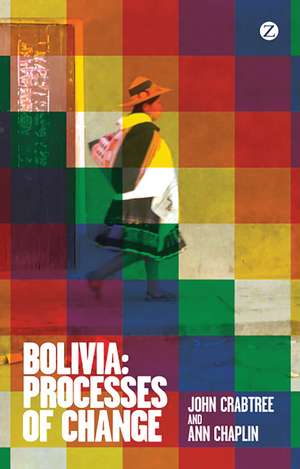
Bolivia: Processes of Change: Zed Books
Autor John Crabtree, Ann Chaplinen Limba Engleză Paperback – 9 mai 2013
Based on a wealth of interview material and original reportage, the book enters the terrain of grassroots politics, identifying how Bolivians work within the country's social movements and how they view the effects that this participation has achieved. It asks how they see their lives as being altered - for better or for worse - by this experience, as well as how they evaluate the experience of becoming politically involved, often for the first time. This unique bottom-up analysis explores the often complex relationship between Bolivia's people, social movements and the state, highlighting both the achievements and limitations of the MAS administration. In doing so, it casts important new light both on the nature of the Bolivian 'experiment' and its implications for participatory politics in other parts of the developing world.
Din seria Zed Books
- 18%
 Preț: 257.65 lei
 - 24%
 Preț: 180.93 lei
 - 15%
 Preț: 261.15 lei
 - 33%
 Preț: 563.50 lei
 - 22%
 Preț: 211.53 lei
 - 36%
 Preț: 539.92 lei
 - 33%
 Preț: 563.78 lei
 - 33%
 Preț: 562.04 lei
 - 25%
 Preț: 194.29 lei
 - 15%
 Preț: 132.40 lei
 - 10%
 Preț: 140.47 lei
 - 23%
 Preț: 168.76 lei
 - 24%
 Preț: 195.53 lei
 - 40%
 Preț: 502.24 lei
 - 10%
 Preț: 111.50 lei
 - 13%
 Preț: 131.78 lei
 - 15%
 Preț: 125.60 lei
 - 14%
 Preț: 148.37 lei
 - 32%
 Preț: 551.25 lei
 - 26%
 Preț: 205.63 lei
 - 27%
 Preț: 440.18 lei
 - 39%
 Preț: 508.90 lei
 - 40%
 Preț: 506.34 lei
 - 20%
 Preț: 146.93 lei
 - 40%
 Preț: 503.51 lei
 - 32%
 Preț: 567.39 lei
 - nou
 Preț: 213.03 lei
 - nou
 Preț: 209.19 lei
 - nou
 Preț: 214.33 lei
Preț: 136.04 lei
Puncte Express: 204
Carte indisponibilă temporar
Livrare prin curier în România Termenul estimat este afișat lângă disponibilitate.
Transport gratuit de la 400.00 lei Plată online sau ramburs, în funcție de opțiunile comenzii.
Retur gratuit în 14 zile Comandă securizată și suport în română.
Specificații
ISBN-13: 9781780323763
ISBN-10: 178032376X
Pagini: 208
Ilustrații: 1 map (black and white)
Dimensiuni: 138 x 216 x 13 mm
Greutate: 0.27 kg
Editura: Bloomsbury Publishing
Colecția Zed Books
Seria Zed Books
Locul publicării:London, United Kingdom
ISBN-10: 178032376X
Pagini: 208
Ilustrații: 1 map (black and white)
Dimensiuni: 138 x 216 x 13 mm
Greutate: 0.27 kg
Editura: Bloomsbury Publishing
Colecția Zed Books
Seria Zed Books
Locul publicării:London, United Kingdom
V-ar putea interesa
-
 Preț: 126.71 lei
 -
 The Center HoldsJonathan AlterPreț: 104.61 lei
 -
 America's Other War: Terrorizing ColombiaDoug Stokes-18%Preț: 202.16 lei247.23 lei
 -
 -16%Preț: 169.43 lei201.48 lei
 -
 The Middle East: The Politics of the Sacred and SecularProfessor Shahrough Akhavi-26%Preț: 192.20 lei258.40 lei
 -
 Thinking PalestineRonit Lentin-16%Preț: 256.78 lei304.91 lei
 -
 Africa: The Politics of Suffering and SmilingPatrick Chabal-16%Preț: 168.56 lei200.53 lei
 -
 Afghanistan: The Mirage of PeaceChris Johnson-27%Preț: 213.66 lei293.12 lei
Cuprins
Prologue
Introduction: popular organization and the processes of change .
1. Land, campesinos and indígenas
2. The Altiplano: sindicatos versus ayllus
3. El Alto: a city of migrants
4. Of mines and miners
5. Of coca and cocaleros
6. Of gas, rents and indigenous movements of the Chaco
7. Santa Cruz and the process of change
8. The Amazonian north
Conclusions
Introduction: popular organization and the processes of change .
1. Land, campesinos and indígenas
2. The Altiplano: sindicatos versus ayllus
3. El Alto: a city of migrants
4. Of mines and miners
5. Of coca and cocaleros
6. Of gas, rents and indigenous movements of the Chaco
7. Santa Cruz and the process of change
8. The Amazonian north
Conclusions
Recenzii
Crabtree and Chapin provide an insightful guide to the ''processes of change'' in Bolivia under the Morales government. This book is extremely useful both for students and scholars of Bolivia and for those interested in understanding the unfolding of social-movement-induced change in Latin America today.
Evo Morales has gone from hungry youngster in the Andes to president of his country with all the concentrated energy that only those born poor such as he seem to find. Bolivia's stories are marshalled here by two accomplished writers with expertise and flair.
John Crabtree and Ann Chaplin write with that clarity and quiet authority bestowed by many years' experience. Their knowledge of Bolivia since the era of military dictatorships shows up here not in dense factual detail or political criticism. Rather, it is reflected in their skilled ability to capture, through scores of interviews undertaken throughout the country, a really telling snapshot of the popular experience of recent years. They show how the period since 2006 has been one of many complications and disputes but also of extensive social change and cultural excitement. Sympathetic but independently minded, the authors have given us a most valuable and accessible survey of Bolivia under Evo Morales.
An excellent introduction to the turbulent politics of Evo Morales' Bolivia. Indigenous empowerment and swelling state revenues are today accompanied by new conflicts, skillfully analysed by the authors. Moving between several regions and sectors, they transmit views from social actors at the base, arguing that the growth in social inclusion is irreversible.
Evo Morales has gone from hungry youngster in the Andes to president of his country with all the concentrated energy that only those born poor such as he seem to find. Bolivia's stories are marshalled here by two accomplished writers with expertise and flair.
John Crabtree and Ann Chaplin write with that clarity and quiet authority bestowed by many years' experience. Their knowledge of Bolivia since the era of military dictatorships shows up here not in dense factual detail or political criticism. Rather, it is reflected in their skilled ability to capture, through scores of interviews undertaken throughout the country, a really telling snapshot of the popular experience of recent years. They show how the period since 2006 has been one of many complications and disputes but also of extensive social change and cultural excitement. Sympathetic but independently minded, the authors have given us a most valuable and accessible survey of Bolivia under Evo Morales.
An excellent introduction to the turbulent politics of Evo Morales' Bolivia. Indigenous empowerment and swelling state revenues are today accompanied by new conflicts, skillfully analysed by the authors. Moving between several regions and sectors, they transmit views from social actors at the base, arguing that the growth in social inclusion is irreversible.