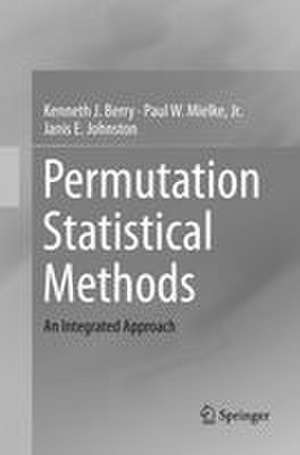
Permutation Statistical Methods
Autor Kenneth J. Berry, Paul W. Mielke, Jr., Janis E. Johnstonen Limba Engleză Paperback – 27 mai 2018
Permutation statistical methods, compared to classical statistical methods, do not rely on theoretical distributions, avoid the usual assumptions of normality and homogeneity of variance, and depend only on the data at hand. This text takes a unique approach to explaining statistics by integrating a large variety of statistical methods, and establishing the rigor of a topic that to many may seem to be a nascent field in statistics. This topic is new in that it took modern computing power to make permutation methods available to people working in the mainstream of research.
lly-informed="" audience,="" and="" can="" also="" easily="" serve="" as="" textbook="" in="" graduate="" course="" departments="" such="" statistics,="" psychology,="" or="" biology.="" particular,="" the="" audience="" for="" book="" is="" teachers="" of="" practicing="" statisticians,="" applied="" quantitative="" students="" fields="" medical="" research,="" epidemiology,="" public="" health,="" biology.
Preț: 662.06 lei
Preț vechi: 778.89 lei
-15%
Puncte Express: 993
Carte tipărită la comandă
Livrare economică 01-15 decembrie
Livrare prin curier în România Termenul estimat este afișat lângă disponibilitate.
Transport gratuit pentru acest produs Plată online sau ramburs, în funcție de opțiunile comenzii.
Retur gratuit în 14 zile Comandă securizată și suport în română.
Specificații
ISBN-13: 9783319804194
ISBN-10: 3319804197
Pagini: 644
Ilustrații: XX, 622 p. 180 illus.
Dimensiuni: 155 x 235 x 35 mm
Greutate: 0.96 kg
Ediția:Softcover reprint of the original 1st edition 2016
Editura: Springer
Locul publicării:Cham, Switzerland
ISBN-10: 3319804197
Pagini: 644
Ilustrații: XX, 622 p. 180 illus.
Dimensiuni: 155 x 235 x 35 mm
Greutate: 0.96 kg
Ediția:Softcover reprint of the original 1st edition 2016
Editura: Springer
Locul publicării:Cham, Switzerland
V-ar putea interesa
-
 Epidemiology and Demography in Public HealthJaphet Killewo-25%Preț: 545.35 lei725.88 lei
 -
 -18%Preț: 278.49 lei338.78 lei
 -
 -22%Preț: 370.66 lei474.33 lei
 -
 Epidemiology: A Very Short IntroductionRodolfo Saracci-24%Preț: 57.89 lei75.86 lei
 -
 Obesity Epidemiology: From Aetiology to Public HealthDavid Crawford-11%Preț: 688.14 lei774.58 lei
 -
 -27%Preț: 583.34 lei796.55 lei
 -
 -5%Preț: 1452.53 lei1528.98 lei
 -
 -5%Preț: 739.98 lei778.93 lei
 -
 Epidemiology of Obesity in Children and AdolescentsLuis A. Moreno-5%Preț: 770.18 lei810.72 lei
 -
 -5%Preț: 307.05 lei323.21 lei
 -
 Epidemiology and the Delivery of Health Care ServicesDenise M. Oleske-5%Preț: 652.30 lei686.63 lei
 -
 Epidemiology of Human Congenital MalformationsBengt Källén-5%Preț: 751.13 lei790.65 lei
Cuprins
Preface.- 1.Introduction.- 2.Completely Randomized Data.- 3.Randomized Designs: Interval Data.- 4.Regression Analysis of Interval Data.- 5.Randomized Designs: Ordinal Data, I.- 6.Randomized Designs: Ordinal Data, II.- 7.Randomized Designs: Nominal Data.- 8.Randomized Designs: Nominal Data.- 9.Randomized Block Designs: Interval Data.- 10.Randomized Block Designs: Ordinal Data.- 11.Randomized Block Designs: Nominal Data.- Epilogue.- References.- Author Index.- Subject Index.
Recenzii
“This book summarizes the applications of the MRPP done by the authors to various statistical problems … . This book may be useful for researchers who are interested in extending the MRPP to other types of data and statistical problems, for example, survival data with possible censoring of observations.” (Dongsheng Tu, zbMATH 1358.62011, 2017)
Textul de pe ultima copertă
This research monograph provides a synthesis of a number of statistical tests and measures, which, at first consideration, appear disjoint and unrelated. Numerous comparisons of permutation and classical statistical methods are presented, and the two methods are compared via probability values and, where appropriate, measures of effect size.
Permutation statistical methods, compared to classical statistical methods, do not rely on theoretical distributions, avoid the usual assumptions of normality and homogeneity of variance, and depend only on the data at hand. This text takes a unique approach to explaining statistics by integrating a large variety of statistical methods, and establishing the rigor of a topic that to many may seem to be a nascent field in statistics. This topic is new in that it took modern computing power to make permutation methods available to people working in the mainstream of research. This research monograph addresses a statistically-informed audience, and can also easily serve as a textbook in a graduate course in departments such as statistics, psychology, or biology. In particular, the audience for the book is teachers of statistics, practicing statisticians, applied statisticians, and quantitative graduate students in fields such as psychology, medical research, epidemiology, public health, and biology.
Permutation statistical methods, compared to classical statistical methods, do not rely on theoretical distributions, avoid the usual assumptions of normality and homogeneity of variance, and depend only on the data at hand. This text takes a unique approach to explaining statistics by integrating a large variety of statistical methods, and establishing the rigor of a topic that to many may seem to be a nascent field in statistics. This topic is new in that it took modern computing power to make permutation methods available to people working in the mainstream of research. This research monograph addresses a statistically-informed audience, and can also easily serve as a textbook in a graduate course in departments such as statistics, psychology, or biology. In particular, the audience for the book is teachers of statistics, practicing statisticians, applied statisticians, and quantitative graduate students in fields such as psychology, medical research, epidemiology, public health, and biology.
Caracteristici
Presents a methodological umbrella under which (1) disparate statistical methods are synthesized and integrated and (2) a number of new permutation statistical methods are developed Synthesizes and integrates a large number of existing classical statistics under a common mathematical function Provides computing algorithms for calculating permutation tests, and details the history of permutation statistical methods
Notă biografică
Kenneth J. Berry is Professor Emeritus in the Department of Sociology at Colorado State University. He is the author of eight books and over 190 journal articles, primarily in the areas of statistics and quantitative research methods.
Janis E. Johnston is employed by the U.S. Government and is an Affiliate Faculty member in the Department of Sociology at Colorado State University. She is the author of six books and over 40 journal articles, primarily in the areas of statistics and quantitative research methods.
Michael A. Long is Professor and Director of Graduate Studies in the Department of Sociology at Oklahoma State University. He is the author of six books and over 100 journal articles and book chapters, primarily in the areas of environmental sociology, green criminology, food insecurity and quantitative methodology.
Paul B. Stretesky is Professor of Sociology in the Department of Social Sciences at Northumbria University, UK. He is author of eight books and over 100 journal articles, primarily in the areas of environmental justice, green criminology and food insecurity.
Michael J. Lynch is Professor and Director of the Graduate Program in the Department of Criminology at University of South Florida. He is author/editor of over 25 books and over 120 journal articles, primarily in the areas of green criminology, radical criminology, and environmental sociology.