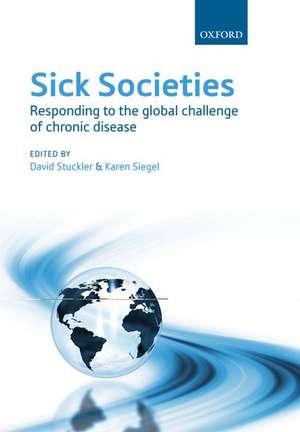
Sick Societies: Responding to the global challenge of chronic disease
Editat de David Stuckler, Karen Siegelen Limba Engleză Paperback – 20 oct 2011
Preț: 583.34 lei
Preț vechi: 796.55 lei
-27%
Puncte Express: 875
Carte tipărită la comandă
Livrare economică 10-16 decembrie
Livrare prin curier în România Termenul estimat este afișat lângă disponibilitate.
Transport gratuit pentru acest produs Plată online sau ramburs, în funcție de opțiunile comenzii.
Retur gratuit în 14 zile Comandă securizată și suport în română.
Specificații
ISBN-13: 9780199574407
ISBN-10: 0199574405
Pagini: 376
Ilustrații: 61 black and white line drawings
Dimensiuni: 172 x 247 x 44 mm
Greutate: 0.65 kg
Editura: Oxford University Press
Colecția OUP Oxford
Locul publicării:Oxford, United Kingdom
ISBN-10: 0199574405
Pagini: 376
Ilustrații: 61 black and white line drawings
Dimensiuni: 172 x 247 x 44 mm
Greutate: 0.65 kg
Editura: Oxford University Press
Colecția OUP Oxford
Locul publicării:Oxford, United Kingdom
V-ar putea interesa
-
 Common WealthJeffrey SachsPreț: 94.31 lei
 -
 -21%Preț: 320.10 lei402.90 lei
 -
 -5%Preț: 1807.16 lei1902.27 lei
 -
 -19%Preț: 393.06 lei484.37 lei
 -
 PreventableDevi Sridhar-18%Preț: 77.03 lei94.11 lei
 -
 How Not to Die (Too Soon)Devi SridharPreț: 159.77 lei
 -
 -25%Preț: 92.16 lei123.29 lei
 -
 Kumar and Clark's Clinical MedicineDavid Randall-25%Preț: 492.82 lei658.70 leiRecomandat
 -
 Essentials of Global HealthBabulal Sethia-27%Preț: 142.00 lei194.59 lei
 -
 -33%Preț: 169.45 lei252.80 lei
 -
 Epidemiology of Chronic Disease: Global PerspectivesRandall E Harris-11%Preț: 571.45 lei644.81 lei
 -
 Pandemics, Poverty, and PoliticsTyler B. EvansPreț: 310.82 lei
 -
 Our World in Crisis: Health and DiseaseIzzi Howell-35%Preț: 75.58 lei116.25 lei
 -
 Everything Is TuberculosisJohn Green-19%Preț: 127.66 lei157.70 leiRecomandat
 -
 Chronic Diseases: The Escalating Dilemma in Developing CountriesAdelia Bovell-Benjamin-23%Preț: 1330.39 lei1736.48 lei
 -
 -21%Preț: 127.75 lei160.89 lei
 -
 -28%Preț: 190.02 lei263.69 lei
 -
 Healthy to 100Ken SternPreț: 122.51 lei
 -
 Doom LoopEswar S. PrasadPreț: 185.03 lei
 -
 -25%Preț: 92.73 lei123.62 lei
Recenzii
This is a fascinating sociological and political view of the structure of the food and health industries in the modern world and how they are responsible for the epidemic we are seeing of obesity and its associated diseases.
Stuckler and Siegel's book expertly pulls together the essential data and ideas needed to combat chronic diseases. It will be a mandatory reader for courses in global health.
From health system financing to the financialization of the global economy, there is scarcely a dimension of our chronic disease pandemic that this book leaves unexplored. There is no better or more timely a text than this one from which to take that step.
This is a powerful, important and ultimately subversive book. It situates the origins and response to the global epidemic of chronic (noncommunicable) diseases as issues of social justice. This book is a must- read for all engaged with chronic diseases, especially, for people not yet engaged whether they be health professionals, development experts or concerned citizens.
Sick Societies is a highly ambitious and accessible book that succeeds in bringing together key material to make the case for accelerated action to address the global chronic disease epidemic. I would highly recommend it to anyone with an interest in chronic disease, and as a key text for courses in global health and public health.
With one out of every three deaths in the world now being caused by four types of chronic disease-heart disease, respiratory disease, common cancers, and type 2 diabetes-what path should public health practitioners take to stem the rising human and financial cost of non-communicable diseases? David Stuckler and Karen Siegel have edited a new data-driven tome that addresses this question better than any text I've seen to date-providing essential reading both for epidemiologists and public health campaigners looking for data and guidance in their movements for healthier foods, cleaner air, and access to essential medicines and primary care medical homes.
Stuckler and Siegel's book expertly pulls together the essential data and ideas needed to combat chronic diseases. It will be a mandatory reader for courses in global health.
From health system financing to the financialization of the global economy, there is scarcely a dimension of our chronic disease pandemic that this book leaves unexplored. There is no better or more timely a text than this one from which to take that step.
This is a powerful, important and ultimately subversive book. It situates the origins and response to the global epidemic of chronic (noncommunicable) diseases as issues of social justice. This book is a must- read for all engaged with chronic diseases, especially, for people not yet engaged whether they be health professionals, development experts or concerned citizens.
Sick Societies is a highly ambitious and accessible book that succeeds in bringing together key material to make the case for accelerated action to address the global chronic disease epidemic. I would highly recommend it to anyone with an interest in chronic disease, and as a key text for courses in global health and public health.
With one out of every three deaths in the world now being caused by four types of chronic disease-heart disease, respiratory disease, common cancers, and type 2 diabetes-what path should public health practitioners take to stem the rising human and financial cost of non-communicable diseases? David Stuckler and Karen Siegel have edited a new data-driven tome that addresses this question better than any text I've seen to date-providing essential reading both for epidemiologists and public health campaigners looking for data and guidance in their movements for healthier foods, cleaner air, and access to essential medicines and primary care medical homes.
Notă biografică
David Stuckler, is a university lecturer in sociology at Cambridge University and research fellow at the London School of Hygiene and Tropical Medicine and Chatham House. He has written over 70 peer-reviewed scientific articles on the economics of global health in The Lancet, Nature, and Foreign Affairs in addition to other major journals. He received his undergraduate degree from the University of Texas, his MPH from Yale University and his PhD from Cambridge before becoming a Research Fellow at the Department of Sociology at Oxford and receiving an appointment as an assistant professor at Harvard. He has won grants from the World Health Organization and UNICEF on the political economy of healthcare, and from the European Centers for Disease Control on the impact of economic crises on public health. He has taught at Harvard, Yale, Cambridge and Oxford on the subjects of global politics, economics and health as well as quantitative methods.Karen Siegel, MPH, is a PhD student in Nutrition and Health Sciences and a Woodruff Scholar at Emory University's Laney Graduate School and Rollins School of Public Health. She has written articles on environmental and policy approaches to prevent chronic diseases in India and globally, as well as on diabetes advocacy issues and chronic disease curricula improvement, in Health Affairs, The Lancet, Globalization & Health, and Nursing Standard. Previously, she played a major role in the development of the Oxford Health Alliance's Community Interventions for Health as part of the study's evaluation team, based at Matrix Public Health Solutions, Inc. and later at Oxford University. Siegel received her BA from the University of Pennsylvania and her MPH from Yale School of Public Health. She is co-chair of the Young Professionals Chronic Disease Network.