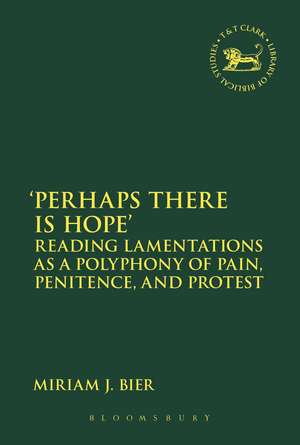
Perhaps there is Hope': Reading Lamentations as a Polyphony of Pain, Penitence, and Protest: The Library of Hebrew Bible/Old Testament Studies
Autor Miriam J. Bieren Limba Engleză Hardback – 23 apr 2015
Din seria The Library of Hebrew Bible/Old Testament Studies
- 28%
 Preț: 523.27 lei
 - 34%
 Preț: 524.05 lei
 - nou
 Preț: 563.78 lei
 - 31%
 Preț: 572.25 lei
 - 32%
 Preț: 596.25 lei
 - 35%
 Preț: 717.27 lei
 - 36%
 Preț: 584.76 lei
 - 24%
 Preț: 1221.79 lei
 - 24%
 Preț: 1239.43 lei
 - 25%
 Preț: 1150.86 lei
 - 25%
 Preț: 1087.98 lei
 - 25%
 Preț: 1171.84 lei
 - 25%
 Preț: 1103.91 lei
 - 26%
 Preț: 851.19 lei
 - 33%
 Preț: 771.63 lei
 - 36%
 Preț: 775.17 lei
 - 24%
 Preț: 1050.50 lei
 - 25%
 Preț: 1103.05 lei
 - 33%
 Preț: 1152.79 lei
 - 24%
 Preț: 1222.30 lei
 - 26%
 Preț: 1160.43 lei
 - 22%
 Preț: 532.76 lei
 - 24%
 Preț: 1179.15 lei
 - 24%
 Preț: 1219.04 lei
 - 29%
 Preț: 1215.32 lei
 - 21%
 Preț: 505.33 lei
 - 25%
 Preț: 1215.95 lei
 - 25%
 Preț: 1232.49 lei
 - 24%
 Preț: 1245.08 lei
 - 25%
 Preț: 1211.71 lei
 - 25%
 Preț: 1213.13 lei
 - 25%
 Preț: 845.74 lei
 - 25%
 Preț: 1216.13 lei
 - 25%
 Preț: 961.42 lei
 - 20%
 Preț: 414.96 lei
 - 24%
 Preț: 964.78 lei
 - 26%
 Preț: 369.50 lei
 - 25%
 Preț: 1088.14 lei
 - 34%
 Preț: 914.32 lei
 - 24%
 Preț: 838.13 lei
 - 33%
 Preț: 1215.43 lei
 - 24%
 Preț: 263.50 lei
 - 24%
 Preț: 706.80 lei
 - 33%
 Preț: 1154.57 lei
 - 24%
 Preț: 772.59 lei
 - 25%
 Preț: 1215.87 lei
 - 33%
 Preț: 1024.39 lei
 - 25%
 Preț: 1153.87 lei
 - 25%
 Preț: 1217.20 lei
 - 33%
 Preț: 1152.36 lei
Preț: 836.26 lei
Preț vechi: 1106.30 lei
-24%
Puncte Express: 1254
Carte tipărită la comandă
Livrare economică 08-22 decembrie
Livrare prin curier în România Termenul estimat este afișat lângă disponibilitate.
Transport gratuit pentru acest produs Plată online sau ramburs, în funcție de opțiunile comenzii.
Retur gratuit în 14 zile Comandă securizată și suport în română.
Specificații
ISBN-13: 9780567658388
ISBN-10: 0567658384
Pagini: 272
Dimensiuni: 156 x 234 x 25 mm
Greutate: 0.54 kg
Editura: Bloomsbury Publishing
Colecția T&T Clark
Seria The Library of Hebrew Bible/Old Testament Studies
Locul publicării:London, United Kingdom
ISBN-10: 0567658384
Pagini: 272
Dimensiuni: 156 x 234 x 25 mm
Greutate: 0.54 kg
Editura: Bloomsbury Publishing
Colecția T&T Clark
Seria The Library of Hebrew Bible/Old Testament Studies
Locul publicării:London, United Kingdom
V-ar putea interesa
-
 In the BeginningKaren ArmstrongPreț: 92.78 lei
 -
 Introducing the Old TestamentR. J. Coggins-30%Preț: 611.52 lei876.22 lei
 -
 A New English Translation of the SeptuagintAlbert PietersmaPreț: 311.84 lei
 -
 -11%Preț: 376.55 lei423.84 lei
 -
 A Prophet Like Moses: Prophecy, Law, and Israelite ReligionJeffrey Stackert-30%Preț: 748.43 lei1071.27 lei
 -
 Fathers and Daughters in the Hebrew BibleJohanna Stiebert-30%Preț: 1059.16 lei1519.27 lei
 -
 Genesis for EveryoneJohn GoldingayPreț: 86.16 lei
 -
 Exodus and Leviticus for EveryoneJohn GoldingayPreț: 77.88 lei
 -
 1 & 2 Samuel for EveryoneJohn GoldingayPreț: 124.97 lei
 -
 Psalms for EveryoneJohn GoldingayPreț: 86.31 lei
 -
 Sarah LaughedTrevor DennisPreț: 101.12 lei
 -
 The Theology of the Book of GenesisR. W. L. MoberlyPreț: 245.57 lei
 -
 At the Scent of WaterJ. Gerald JanzenPreț: 114.15 lei
 -
 Institutional Choice and Global CommerceJoseph Jupille-19%Preț: 191.55 lei236.54 lei
Cuprins
Contents
Acknowledgements
Abbreviations
Chapter 1: Introduction
Chapter 2: Reading Lamentations 1 as a Polyphony
Chapter 3: Reading Lamentations 2 as a Polyphony
Chapter 4: Reading Lamentations 3 as a Polyphony
Chapter 5: Reading Lamentations 4 as a Polyphony
Chapter 6: Reading Lamentations 5 as a Polyphony
Chapter 7: Reading the Book of Lamentations as a Polyphony
Summary and Conclusions: The Hermeneutical Implications of Polyphony
Conclusions
Bibliography
Acknowledgements
Abbreviations
Chapter 1: Introduction
Chapter 2: Reading Lamentations 1 as a Polyphony
Chapter 3: Reading Lamentations 2 as a Polyphony
Chapter 4: Reading Lamentations 3 as a Polyphony
Chapter 5: Reading Lamentations 4 as a Polyphony
Chapter 6: Reading Lamentations 5 as a Polyphony
Chapter 7: Reading the Book of Lamentations as a Polyphony
Summary and Conclusions: The Hermeneutical Implications of Polyphony
Conclusions
Bibliography