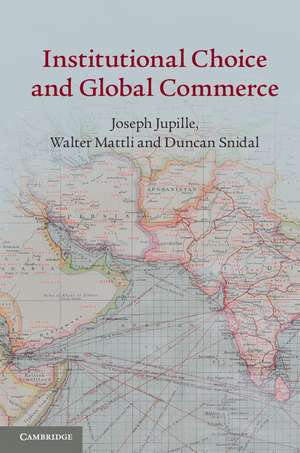
Institutional Choice and Global Commerce
Autor Joseph Jupille, Walter Mattli, Duncan Snidalen Limba Engleză Paperback – 29 aug 2013
Această monografie publicată de Cambridge University Press reprezintă o contribuție esențială la studiul economiei politice internaționale, propunând un cadru analitic inovator pentru înțelegerea modului în care statele interacționează cu structurile de guvernanță globală. Observăm că autorii Joseph Jupille, Walter Mattli și Duncan Snidal se distanțează de modelele simpliste ale alegerii raționale, introducând conceptul de raționalitate limitată pentru a explica patru acțiuni strategice fundamentale: utilizarea instituțiilor existente, selecția între forumuri alternative, modificarea regulilor actuale sau crearea unor aranjamente noi (modelul USCC). Descoperim aici o analiză istorică vastă, ce pornește de la înființarea Curților Mixte din Egipt în 1876 — primul sistem internațional de rezoluție a disputelor comerciale — și ajunge până la funcționarea World Trade Organization (WTO) și a Consiliului pentru Standarde Internaționale de Contabilitate (IASB). Lucrarea acoperă aceeași arie tematică precum Institutions and the Path to the Modern Economy de Avner Greif, însă Institutional Choice and Global Commerce oferă o abordare mai aplicată pe mecanismele decizionale imediate ale statelor, spre deosebire de focusul lui Greif pe originile istorice profunde. De asemenea, volumul completează perspectivele din Between Interests and Law de Thomas Hale, oferind un cadru teoretic mai riguros pentru diversitatea formelor instituționale. Structura este organizată logic în trei părți: prima definește strategiile de cooperare și alternativele instituționale, a doua explorează cazuri empirice de complexitate comercială și guvernanță contabilă, iar ultima parte compară teoria propusă cu alte modele instituționale consacrate. Prin integrarea a 10 ilustrații și 8 tabele, textul devine un instrument de lucru precis pentru cercetătorii care doresc să înțeleagă de ce anumite instituții persistă în timp ce altele sunt abandonate sau reformate.
Preț: 187.05 lei
Preț vechi: 233.27 lei
-20%
Carte indisponibilă temporar
Specificații
ISBN-10: 1107645921
Pagini: 265
Ilustrații: 10 b/w illus. 8 tables
Dimensiuni: 152 x 226 x 13 mm
Greutate: 0.44 kg
Ediția:New.
Editura: Cambridge University Press
Locul publicării:New York, United States
V-ar putea interesa
-
 A New English Translation of the SeptuagintAlbert PietersmaPreț: 311.84 lei
 -
 -28%Preț: 441.01 lei614.02 lei
 -
 The Oxford Handbook of International RelationsChristian Reus-Smit-16%Preț: 317.62 lei376.60 lei
 -
 -28%Preț: 387.33 lei539.15 lei
 -
 Genesis for EveryoneJohn GoldingayPreț: 86.04 lei
 -
 Psalms for Everyone: Part 1 – Psalms 1–72John GoldingayPreț: 85.13 lei
 -
 Sarah LaughedTrevor DennisPreț: 101.12 lei
 -
 The Theology of the Book of GenesisR. W. L. MoberlyPreț: 245.57 lei
 -
 Life in the Psalms: Contemporary Meaning in Ancient Texts: The Mowbray Lent Book 2016(The Revd Canon) Patrick Woodhouse-40%Preț: 84.83 lei140.93 lei
 -
 Esther: A Handbook on the Hebrew TextJohn ScrenockPreț: 351.97 lei
De ce să citești această carte
Cartea se adresează specialiștilor în relații internaționale, economiștilor și celor interesați de dreptul comercial internațional. Cititorul câștigă o înțelegere profundă a modelului USCC, un instrument teoretic ce explică logic de ce statele preferă adesea să repare „nava lui Tezeu” — instituțiile existente — în loc să construiască altele noi. Este o resursă fundamentală pentru a descifra dinamica din spatele organizațiilor care guvernează astăzi comerțul mondial.
Despre autor
Joseph Jupille este profesor asociat de științe politice la University of Colorado, Boulder. Lucrarea de față se înscrie organic în traiectoria sa academică, fiind o rafinare a temelor explorate în volumele anterioare, precum Theories of Institutions, unde a cartografiat diversitatea aranjamentelor sociale. Dacă în Procedural Politics s-a aplecat asupra modului în care actorii se raportează la regulile din interiorul Uniunii Europene, în acest volum extinde analiza la nivel global, colaborând cu Walter Mattli și Duncan Snidal pentru a oferi o viziune sistemică asupra alegerii instituționale.
Descriere scurtă
Cuprins
Recenzii
'Jupille, Mattli and Snidal provide us with one of the most cogent and comprehensive accounts of institutional choice and change to date. Melding together historical institutionalism with more rationalist accounts of politics, the book explains why institutional reform is difficult and should not be expected under 'normal' conditions. This is critical reading for all scholars of international relations.' Judith Goldstein, Janet Peck Professor of International Communication and Professor of Political Science, Stanford University
'The authors provide a novel theoretical approach to a world of proliferating international institutions that frequently underperform. They illuminate institutional creation, persistence, and change in the face of a constantly evolving global agenda.' Miles Kahler, University of California, San Diego
'In this interesting and rich new book, Jupille, Mattli and Snidal stake out a theoretically-principled approach to international institutions between pure rational design and pure path-dependency. In their theory, actors are boundedly rational and usually rely on existing institutions or modify them slightly, even when the institutions are suboptimal. But, as the authors show, there are specific, predictable circumstances when they will try to craft new institutions to meet new problems. This clear, readable analysis weaves together theory and empirical tests to shed new light on why institutions persist, why new ones are built, and how states select and use international institutions.' Charles Lipson, Peter B. Ritzma Professor in Political Science, University of Chicago