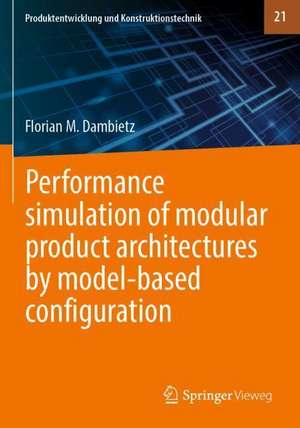
Performance simulation of modular product architectures by model-based configuration: Produktentwicklung und Konstruktionstechnik, cartea 21
Autor Florian M. Dambietzen Limba Engleză Paperback – 2 oct 2022







Preț: 944.62 lei
Preț vechi: 1151.98 lei
-18%
Puncte Express: 1417
Carte tipărită la comandă
Livrare economică 04-18 decembrie
Livrare prin curier în România Termenul estimat este afișat lângă disponibilitate.
Transport gratuit pentru acest produs Plată online sau ramburs, în funcție de opțiunile comenzii.
Retur gratuit în 14 zile Comandă securizată și suport în română.
Specificații
ISBN-13: 9783662642351
ISBN-10: 3662642352
Pagini: 196
Ilustrații: XIV, 179 p. 96 illus., 86 illus. in color.
Dimensiuni: 168 x 240 x 11 mm
Greutate: 0.32 kg
Ediția:1st ed. 2022
Editura: Springer
Colecția Produktentwicklung und Konstruktionstechnik
Seria Produktentwicklung und Konstruktionstechnik
Locul publicării:Berlin, Heidelberg, Germany
ISBN-10: 3662642352
Pagini: 196
Ilustrații: XIV, 179 p. 96 illus., 86 illus. in color.
Dimensiuni: 168 x 240 x 11 mm
Greutate: 0.32 kg
Ediția:1st ed. 2022
Editura: Springer
Colecția Produktentwicklung und Konstruktionstechnik
Seria Produktentwicklung und Konstruktionstechnik
Locul publicării:Berlin, Heidelberg, Germany
V-ar putea interesa
-
 Software Architecture in PracticeLen Bass-20%Preț: 394.59 lei493.24 lei
 -
 SimulationSheldon M. Ross-32%Preț: 510.77 lei749.22 lei
 -
 Computational Intelligence in Design and ManufacturingAndrew Kusiak-14%Preț: 931.37 lei1082.98 lei
 -
 Model-Based Product Line Engineering (Mbple)Marco Forlingieri-20%Preț: 812.13 lei1015.16 lei
 -
 Barry's Construction TechnologyStephen EmmittPreț: 379.66 lei
 -
 -20%Preț: 432.49 lei540.61 lei
 -
 Parametric Design for ArchitectureWassim Jabi-26%Preț: 229.91 lei309.66 lei
 -
 -24%Preț: 385.00 lei508.60 lei
 -
 Production SchedulingPierre Lopez-14%Preț: 1212.96 lei1410.42 lei
 -
 -15%Preț: 668.91 lei786.95 lei
 -
 Components Operationally: Reversibility and System EngineeringClaudio Antares Mezzina-20%Preț: 389.32 lei486.66 lei
 -
 -20%Preț: 318.67 lei398.33 lei
 -
 Methodical Development of Modular Product FamiliesDieter Krause-15%Preț: 701.31 lei825.06 lei
 -
 Bottleneck Just-in-Time SequencingChudamani PoudyalPreț: 372.79 lei
 -
 Prefab and ModularGestaltenPreț: 356.75 lei
 -
 Designed to StayGestalten-8%Preț: 440.08 lei478.35 lei
 -
 Building Model-based Enterprise ArchitectureMudar Bahri-20%Preț: 241.80 lei302.25 lei
Cuprins
Introduction.- Challenges in modular product architecture alternative decisions.- State of the art.- Simulation approach for the performance analysis of modular product architectures.- Validation of the methods.- Conclusion and outlook.
Textul de pe ultima copertă
The use of modular product architectures can significantly increase the efficiency in manufacturing companies. Various modularization methods are used in the development of these architectures, but they always result in different architecture alternatives. This thesis describes the development of a model-based simulation for multi-dimensional performance assessment of these architecture alternatives with their corresponding modular kits. The central element of this simulation is formed by a model-based configuration system, identifying individually valid product variants using concepts and tools of Model-based-systems-engineering (MBSE). Based on the developed Hyperspace algorithm, a geometric-mathematical solution approach, these variants are then evaluated considering multiple parameters. By recursively configuring multiple customer requests using alternative modular kits, an individual performance criterion of these alternatives can be generated, including customer-, market- and company parameters. This thesis describes the development of the performance simulation on the basis of a simplified explanation example. A validation based on customer-specific laser welding systems is also shown.
The author
Dipl.-Wirtsch.-Ing. Florian M. Dambietz studied Business Administration and Engineering with a specialization in mechanical engineering and management at the Friedrich-Alexander-Universität Erlangen-Nürnberg (FAU). He then began working in the areas of technical sales and complexity management at a special equipment manufacturing company for laser machine systems in 2018. He has continued his employment there as Head of Research and Development since 2020. In the period from 2018 to 2021, he dealt with the topics of variant management, Model-based systems engineering and the development of a model-based product configurator as part of his company-related doctorate at the Institute for Product Development and Mechanical Engineering Design (PKT) at the Hamburg University of Technology (TUHH).
Caracteristici
Provides a multi-dimensional simulation for the early-stage performance assessment Develops a dynamically adaptable product configuration system for complex product architectures Implements the modelling of modular product architectures using concepts of MBSE