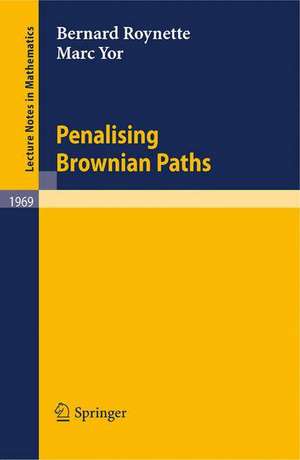
Penalising Brownian Paths: Lecture Notes in Mathematics, cartea 1969
Autor Bernard Roynette, Marc Yoren Limba Engleză Paperback – 25 mar 2009
Din seria Lecture Notes in Mathematics
-
 Preț: 340.60 lei
 -
 Preț: 429.99 lei
 - 17%
 Preț: 404.51 lei
 -
 Preț: 443.63 lei
 - 17%
 Preț: 409.79 lei
 -
 Preț: 500.22 lei
 - 17%
 Preț: 411.39 lei
 - 17%
 Preț: 485.60 lei
 - 17%
 Preț: 486.74 lei
 -
 Preț: 266.56 lei
 -
 Preț: 404.87 lei
 -
 Preț: 335.43 lei
 -
 Preț: 262.16 lei
 -
 Preț: 315.67 lei
 -
 Preț: 392.84 lei
 -
 Preț: 408.44 lei
 -
 Preț: 410.84 lei
 -
 Preț: 315.87 lei
 -
 Preț: 405.97 lei
 -
 Preț: 313.49 lei
 -
 Preț: 318.08 lei
 -
 Preț: 389.30 lei
 -
 Preț: 411.74 lei
 -
 Preț: 350.23 lei
 -
 Preț: 390.96 lei
 -
 Preț: 267.53 lei
 - 20%
 Preț: 471.32 lei
 -
 Preț: 464.87 lei
 -
 Preț: 464.67 lei
 - 15%
 Preț: 481.85 lei
 -
 Preț: 410.48 lei
 -
 Preț: 468.94 lei
 -
 Preț: 262.84 lei
 -
 Preț: 327.35 lei
 -
 Preț: 407.65 lei
 -
 Preț: 322.53 lei
 -
 Preț: 217.70 lei
 -
 Preț: 500.82 lei
 -
 Preț: 400.49 lei
 -
 Preț: 373.93 lei
 -
 Preț: 337.06 lei
 - 15%
 Preț: 573.68 lei
 -
 Preț: 266.72 lei
 -
 Preț: 360.44 lei
 -
 Preț: 405.97 lei
 -
 Preț: 177.34 lei
 -
 Preț: 409.69 lei
 -
 Preț: 468.94 lei
 -
 Preț: 386.51 lei
 -
 Preț: 316.78 lei
Preț: 390.96 lei
Puncte Express: 586
Carte tipărită la comandă
Livrare economică 28 noiembrie-12 decembrie
Livrare prin curier în România Termenul estimat este afișat lângă disponibilitate.
Transport gratuit de la 400.00 lei Plată online sau ramburs, în funcție de opțiunile comenzii.
Retur gratuit în 14 zile Comandă securizată și suport în română.
Specificații
ISBN-13: 9783540896982
ISBN-10: 3540896988
Pagini: 296
Ilustrații: XIII, 275 p.
Dimensiuni: 155 x 235 x 17 mm
Greutate: 0.45 kg
Ediția:2009
Editura: Springer
Colecția Lecture Notes in Mathematics
Seria Lecture Notes in Mathematics
Locul publicării:Berlin, Heidelberg, Germany
ISBN-10: 3540896988
Pagini: 296
Ilustrații: XIII, 275 p.
Dimensiuni: 155 x 235 x 17 mm
Greutate: 0.45 kg
Ediția:2009
Editura: Springer
Colecția Lecture Notes in Mathematics
Seria Lecture Notes in Mathematics
Locul publicării:Berlin, Heidelberg, Germany
V-ar putea interesa
-
 -33%Preț: 791.90 lei1173.91 lei
 -
 The Oxford Dictionary of Statistical TermsYadolah Dodge-18%Preț: 361.27 lei440.83 lei
 -
 Bayesian Statistics 8J. M. Bernardo-31%Preț: 784.33 lei1129.94 lei
 -
 Spatial Statistics and ModelingCarlo Gaetan-18%Preț: 1156.33 lei1410.17 lei
 -
 An Introduction to the BootstrapBradley Efron-9%Preț: 1354.26 lei1488.19 lei
 -
 Probability with MartingalesDavid WilliamsPreț: 369.73 lei
 -
 New Camb Statistical Tables 2edD. V. LindleyPreț: 138.38 lei
 -
 Asymptotic StatisticsA. W. Van Der Vaart-11%Preț: 483.13 lei542.85 lei
 -
 -11%Preț: 645.38 lei725.14 lei
 -
 Exercises in ProbabilityL. Chaumont-11%Preț: 442.31 lei496.98 lei
 -
 S ProgrammingWilliam Venables-15%Preț: 699.21 lei822.60 lei
 -
 Biostatistics with RBabak Shahbaba-5%Preț: 597.09 lei628.52 lei
 -
 -18%Preț: 788.11 lei961.10 lei
 -
 Laws of Small Numbers: Extremes and Rare EventsMichael Falk-18%Preț: 799.54 lei975.06 lei
 -
 -18%Preț: 846.49 lei1032.30 lei
Public țintă
ResearchCuprins
Some penalisations of theWiener measure.- Feynman-Kac penalisations for Brownian motion.- Penalisations of a Bessel process with dimension d(0 d 2) by a function of the ranked lengths of its excursions.- A general principle and some questions about penalisations.
Recenzii
From the reviews:“In this book the authors give a systematic study of penalisation. The book is divided into 5 chapters. … This book is very useful for graduate students and researchers interested in learning penalisations.” (Ren Ming Song, Mathematical Reviews, Issue 2010 e)
Textul de pe ultima copertă
Penalising a process is to modify its distribution with a limiting procedure, thus defining a new process whose properties differ somewhat from those of the original one.
We are presenting a number of examples of such penalisations in the Brownian and Bessel processes framework. The Martingale theory plays a crucial role.
A general principle for penalisation emerges from these examples. In particular, it is shown in the Brownian framework that a positive sigma-finite measure takes a large class of penalisations into account.
We are presenting a number of examples of such penalisations in the Brownian and Bessel processes framework. The Martingale theory plays a crucial role.
A general principle for penalisation emerges from these examples. In particular, it is shown in the Brownian framework that a positive sigma-finite measure takes a large class of penalisations into account.