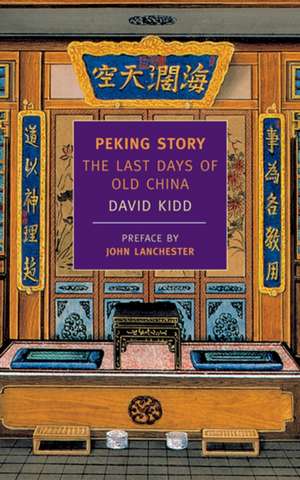
Peking Story
Autor David Kidden Limba Engleză Paperback – 31 iul 2003
Preț: 83.89 lei
Preț vechi: 136.79 lei
-39%
Puncte Express: 126
Disponibilitate incertă
Doresc să fiu notificat când acest titlu va fi disponibil:
Se trimite...
Specificații
ISBN-13: 9781590170403
ISBN-10: 1590170407
Pagini: 183
Dimensiuni: 128 x 204 x 13 mm
Greutate: 0.21 kg
Editura: NEW YORK REVIEW OF BOOKS
ISBN-10: 1590170407
Pagini: 183
Dimensiuni: 128 x 204 x 13 mm
Greutate: 0.21 kg
Editura: NEW YORK REVIEW OF BOOKS
V-ar putea interesa
-
 Historia de la Marina de ChileCarlos López UrrutiaPreț: 294.68 lei
 -
 Journey into the Mind's EyeLesley Blanch-18%Preț: 88.70 lei107.81 lei
 -
 WarriorsGerald Hanley-19%Preț: 80.33 lei99.17 lei
 -
 Skeptics vs. Scripture Book IDavid KiddPreț: 153.80 lei
 -
 My Dog TulipJ. R. AckerleyPreț: 84.78 lei
 -
 The Fall and Rise of Christian StandardsDavid KiddPreț: 102.94 lei
 -
 The Last Time I Saw ParisElliot PaulPreț: 89.97 leiNou
 -
 Birds of PassageNancy Shields-37%Preț: 76.97 lei121.61 lei
 -
 Forgotten KingdomPeter Goullart-19%Preț: 87.19 lei107.31 lei
 -
 Hermit of PekingHugh Trevor-RoperPreț: 137.20 lei
 -
 Manchu DecadenceEdmund BackhousePreț: 132.97 lei
Notă biografică
David Kidd (1926ߝ1996) was born in Corbin, Kentucky to a coal-mining community. He later grew up in Detroit, where his father became an executive in the automotive industry. In 1946, at age nineteen, Kidd made his first trip to Peking as a University of Michigan exchange student with one idea in mind: to get as far away from home as possible. He spent the next four years teaching English in the Peking suburbs. During this time, he married the daughter of a former Chief Justice of the Supreme Court, moving into her family’s 101-room palace, where he had a uniquely intimate view of the Communist takeover. His account of his experiences was serialized in The New Yorker and published in book-form as All the Emperor’s Horses in 1960, later retitled Peking Story: The Last Days of Old China. He returned to the US in 1950 and taught at the Asia Institute until 1956, when he moved to Japan. There he continued to work as a lecturer, became a devoted collector of Chinese and Japanese art and antiquities, and, in 1976, founded the Oomoto School of Traditional Japanese Arts in Kyoto. He lived in Kyoto until his death of cancer at age sixty-nine.
Recenzii
Kidd’s pieces have been a double illumination. Their intimate domestic lanterns shed light on the dark side of the moon and, exotic and informational interest aside, glow in their own skins, as art. They are simple, graceful, comic, mournful miniatures of an ominous catastrophe, the unprecedently swift death of a uniquely ancient civilization.
— John Updike
In the reader’s eye, Kidd’s story wavers between fact and fiction. It seems too good to be true, like the perfectly woven family sagas common to the great Chinese novels and Victorian fiction. But the climax, the unwritten final chapter of Peking Story, is firmly written in fact: the crumbling of an empire 4000 years old. To achieve this effect in less than 200 pages is astounding.
— Alberto Manguel
— John Updike
In the reader’s eye, Kidd’s story wavers between fact and fiction. It seems too good to be true, like the perfectly woven family sagas common to the great Chinese novels and Victorian fiction. But the climax, the unwritten final chapter of Peking Story, is firmly written in fact: the crumbling of an empire 4000 years old. To achieve this effect in less than 200 pages is astounding.
— Alberto Manguel
Descriere
Descriere de la o altă ediție sau format:
A haunting and delicately observed description of the last days of Mandarin culture before the revolution. This book is a testimony to a way of life, a culture, an aesthetic and a civilisation which has since completely disappeared.
A haunting and delicately observed description of the last days of Mandarin culture before the revolution. This book is a testimony to a way of life, a culture, an aesthetic and a civilisation which has since completely disappeared.