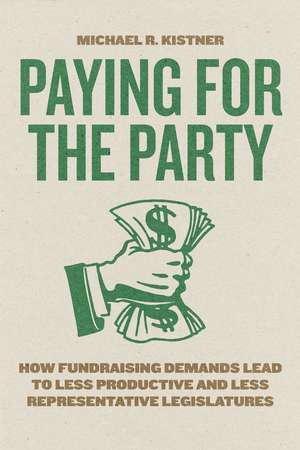
Paying for the Party: How Fundraising Demands Lead to Less Productive and Less Representative Legislatures: Chicago Studies in American Politics
Autor Michael R. Kistneren Limba Engleză Paperback – 19 iun 2026
Lawmakers in Congress and state legislatures across the United States spend enormous amounts of time and effort fundraising, not just for their own seats but for the party. Whether dialing for dollars or hosting high-priced fundraising events, the pursuit of campaign funds is now a massive part of the American legislator’s job description. What explains this transformation, and what are the consequences for public policy?
In Paying for the Party, Michael Kistner uses new theory and new data to answer these questions. He shows that state legislative party organizations—Democratic and Republican caucuses in capitols across the country—are responsible for turning their members into single-minded seekers of money. Parties reward legislators who contribute the most with powerful leadership and committee positions. Consequently, the members who now hold these agenda-setting positions are increasingly neither the most productive nor knowledgeable lawmakers, but rather those who can raise the most money. And when legislators are asked to raise more money, they skip committee hearings for fundraising events, enacting fewer substantive policies as a result. Paying for the Party shows that parties in contemporary American legislatures have hollowed out the policymaking capacity of their institutions and empowered a decidedly non-representative set of legislators.
| Toate formatele și edițiile | Preț | Express |
|---|---|---|
| Paperback (1) | 215.70 lei Precomandă | |
| University of Chicago Press – 19 iun 2026 | 215.70 lei Precomandă | |
| Hardback (1) | 627.98 lei Precomandă | |
| University of Chicago Press – 19 iun 2026 | 627.98 lei Precomandă |
Din seria Chicago Studies in American Politics
-
 Preț: 217.06 lei
 -
 Preț: 257.74 lei
 -
 Preț: 167.77 lei
 -
 Preț: 215.35 lei
 -
 Preț: 231.67 lei
 -
 Preț: 216.28 lei
 -
 Preț: 217.28 lei
 -
 Preț: 201.64 lei
 -
 Preț: 216.28 lei
 -
 Preț: 199.36 lei
 -
 Preț: 199.67 lei
 -
 Preț: 215.77 lei
 -
 Preț: 202.58 lei
 -
 Preț: 174.47 lei
 -
 Preț: 175.86 lei
 -
 Preț: 200.07 lei
 -
 Preț: 199.41 lei
 -
 Preț: 216.75 lei
 -
 Preț: 215.66 lei
 -
 Preț: 150.41 lei
 -
 Preț: 215.86 lei
 -
 Preț: 226.11 lei
 -
 Preț: 258.08 lei
 -
 Preț: 216.64 lei
 -
 Preț: 215.97 lei
 -
 Preț: 177.67 lei
 -
 Preț: 200.33 lei
 -
 Preț: 199.36 lei
 -
 Preț: 235.12 lei
 -
 Preț: 251.99 lei
 -
 Preț: 253.78 lei
 -
 Preț: 225.05 lei
 -
 Preț: 210.15 lei
 -
 Preț: 136.84 lei
 - 23%
 Preț: 649.82 lei
 - 23%
 Preț: 548.01 lei
 - 23%
 Preț: 559.78 lei
 - 23%
 Preț: 558.05 lei
 -
 Preț: 475.52 lei
 -
 Preț: 236.23 lei
 -
 Preț: 239.79 lei
 -
 Preț: 254.89 lei
 -
 Preț: 220.56 lei
Preț: 215.70 lei
Precomandă
Puncte Express: 324
Preț estimativ în valută:
38.17€ • 44.76$ • 33.52£
38.17€ • 44.76$ • 33.52£
Carte nepublicată încă
Doresc să fiu notificat când acest titlu va fi disponibil:
Se trimite...
Preluare comenzi: 021 569.72.76
Specificații
ISBN-13: 9780226850221
ISBN-10: 0226850226
Pagini: 208
Ilustrații: 24 halftones, 4 line drawings, 11 tables
Dimensiuni: 152 x 229 mm
Greutate: 0.45 kg
Ediția:First Edition
Editura: University of Chicago Press
Colecția University of Chicago Press
Seria Chicago Studies in American Politics
ISBN-10: 0226850226
Pagini: 208
Ilustrații: 24 halftones, 4 line drawings, 11 tables
Dimensiuni: 152 x 229 mm
Greutate: 0.45 kg
Ediția:First Edition
Editura: University of Chicago Press
Colecția University of Chicago Press
Seria Chicago Studies in American Politics
Notă biografică
Michael Kistner is assistant professor of political science at the University of Houston. His research has appeared in The Journal of Politics, The Quarterly Journal of Political Science, and The Journal of Political Institutions and Political Economy.
Cuprins
List of Illustrations
1. Introduction: The New Money Race
Part I: Explaining Party Fundraising
2. A Theory of Party Fundraising
3. Party Fundraising in the States
4. Who Gives, and Why?
Part II: The Consequences of Party Fundraising
5. A Theory of Fundraising and Policymaking
6. Fundraising Demands and Policy Productivity
7. Fundraising Demands and Descriptive Representation
Part III: Conclusion
8. The Future of Party Fundraising
Acknowledgments
Notes
Bibliography
Index
1. Introduction: The New Money Race
Part I: Explaining Party Fundraising
2. A Theory of Party Fundraising
3. Party Fundraising in the States
4. Who Gives, and Why?
Part II: The Consequences of Party Fundraising
5. A Theory of Fundraising and Policymaking
6. Fundraising Demands and Policy Productivity
7. Fundraising Demands and Descriptive Representation
Part III: Conclusion
8. The Future of Party Fundraising
Acknowledgments
Notes
Bibliography
Index
Recenzii
“Paying for the Party is a highly original work of top-rate scholarship that explores essential questions: Why do legislators spend so much time and effort fundraising for the party? How has the rise of fundraising demands for the party shaped American politics? Michael Kistner’s findings are critical for understanding political representation.”
“Paying for the Party is political science at its best: earnest, rigorous, and focused on real, substantive issues. Kistner grapples with how state legislatures have transformed into fundraising machines, where climbing the political ladder increasingly requires raising cash for the party. Readers will gain a vital new understanding of why these crucial policymaking bodies are changing—and what it may mean for our political future.”
“Paying for the Party is political science at its best: earnest, rigorous, and focused on real, substantive issues. Kistner grapples with how state legislatures have transformed into fundraising machines, where climbing the political ladder increasingly requires raising cash for the party. Readers will gain a vital new understanding of why these crucial policymaking bodies are changing—and what it may mean for our political future.”