
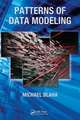
Patterns of Data Modeling: Emerging Directions in Database Systems and Applications
Autor Michael Blahaen Limba Engleză Hardback – 27 iul 2017
| Toate formatele și edițiile | Preț | Express |
|---|---|---|
| Paperback (1) | 422.61 lei 6-8 săpt. | |
| CRC Press – iun 2010 | 422.61 lei 6-8 săpt. | |
| Hardback (1) | 1363.47 lei 6-8 săpt. | |
| CRC Press – 27 iul 2017 | 1363.47 lei 6-8 săpt. |



Preț: 1363.47 lei
Preț vechi: 1704.34 lei
-20%
Puncte Express: 2045
Preț estimativ în valută:
240.91€ • 276.26$ • 209.08£
240.91€ • 276.26$ • 209.08£
Carte tipărită la comandă
Livrare economică 14-28 mai
Specificații
ISBN-13: 9781138402232
ISBN-10: 1138402230
Pagini: 266
Dimensiuni: 156 x 234 mm
Greutate: 0.55 kg
Ediția:1
Editura: CRC Press
Colecția CRC Press
Seria Emerging Directions in Database Systems and Applications
ISBN-10: 1138402230
Pagini: 266
Dimensiuni: 156 x 234 mm
Greutate: 0.55 kg
Ediția:1
Editura: CRC Press
Colecția CRC Press
Seria Emerging Directions in Database Systems and Applications
V-ar putea interesa
-
 Advances in Machine Learning and Data Mining for AstronomyMichael J. Way-20%Preț: 425.30 lei531.62 lei
 -
 Data Mining for Design and MarketingYukio Ohsawa-20%Preț: 1556.31 lei1945.39 lei
 -
 Next Generation of Data MiningHillol Kargupta-20%Preț: 1079.96 lei1349.95 lei
 -
 Statistical Data Mining Using SAS ApplicationsGeorge Fernandez-18%Preț: 1077.45 lei1313.96 lei
 -
 Knowledge Discovery from Data StreamsJoao Gama-20%Preț: 685.11 lei856.39 lei
 -
 -18%Preț: 854.91 lei1042.58 lei
 -
 Linked Data: A Geographic PerspectiveGlen Hart-18%Preț: 1200.65 lei1464.21 lei
 -
 Manifold Learning Theory and ApplicationsYunqian Ma-20%Preț: 1125.12 lei1406.40 lei
 -
 Computational Business AnalyticsSubrata Das-20%Preț: 1061.75 lei1327.18 lei
 -
 Mining User Generated ContentMarie-Francine Moens-20%Preț: 1016.56 lei1270.71 lei
 -
 Data Clustering: Algorithms and ApplicationsCharu C. Aggarwal-9%Preț: 1021.85 lei1122.92 lei
 -
 Applied Data MiningGuandong Xu-20%Preț: 928.69 lei1160.86 lei
 -
 -15%Preț: 650.25 lei765.00 lei
 -
 -20%Preț: 731.51 lei914.38 lei
 -
 The Data Book: Collection and Management of Research DataMeredith Zozus-15%Preț: 659.66 lei776.08 lei
 -
 UML Database Modeling WorkbookMichael Blaha-20%Preț: 187.19 lei233.99 lei
 -
 Cluster Analysis and Data MiningRonald S. King-20%Preț: 275.38 lei344.22 lei
 -
 Smart Systems for E-HealthHanen Idoudi-5%Preț: 1242.29 lei1307.67 lei
 -
 Business Information SystemsWitold Abramowicz-20%Preț: 328.24 lei410.30 lei
 -
 -20%Preț: 300.06 lei375.07 lei
 -
 Data-Driven Process Discovery and AnalysisPaolo Ceravolo-20%Preț: 314.60 lei393.25 lei
 -
 The Data Science Design ManualSteven S. Skiena-20%Preț: 398.51 lei498.15 lei
Public țintă
Professional Practice & DevelopmentRecenzii
Patterns of Data Modeling should be on the shelf of every database, software, and systems architect. The book captures decades of experience, presenting distilled knowledge in a concise and easy-to-understand format. The breadth of coverage is enormous, ranging from basic data structures through star schema, archetypes for representing commonly found concepts, and canonical models for tough problems.
—Paul C. Brown, Principal Software Architect, TIBCO Software Inc.
Mike Blaha has written a clear book with precise definitions and excellent examples. All examples are presented in a graphical form that is easy to read and understand. Blaha assumes the reader has a basic understanding of data modeling, but gives his examples in such a way that if the reader needs some review, it is built in.
—Toby Teorey, author of Database Modeling and Design, Fourth Edition
Also endorsed by the Sparx Systems Enterprise Architect Community
—Paul C. Brown, Principal Software Architect, TIBCO Software Inc.
Mike Blaha has written a clear book with precise definitions and excellent examples. All examples are presented in a graphical form that is easy to read and understand. Blaha assumes the reader has a basic understanding of data modeling, but gives his examples in such a way that if the reader needs some review, it is built in.
—Toby Teorey, author of Database Modeling and Design, Fourth Edition
Also endorsed by the Sparx Systems Enterprise Architect Community
Cuprins
Introduction. Mathematical Templates. Antipatterns. Archetypes. Identity. Canonical Models. Relational Database Design. Appendices.
Notă biografică
Serving as program and conference chair at the Working Conference on Reverse Engineering, Dr. Michael Blaha has authored six U.S. patents, four widely used books, and many papers while giving lectures throughout the world. Since 1994 Dr. Blaha has been a consultant and trainer in conceiving, architecting, modeling, designing, and tuning databases. He has worked with dozens of organizations throughout the world. He received his doctorate from Washington University in St. Louis and is an alumnus of GE Global Research in Schenectady, NY.
Descriere
Offers tried and tested data model patterns, to help readers avoid common modeling mistakes in building effective data models. This book provides advanced techniques for those who have mastered the basics. It focuses on databases rather than programming. It applies the patterns perspective to database systems and data models.