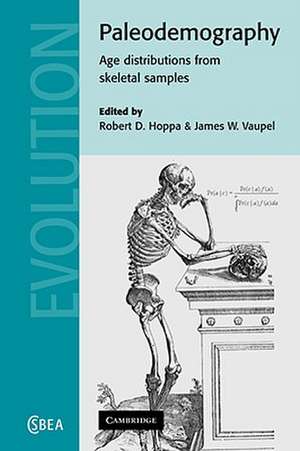
Paleodemography: Age Distributions from Skeletal Samples: Cambridge Studies in Biological and Evolutionary Anthropology, cartea 31
Editat de Robert D. Hoppa, James W. Vaupelen Limba Engleză Paperback – 29 oct 2008
Această monografie de referință, publicată de Cambridge University Press, abordează frontal provocările metodologice ale reconstrucției structurii demografice a populațiilor trecute. Remarcăm efortul editorilor Robert D. Hoppa și James W. Vaupel de a reuni antropologi fizici și statisticieni pentru a chestiona supozițiile care pot introduce erori majore în interpretarea sănătății și bunăstării comunităților arheologice. Structura volumului Paleodemography ghidează cititorul de la fundamentele teoretice ale legăturii dintre morfologia osoasă și vârsta cronologică, până la modele biostatistice complexe de estimare a mortalității.
Reținem precizia cu care sunt tratate limitările eșantioanelor scheletice, oferind soluții pentru validarea datelor care, în mod tradițional, erau susceptibile de subiectivitate. Includerea celor 25 de tabele și 32 de ilustrații facilitează înțelegerea aplicării modelelor matematice pe resturi umane fragmentare. Această lucrare reprezintă o alternativă tehnică riguroasă la Handbook of Palaeodemography de Isabelle Séguy pentru cursurile de antropologie fizică, cu avantajul unei concentrări stricte pe analiza distribuției pe vârste și pe integrarea demografiei matematice în cercetarea arheologică.
În contextul operei editorului, Paleodemography continuă direcția începută de Robert D. Hoppa în Human Growth in the Past. Dacă lucrarea anterioară se concentra pe creșterea și dezvoltarea dentară și scheletică, volumul de față extinde analiza asupra întregului ciclu de viață și a dinamicii populaționale. Este un instrument esențial pentru cercetătorii care caută să depășească simpla descriere a artefactelor umane, vizând o reconstrucție statistică validă a trecutului biologic.
Din seria Cambridge Studies in Biological and Evolutionary Anthropology
- 14%
 Preț: 766.23 lei
 -
 Preț: 437.62 lei
 -
 Preț: 444.32 lei
 -
 Preț: 420.79 lei
 -
 Preț: 446.38 lei
 -
 Preț: 287.80 lei
 -
 Preț: 312.61 lei
 -
 Preț: 376.82 lei
 -
 Preț: 381.40 lei
 -
 Preț: 339.54 lei
 -
 Preț: 430.81 lei
 -
 Preț: 311.51 lei
 -
 Preț: 316.97 lei
 -
 Preț: 363.72 lei
 - 11%
 Preț: 430.20 lei
 -
 Preț: 316.24 lei
 -
 Preț: 323.31 lei
 - 11%
 Preț: 411.17 lei
 -
 Preț: 329.65 lei
 -
 Preț: 443.17 lei
 -
 Preț: 445.05 lei
 - 11%
 Preț: 427.14 lei
 - 11%
 Preț: 458.29 lei
 -
 Preț: 438.43 lei
 -
 Preț: 387.45 lei
 - 23%
 Preț: 732.42 lei
 - 11%
 Preț: 415.27 lei
 - 11%
 Preț: 426.25 lei
 -
 Preț: 324.97 lei
 - 14%
 Preț: 997.56 lei
Preț: 433.60 lei
Carte tipărită la comandă
Livrare economică 20 iunie-04 iulie
Specificații
ISBN-10: 0521089166
Pagini: 276
Ilustrații: 32 b/w illus. 25 tables
Dimensiuni: 152 x 229 x 16 mm
Greutate: 0.41 kg
Editura: Cambridge University Press
Colecția Cambridge University Press
Seria Cambridge Studies in Biological and Evolutionary Anthropology
Locul publicării:Cambridge, United Kingdom
V-ar putea interesa
-
 The Rise And Fall Of The Third ChimpanzeeJared Diamond-20%Preț: 71.22 lei89.10 lei
 -
 Myths and Memories of the NationAnthony D. Smith-20%Preț: 510.84 lei641.39 lei
 -
 Lucy to Language: The Benchmark PapersR. I. M. Dunbar-34%Preț: 818.76 lei1231.43 lei
 -
 Teeth: A Very Short IntroductionPeter S. Ungar-20%Preț: 55.24 lei68.86 lei
 -
 The Menace of Multiculturalism: Trojan Horse in AmericaAlvin J. Schmidt-31%Preț: 389.21 lei562.56 lei
 -
 After Empire: Melancholia or Convivial Culture?Paul GilroyPreț: 375.80 lei
 -
 Dental Functional Morphology: How Teeth WorkPeter W. LucasPreț: 453.16 lei
 -
 Preț: 289.33 lei
 -
 The Human StoryRobin DunbarPreț: 87.90 lei
 -
 The Ethnography of CommunicationMuriel Saville-Troike-8%Preț: 418.67 lei455.08 lei
 -
 A Brief History of DrugsAntonio EscohotadoPreț: 78.52 lei
 -
 Thin on the GroundSteven E Churchill-9%Preț: 913.71 lei1004.07 lei
 -
 A Companion to Forensic AnthropologyDennis DirkmaatPreț: 398.72 lei
 -
 Handbook of EthnographyPaul Atkinson-8%Preț: 619.61 lei673.49 lei
 -
 -23%Preț: 720.29 lei935.44 lei
 -
 Organizational EthnographySierk Ybema-15%Preț: 464.21 lei546.13 lei
De ce să citești această carte
Această carte este indispensabilă pentru antropologi și demografi deoarece oferă un cadru statistic solid pentru a corecta erorile de estimare a vârstei în eșantioanele arheologice. Cititorul câștigă acces la metodologii avansate care transformă resturile scheletice în date demografice fiabile, permițând o înțelegere mai profundă a mortalității și structurii populațiilor vechi prin modele biostatistice verificate.
Despre autor
Robert D. Hoppa este un distins antropolog fizic în cadrul Departamentului de Antropologie de la Universitatea din Manitoba. Interesele sale de cercetare sunt vaste, acoperind demografia istorică, epidemiologia, biologia scheletului uman și antropologia judiciară. Experiența sa în studiul creșterii umane prin analiza oaselor și a dinților a fost consolidată anterior prin co-editarea volumului Human Growth in the Past (1999). În lucrarea de față, el își folosește expertiza pentru a rafina metodele de reconstrucție demografică, fiind o figură centrală în dialogul dintre antropologia biologică și statistică.
Descriere scurtă
Cuprins
Recenzii
Review of the hardback: 'Paleodemography has a checkered history and this book will mark a milepost.' American Journal of Human Biology
Review of the hardback: 'There are many excellent aspects of this well-produced book, not least the standardisation of terminology and notation across the contributions which makes the statistical reasoning less impenetrable than would otherwise be the case.' Journal of Human Evolution
Review of the hardback: 'In sum, palaodemographers, skeletal biologists, forensic anthropologists, bioarchaeologists, as well as archaeologists will find Paleodemography an important resource.' Society for Archaeological Sciences Bulletin
Review of the hardback: '… essential for everyone with an interest in palaeodemography, including researchers and graduate students in biological anthropology, palaeopathology and biostatistics.' Annals of Human Biology
'This very important book is an essential reference for anyone attempting to estimate demographic parameters through the study of human remains. … this volume is a carefully crafted contribution to palaeodemography, focused upon methodological concerns. Essential for practitioners, its contents should also appeal to a broader scientific community, including statisticians, demographers and evolutionary biologists.' Antiquity