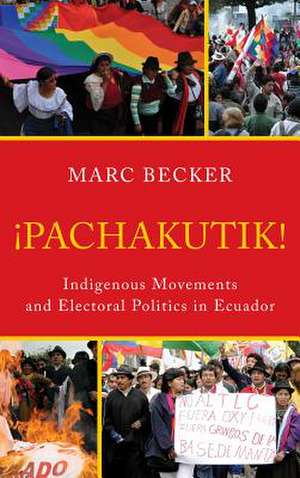
Pachakutik: Indigenous Movements and Electoral Politics in Ecuador: Critical Currents in Latin American Perspective Series
Autor Marc Beckeren Limba Engleză Paperback – 3 oct 2012




Preț: 316.43 lei
Preț vechi: 408.36 lei
-23%
Puncte Express: 475
Carte tipărită la comandă
Livrare economică 07-21 noiembrie
Livrare prin curier în România Termenul estimat este afișat lângă disponibilitate.
Transport gratuit de la 400.00 lei Plată online sau ramburs, în funcție de opțiunile comenzii.
Retur gratuit în 14 zile Comandă securizată și suport în română.
Specificații
ISBN-13: 9781442207547
ISBN-10: 144220754X
Pagini: 292
Dimensiuni: 153 x 225 x 22 mm
Greutate: 0.44 kg
Ediția:Updated
Editura: Bloomsbury Publishing
Colecția Rowman & Littlefield
Seria Critical Currents in Latin American Perspective Series
Locul publicării:New York, United States
ISBN-10: 144220754X
Pagini: 292
Dimensiuni: 153 x 225 x 22 mm
Greutate: 0.44 kg
Ediția:Updated
Editura: Bloomsbury Publishing
Colecția Rowman & Littlefield
Seria Critical Currents in Latin American Perspective Series
Locul publicării:New York, United States
Descriere
This authoritative book provides a deeply informed overview of one of the most dynamic social movements in Latin America. Focusing on contemporary Indigenous movements in Ecuador, leading scholar Marc Becker traces the growing influence of the Confederation of Indigenous Nationalities of Ecuador (CONAIE), which in 1990 led a powerful uprising that dramatically placed a struggle for Indigenous rights at the center of public consciousness. Activists began to refer to this uprising as a "pachakutik," a Kichwa word that means change, rebirth, and transformation, both in the sense of a return in time and the coming of a new era. Five years later, proponents launched a new political movement called Pachakutik to compete for elected office. In 2006, Ecuadorians elected Rafael Correa, who many saw as emblematic of the new Latin American left, to the presidency of the country. Even though CONAIE, Pachakutik, and Correa shared similar concerns for social justice, they soon came into conflict with each other.
Becker examines the competing strategies and philosophies that emerge when social movements and political parties embrace comparable visions but follow different paths to realize their objectives. In exploring the multiple and conflictive strategies that Indigenous movements have followed over the past twenty years, he definitively documents the recent history and charts the trajectory of one of the Americas' most powerful and best organized social movements.
Becker examines the competing strategies and philosophies that emerge when social movements and political parties embrace comparable visions but follow different paths to realize their objectives. In exploring the multiple and conflictive strategies that Indigenous movements have followed over the past twenty years, he definitively documents the recent history and charts the trajectory of one of the Americas' most powerful and best organized social movements.
Cuprins
Chapter 1: The Politicization of Indigenous Identities
Chapter 2: Uprisings
Chapter 3: The Emergence of an Electoral Option
Chapter 4: The Last Coup of the Twentieth Century
Chapter 5: Indians in Power
Chapter 6: A Citizens' Revolution
Chapter 7: Rewriting the Constitution . . . Again
Chapter 8: 2009 Elections
Chapter 9: Social Movements and Electoral Politics
Bibliography
Chapter 2: Uprisings
Chapter 3: The Emergence of an Electoral Option
Chapter 4: The Last Coup of the Twentieth Century
Chapter 5: Indians in Power
Chapter 6: A Citizens' Revolution
Chapter 7: Rewriting the Constitution . . . Again
Chapter 8: 2009 Elections
Chapter 9: Social Movements and Electoral Politics
Bibliography
Recenzii
This is a terrific book! Beyond an excellent account of Ecuador's recent political history, Becker provides us with the history of a paradox: how the strongest Indigenous movement in the Americas found itself in campaigns and alliances that served to limit and undermine its political influence. Ideal for courses on Latin American politics and social movements, this book offers a provocative cautionary tale about the dangers of social movement success.
Pachakutik, a Quechua Indian term that signifies rebirth and transformation, depicts the struggle of Ecuador's Indigenous movement for equal rights and justice. Becker (Truman State Univ.) writes as an activist who helped the Indigenous movement establish an Internet base and participated in many of the activities he describes. He discusses the political awakening of Indigenous forces in 1990 and their ensuing massive demonstrations in reaction to deepening poverty aggravated by the government's neoliberal economic policies that privatized public resources and functions. Actions such as the blocking of highways put pressure on Ecuadoran governments to change policies, helped bring about the overthrow of two presidents, and compelled presidents to address issues presented by the Indigenous movement. However, tangible benefits to indigenous communities were quite limited. The pachakutik movement also became engaged in electoral politics, with some success in local, regional, and national elections and the gaining of a few government cabinet positions. However, disunity among Indigenous forces and the influence of powerful national and international economic interests limited indigenous gains, leading to disillusionment and the recent decline in the political influence of the indigenous community. Recommended. Upper-division undergraduate, graduate, and research collections.
Becker's rendering of contemporary Ecuadorian politics, Indigenous organizing, and social movements is superb and reflects an insider's knowledge of this country. Moreover, his treatment of the challenges that organizations face when transitioning from social movements to electoral politics makes this book not only ideal for classroom use but also essential reading for those wishing to gain a greater understanding of the recent grassroots democratization campaigns that have reverberated throughout the world.
Becker gives us a vocabulary and an analytic framework with which to track the efforts of Ecuador's Indigenous movement to resume the role of protagonist and transform Ecuador into a place where its peoples live not just better but well.
Pachakutik, a Quechua Indian term that signifies rebirth and transformation, depicts the struggle of Ecuador's Indigenous movement for equal rights and justice. Becker (Truman State Univ.) writes as an activist who helped the Indigenous movement establish an Internet base and participated in many of the activities he describes. He discusses the political awakening of Indigenous forces in 1990 and their ensuing massive demonstrations in reaction to deepening poverty aggravated by the government's neoliberal economic policies that privatized public resources and functions. Actions such as the blocking of highways put pressure on Ecuadoran governments to change policies, helped bring about the overthrow of two presidents, and compelled presidents to address issues presented by the Indigenous movement. However, tangible benefits to indigenous communities were quite limited. The pachakutik movement also became engaged in electoral politics, with some success in local, regional, and national elections and the gaining of a few government cabinet positions. However, disunity among Indigenous forces and the influence of powerful national and international economic interests limited indigenous gains, leading to disillusionment and the recent decline in the political influence of the indigenous community. Recommended. Upper-division undergraduate, graduate, and research collections.
Becker's rendering of contemporary Ecuadorian politics, Indigenous organizing, and social movements is superb and reflects an insider's knowledge of this country. Moreover, his treatment of the challenges that organizations face when transitioning from social movements to electoral politics makes this book not only ideal for classroom use but also essential reading for those wishing to gain a greater understanding of the recent grassroots democratization campaigns that have reverberated throughout the world.
Becker gives us a vocabulary and an analytic framework with which to track the efforts of Ecuador's Indigenous movement to resume the role of protagonist and transform Ecuador into a place where its peoples live not just better but well.