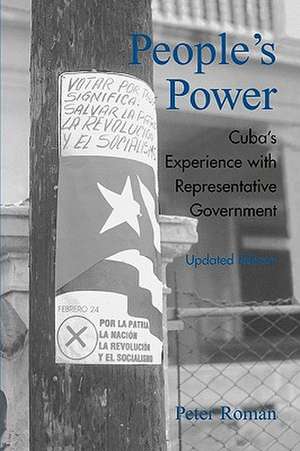
People's Power: Cuba's Experience with Representative Government: Critical Currents in Latin American Perspective Series
Autor Peter Romanen Limba Engleză Paperback – 11 noi 2003
Preț: 374.13 lei
Preț vechi: 553.17 lei
-32%
Puncte Express: 561
Carte tipărită la comandă
Livrare economică 17 noiembrie-01 decembrie
Livrare prin curier în România Termenul estimat este afișat lângă disponibilitate.
Transport gratuit de la 400.00 lei Plată online sau ramburs, în funcție de opțiunile comenzii.
Retur gratuit în 14 zile Comandă securizată și suport în română.
Specificații
ISBN-13: 9780742525658
ISBN-10: 0742525651
Pagini: 312
Dimensiuni: 150 x 229 x 20 mm
Greutate: 0.48 kg
Ediția:Updated
Editura: Bloomsbury Publishing
Colecția Rowman & Littlefield
Seria Critical Currents in Latin American Perspective Series
Locul publicării:New York, United States
ISBN-10: 0742525651
Pagini: 312
Dimensiuni: 150 x 229 x 20 mm
Greutate: 0.48 kg
Ediția:Updated
Editura: Bloomsbury Publishing
Colecția Rowman & Littlefield
Seria Critical Currents in Latin American Perspective Series
Locul publicării:New York, United States
V-ar putea interesa
-
 -21%Preț: 276.81 lei350.79 lei
 -
 -19%Preț: 365.81 lei454.06 lei
 -
 Democratic Accountability in Latin AmericaScott Mainwaring-33%Preț: 709.59 lei1053.46 lei
 -
 -29%Preț: 402.77 lei564.49 lei
 -
 Democracy in Europe: The EU and National PolitiesVivien A. Schmidt-21%Preț: 367.88 lei466.00 lei
 -
 Narrative Politics: Stories and Collective ActionFrederick W. Mayer-31%Preț: 593.23 lei862.00 lei
 -
 -14%Preț: 296.15 lei346.14 lei
 -
 Democracy and Its CriticsRobert A. DahlPreț: 196.30 lei
 -
 Preț: 268.26 lei
 -
 Why Deliberative Democracy?Amy GutmannPreț: 265.21 lei
 -
 Preț: 499.40 lei
 -
 Models of DemocracyDavid HeldPreț: 312.48 lei
 -
 Post-DemocracyColin CrouchPreț: 112.50 lei
 -
 The Inner Enemies of DemocracyTzvetan TodorovPreț: 114.79 lei
 -
 Necessary IllusionsNoam ChomskyPreț: 117.55 lei
 -
 Myths, Politicians and MoneyB. GouldPreț: 338.37 lei
 -
 The Uncivil WarDavid LebedoffPreț: 196.83 lei
 -
 DemocracyDavid BeethamPreț: 79.25 lei
Cuprins
Chapter 1 Introduction
Chapter 2 Early Theories of Socialist Government
Chapter 3 Lenin and the Socialist State
Chapter 4 The Organs of People's Power: An Overview
Chapter 5 Nominations and Elections
Chapter 6 Accountability
Chapter 7 The People's Councils
Chapter 8 Conclusion
Part 9 Appendix: Workers' Parliament in Cuba
Chapter 2 Early Theories of Socialist Government
Chapter 3 Lenin and the Socialist State
Chapter 4 The Organs of People's Power: An Overview
Chapter 5 Nominations and Elections
Chapter 6 Accountability
Chapter 7 The People's Councils
Chapter 8 Conclusion
Part 9 Appendix: Workers' Parliament in Cuba
Recenzii
Praise for the first edition: This is the first study to demarcate an important organ of Cuba's socialist government from its Soviet model. The study results in a reassessment of some entrenched presumptions about Cuba-that its government is totalitarianand non-responsive, and that all its allegedly representative bodies are rubber stamps, totally dominated by the Communist Party....
Praise for the first edition: [Poeple's Power] reminds readers of a largely forgotten alternative approach to democracy, a (not fully worked out) approach that was embraced by many socialists for over a century but later was largely forgotten following the rejection of its completely bastardized application in the USSR. In this way this work also constitutes a contribution to the current debate on the nature of democracy under socialism, arguably the central issue in the post USSR debate on the nature of socialism...
Praise for the first edition: This is a powerful, well-written, well-argued, and honest book. It makes a really eye-opening classroom text for courses on Cuba or socialism. Peter Roman should be congratulated upon a singular accomplishment.....
Peter Roman's book is a valuable study that helps us better understand the workings, successes, and shortcomings of the Cuban government's effort to promote democracy in that country.
This well-researched and -written book . . . will come as a revelation to many readers. People's Power, based on years of field work and first-hand experience of Cuban elections and the workings of representative bodies, demonstrates that there is a functioning popular democratic political culture as the basis of the Cuban government.
Deserves a place on the shelves of all serious students of Cuba and of comparative government.
Praise for the first edition:
This detailed study of the representative institutions of Cuban government provides considerable insight as to the sources of the resilience of Cuban socialism in the face of its well-known economic challenges. . . . Roman makes a strong case that local participation by ordinary citizens is common, lively, and given the lack of resources, reasonably effective. . . . Cuba's system should definitely be pondered by serious students of democracy, and Roman's informative book is a good place to start.
Praise for the first edition: [Poeple's Power] reminds readers of a largely forgotten alternative approach to democracy, a (not fully worked out) approach that was embraced by many socialists for over a century but later was largely forgotten following the rejection of its completely bastardized application in the USSR. In this way this work also constitutes a contribution to the current debate on the nature of democracy under socialism, arguably the central issue in the post USSR debate on the nature of socialism...
Praise for the first edition: This is a powerful, well-written, well-argued, and honest book. It makes a really eye-opening classroom text for courses on Cuba or socialism. Peter Roman should be congratulated upon a singular accomplishment.....
Peter Roman's book is a valuable study that helps us better understand the workings, successes, and shortcomings of the Cuban government's effort to promote democracy in that country.
This well-researched and -written book . . . will come as a revelation to many readers. People's Power, based on years of field work and first-hand experience of Cuban elections and the workings of representative bodies, demonstrates that there is a functioning popular democratic political culture as the basis of the Cuban government.
Deserves a place on the shelves of all serious students of Cuba and of comparative government.
Praise for the first edition:
This detailed study of the representative institutions of Cuban government provides considerable insight as to the sources of the resilience of Cuban socialism in the face of its well-known economic challenges. . . . Roman makes a strong case that local participation by ordinary citizens is common, lively, and given the lack of resources, reasonably effective. . . . Cuba's system should definitely be pondered by serious students of democracy, and Roman's informative book is a good place to start.