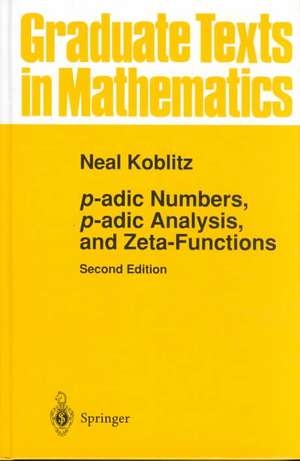
p-adic Numbers, p-adic Analysis, and Zeta-Functions: Graduate Texts in Mathematics, cartea 58
Autor Neal Koblitzen Limba Engleză Hardback – 23 iul 1984
Din seria Graduate Texts in Mathematics
- 13%
 Preț: 402.23 lei
 -
 Preț: 489.62 lei
 - 15%
 Preț: 408.55 lei
 - 15%
 Preț: 402.87 lei
 - 15%
 Preț: 394.84 lei
 -
 Preț: 388.76 lei
 -
 Preț: 364.67 lei
 -
 Preț: 366.24 lei
 - 15%
 Preț: 443.82 lei
 -
 Preț: 384.47 lei
 - 15%
 Preț: 476.11 lei
 -
 Preț: 377.54 lei
 - 15%
 Preț: 515.66 lei
 -
 Preț: 439.47 lei
 - 15%
 Preț: 562.38 lei
 -
 Preț: 381.34 lei
 - 15%
 Preț: 424.86 lei
 - 15%
 Preț: 518.68 lei
 - 15%
 Preț: 489.24 lei
 - 15%
 Preț: 540.38 lei
 -
 Preț: 481.43 lei
 -
 Preț: 422.40 lei
 -
 Preț: 387.61 lei
 - 15%
 Preț: 576.47 lei
 - 15%
 Preț: 477.57 lei
 -
 Preț: 442.38 lei
 - 15%
 Preț: 460.83 lei
 -
 Preț: 480.91 lei
 - 15%
 Preț: 681.72 lei
 -
 Preț: 443.71 lei
 - 15%
 Preț: 580.34 lei
 -
 Preț: 371.33 lei
 - 15%
 Preț: 566.70 lei
 - 15%
 Preț: 516.13 lei
 - 15%
 Preț: 496.64 lei
 -
 Preț: 373.40 lei
Preț: 482.39 lei
Preț vechi: 567.52 lei
-15%
Puncte Express: 724
Carte tipărită la comandă
Livrare economică 17-31 iulie
Livrare express 12-18 iunie pentru 49.71 lei
Livrare prin curier în România Termenul estimat este afișat lângă disponibilitate.
Transport gratuit pentru acest produs Plată online sau ramburs, în funcție de opțiunile comenzii.
Retur gratuit în 14 zile Comandă securizată și suport în română.
Specificații
ISBN-13: 9780387960173
ISBN-10: 0387960171
Pagini: 172
Ilustrații: XII, 153 p.
Dimensiuni: 160 x 241 x 15 mm
Greutate: 0.43 kg
Ediția:Second Edition 1984
Editura: Springer
Colecția Graduate Texts in Mathematics
Seria Graduate Texts in Mathematics
Locul publicării:New York, NY, United States
ISBN-10: 0387960171
Pagini: 172
Ilustrații: XII, 153 p.
Dimensiuni: 160 x 241 x 15 mm
Greutate: 0.43 kg
Ediția:Second Edition 1984
Editura: Springer
Colecția Graduate Texts in Mathematics
Seria Graduate Texts in Mathematics
Locul publicării:New York, NY, United States
V-ar putea interesa
-
 Algebraic Projective GeometryJ. G. Semple-26%Preț: 583.18 lei792.07 lei
 -
 Rings and FieldsGraham Ellis-34%Preț: 643.84 lei968.70 lei
 -
 An Introduction to Homological AlgebraJoseph J. Rotman-15%Preț: 461.59 lei543.05 lei
 -
 Advanced Linear AlgebraSteven Roman-15%Preț: 449.39 lei528.70 lei
 -
 Mathematics as Problem SolvingAlexander SoiferPreț: 398.27 lei
 -
 Introduction to Lie Algebras and Representation TheoryJ. E. HumphreysPreț: 470.81 lei
 -
 Linear AlgebraRobert J. Valenza-15%Preț: 459.65 lei540.77 lei
 -
 Commutative Algebra: with a View Toward Algebraic GeometryDavid EisenbudPreț: 315.64 lei
 -
 Galois TheoryL. Schneps-19%Preț: 523.62 lei646.44 lei
 -
 Preț: 474.26 lei
 -
 Basic Linear AlgebraT. S. BlythPreț: 311.68 lei
 -
 Methods of Homological AlgebraSergei I. Gelfand-18%Preț: 764.67 lei932.52 lei
 -
 Risk and Asset AllocationAttilio Meucci-15%Preț: 572.86 lei673.96 lei
 -
 Methods of Homological AlgebraSergei I. Gelfand-18%Preț: 752.62 lei917.84 lei
Public țintă
GraduateCuprins
I p-adic numbers.- 1. Basic concepts.- 2. Metrics on the rational numbers.- Exercises.- 3. Review of building up the complex numbers.- 4. The field of p-adic numbers.- 5. Arithmetic in ?p.- Exercises.- II p-adic interpolation of the Riemann zeta-function.- 1. A formula for ?(2k).- 2. p-adic interpolation of the function f(s) = as.- Exercises.- 3. p-adic distributions.- Exercises.- 4. Bernoulli distributions.- 5. Measures and integration.- Exercises.- 6. The p-adic ?-function as a Mellin-Mazur transform.- 7. A brief survey (no proofs).- Exercises.- III Building up ?.- 1. Finite fields.- Exercises.- 2. Extension of norms.- Exercises.- 3. The algebraic closure of ?p.- 4. ?.- Exercises.- IV p-adic power series.- 1. Elementary functions.- Exercises.- 2. The logarithm, gamma and Artin-Hasse exponential functions.- Exercises.- 3. Newton polygons for polynomials.- 4. Newton polygons for power series.- Exercises.- V Rationality of the zeta-function of a set of equations over a finite field.- 1. Hypersurfaces and their zeta-functions.- Exercises.- 2. Characters and their lifting.- 3. A linear map on the vector space of power series.- 4. p-adic analytic expression for the zeta-function.- Exercises.- 5. The end of the proof.- Answers and Hints for the Exercises.
Recenzii
From the reviews of the second edition:
“In the second edition of this text, Koblitz presents a wide-ranging introduction to the theory of p-adic numbers and functions. … there are some really nice exercises that allow the reader to explore the material. … And with the exercises, the book would make a good textbook for a graduate course, provided the students have a decent background in analysis and number theory.” (Donald L. Vestal, The Mathematical Association of America, April, 2011)
“In the second edition of this text, Koblitz presents a wide-ranging introduction to the theory of p-adic numbers and functions. … there are some really nice exercises that allow the reader to explore the material. … And with the exercises, the book would make a good textbook for a graduate course, provided the students have a decent background in analysis and number theory.” (Donald L. Vestal, The Mathematical Association of America, April, 2011)