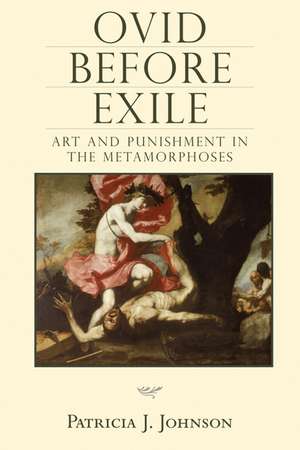
Ovid before Exile: Art and Punishment in the Metamorphoses: Wisconsin Studies in Classics
Autor Patricia Johnsonen Limba Engleză Paperback – 15 dec 2010
The epic Metamorphoses, Ovid’s most renowned work, has regained its stature among the masterpieces of great poets such as Vergil, Horace, and Tibullus. Yet its irreverent tone and bold defiance of generic boundaries set the Metamorphoses apart from its contemporaries. Ovid before Exile provides a compelling new reading of the epic, examining the text in light of circumstances surrounding the final years of Augustus’ reign, a time when a culture of poets and patrons was in sharp decline, discouraging and even endangering artistic freedom of expression.
Patricia J. Johnson demonstrates how the production of art—specifically poetry—changed dramatically during the reign of Augustus. By Ovid’s final decade in Rome, the atmosphere for artistic work had transformed, leading to a drop in poetic production of quality. Johnson shows how Ovid, in the episodes of artistic creation that anchor his Metamorphoses, responded to his audience and commented on artistic circumstances in Rome.
Patricia J. Johnson demonstrates how the production of art—specifically poetry—changed dramatically during the reign of Augustus. By Ovid’s final decade in Rome, the atmosphere for artistic work had transformed, leading to a drop in poetic production of quality. Johnson shows how Ovid, in the episodes of artistic creation that anchor his Metamorphoses, responded to his audience and commented on artistic circumstances in Rome.
Din seria Wisconsin Studies in Classics
-
 Preț: 67.42 lei
 -
 Preț: 209.57 lei
 -
 Preț: 180.28 lei
 -
 Preț: 173.20 lei
 -
 Preț: 109.19 lei
 -
 Preț: 230.01 lei
 -
 Preț: 247.47 lei
 -
 Preț: 349.86 lei
 -
 Preț: 212.73 lei
 - 23%
 Preț: 451.03 lei
 -
 Preț: 118.06 lei
 -
 Preț: 428.13 lei
 -
 Preț: 324.43 lei
 -
 Preț: 508.31 lei
 -
 Preț: 123.68 lei
 -
 Preț: 360.95 lei
 -
 Preț: 161.48 lei
 - 23%
 Preț: 610.88 lei
 -
 Preț: 212.79 lei
 -
 Preț: 150.33 lei
 -
 Preț: 60.44 lei
 -
 Preț: 117.94 lei
 -
 Preț: 239.79 lei
 -
 Preț: 164.58 lei
 -
 Preț: 188.78 lei
 -
 Preț: 323.89 lei
 -
 Preț: 429.48 lei
 -
 Preț: 249.14 lei
 -
 Preț: 71.89 lei
 -
 Preț: 405.74 lei
 -
 Preț: 178.02 lei
 -
 Preț: 223.45 lei
 -
 Preț: 160.93 lei
 -
 Preț: 405.59 lei
 -
 Preț: 200.23 lei
 -
 Preț: 219.51 lei
 - 23%
 Preț: 590.53 lei
 -
 Preț: 176.20 lei
 -
 Preț: 168.78 lei
 -
 Preț: 337.65 lei
 -
 Preț: 164.89 lei
 -
 Preț: 280.26 lei
 -
 Preț: 197.65 lei
Preț: 197.76 lei
Puncte Express: 297
Carte indisponibilă temporar
Doresc să fiu notificat când acest titlu va fi disponibil:
Se trimite...
Specificații
ISBN-13: 9780299224042
ISBN-10: 029922404X
Pagini: 200
Dimensiuni: 152 x 229 x 15 mm
Greutate: 0.3 kg
Ediția:1
Editura: University of Wisconsin Press
Colecția University of Wisconsin Press
Seria Wisconsin Studies in Classics
ISBN-10: 029922404X
Pagini: 200
Dimensiuni: 152 x 229 x 15 mm
Greutate: 0.3 kg
Ediția:1
Editura: University of Wisconsin Press
Colecția University of Wisconsin Press
Seria Wisconsin Studies in Classics
Recenzii
“A new and stimulating reading of three central episodes of Ovid’s brilliant Metamorphoses: the artistic contests between the Muses and their challengers, and Minerva and her challenger Arachne, and the more extended tale of Orpheus singing his lays of boy-love and forbidden female passions. All three narratives are set in the full dimensions of Ovid’s own literary and political context. Johnson’s scholarship is up-to-date, and her subtle interpretation is supported by translation of all passages discussed. It is at the center of current Latin literary studies, and should provoke lively and positive reactions.”—Elaine Fantham, Princeton University
“A very readable close analysis of the key episodes about artists and their relationship to their audiences and those in power. Johnson shows that the sense of foreboding about artistic freedom of expression that pervades Ovid’s exile-poetry had set in even when he was writing the earlier Metamorphoses.”—Martin Helzle, Case Western Reserve University
"Johnson offer[s] useful interpretive observations, especially on Ovid's use of his Greek and Latin influences."—Choice
“[A]n engagingly-written and well-constructed book which should be of interest to students and scholars of Ovid alike.”—Rebecca Armstrong, Journal of Roman Studies
Notă biografică
Patricia J. Johnson is associate professor of classical studies at Boston University.
Cuprins
Acknowledgments
Introduction
1 Ovid's Artists
2 The Poetic Contest: Metamorphoses 5
3 The Weaving Contest: Metamorphoses 6
4 Songs from Hell: Metamorphoses 10
5 Ovid Anticipates Exile
Notes
Bibliography
Index
Index Locorum
Introduction
1 Ovid's Artists
2 The Poetic Contest: Metamorphoses 5
3 The Weaving Contest: Metamorphoses 6
4 Songs from Hell: Metamorphoses 10
5 Ovid Anticipates Exile
Notes
Bibliography
Index
Index Locorum
Descriere
The epic Metamorphoses, Ovid’s most renowned work, has regained its stature among the masterpieces of great poets such as Vergil, Horace, and Tibullus. Yet its irreverent tone and bold defiance of generic boundaries set the Metamorphoses apart from its contemporaries. Ovid before Exile provides a compelling new reading of the epic, examining the text in light of circumstances surrounding the final years of Augustus’ reign, a time when a culture of poets and patrons was in sharp decline, discouraging and even endangering artistic freedom of expression.
Patricia J. Johnson demonstrates how the production of art—specifically poetry—changed dramatically during the reign of Augustus. By Ovid’s final decade in Rome, the atmosphere for artistic work had transformed, leading to a drop in poetic production of quality. Johnson shows how Ovid, in the episodes of artistic creation that anchor his Metamorphoses, responded to his audience and commented on artistic circumstances in Rome.
Patricia J. Johnson demonstrates how the production of art—specifically poetry—changed dramatically during the reign of Augustus. By Ovid’s final decade in Rome, the atmosphere for artistic work had transformed, leading to a drop in poetic production of quality. Johnson shows how Ovid, in the episodes of artistic creation that anchor his Metamorphoses, responded to his audience and commented on artistic circumstances in Rome.