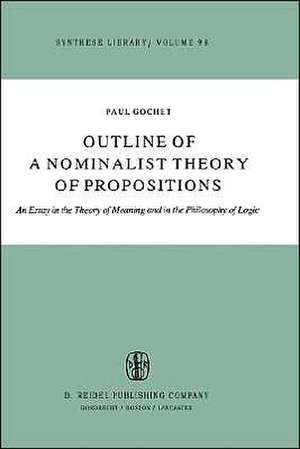
Outline of a Nominalist Theory of Propositions: An Essay in the Theory of Meaning and in the Philosophy of Logic: Synthese Library, cartea 98
Autor Paul Gocheten Limba Engleză Hardback – 31 mar 1980
| Toate formatele și edițiile | Preț | Express |
|---|---|---|
| Paperback (1) | 612.55 lei 6-8 săpt. | |
| SPRINGER NETHERLANDS – 12 oct 2011 | 612.55 lei 6-8 săpt. | |
| Hardback (1) | 618.50 lei 6-8 săpt. | |
| SPRINGER NETHERLANDS – 31 mar 1980 | 618.50 lei 6-8 săpt. |
Din seria Synthese Library
- 20%
 Preț: 602.14 lei
 - 20%
 Preț: 601.55 lei
 - 15%
 Preț: 613.80 lei
 - 18%
 Preț: 951.53 lei
 - 15%
 Preț: 573.68 lei
 - 15%
 Preț: 564.27 lei
 - 15%
 Preț: 669.59 lei
 - 18%
 Preț: 858.26 lei
 - 15%
 Preț: 618.50 lei
 -
 Preț: 297.31 lei
 - 18%
 Preț: 915.43 lei
 - 18%
 Preț: 917.46 lei
 -
 Preț: 426.21 lei
 - 5%
 Preț: 358.05 lei
 - 15%
 Preț: 613.00 lei
 - 18%
 Preț: 921.64 lei
 - 15%
 Preț: 617.57 lei
 - 18%
 Preț: 1182.77 lei
 - 15%
 Preț: 618.03 lei
 - 18%
 Preț: 961.53 lei
 -
 Preț: 367.70 lei
 - 15%
 Preț: 612.68 lei
 - 18%
 Preț: 915.29 lei
 - 18%
 Preț: 1183.40 lei
 - 15%
 Preț: 621.03 lei
 -
 Preț: 380.82 lei
 -
 Preț: 385.26 lei
 - 18%
 Preț: 1177.80 lei
 - 15%
 Preț: 614.24 lei
 - 18%
 Preț: 1184.15 lei
 -
 Preț: 366.02 lei
 -
 Preț: 379.89 lei
 - 15%
 Preț: 615.66 lei
 - 15%
 Preț: 614.41 lei
 -
 Preț: 367.49 lei
 - 15%
 Preț: 618.19 lei
Preț: 618.50 lei
Preț vechi: 727.65 lei
-15% Nou
Puncte Express: 928
Preț estimativ în valută:
109.43€ • 127.68$ • 95.67£
109.43€ • 127.68$ • 95.67£
Carte tipărită la comandă
Livrare economică 16-30 ianuarie 26
Preluare comenzi: 021 569.72.76
Specificații
ISBN-13: 9789027710314
ISBN-10: 9027710317
Pagini: 228
Ilustrații: XII, 212 p.
Dimensiuni: 155 x 235 x 18 mm
Greutate: 0.5 kg
Ediția:1980
Editura: SPRINGER NETHERLANDS
Colecția Springer
Seria Synthese Library
Locul publicării:Dordrecht, Netherlands
ISBN-10: 9027710317
Pagini: 228
Ilustrații: XII, 212 p.
Dimensiuni: 155 x 235 x 18 mm
Greutate: 0.5 kg
Ediția:1980
Editura: SPRINGER NETHERLANDS
Colecția Springer
Seria Synthese Library
Locul publicării:Dordrecht, Netherlands
V-ar putea interesa
-
 Preț: 131.76 lei
 -
 -15%Preț: 317.48 lei371.56 lei
 -
 -9%Preț: 361.67 lei398.40 lei
 -
 Preț: 54.43 lei
 -
 The Quark And The JaguarMurray Gell-Mann-27%Preț: 74.83 lei103.19 lei
 -
 Preț: 379.24 lei
 -
 Science, Order and Creativity second editionDavid Bohm-24%Preț: 189.27 lei249.26 lei
 -
 Inference to the Best ExplanationPeter LiptonPreț: 336.13 lei
 -
 The Logic of Scientific DiscoveryKarl PopperPreț: 187.79 lei
 -
 Conjectures and RefutationsKarl PopperPreț: 186.67 lei
 -
 Science and PoetryMary MidgleyPreț: 184.53 lei
 -
 -14%Preț: 775.72 lei902.01 lei
 -
 Preț: 145.29 lei
 -
 The Crack in the Cosmic Egg: New Constructs of Mind and RealityJoseph Chilton PearcePreț: 125.34 lei
 -
 The Evolutionary MindRupert, Ph.D. SheldrakePreț: 100.64 lei
 -
 A Sense of the Mysterious: Science and the Human SpiritAlan LightmanPreț: 104.07 lei
 -
 Preț: 97.47 lei
 -
 -24%Preț: 4491.56 lei5909.94 lei
Public țintă
ResearchCuprins
1. Importance of the Subject.- 2. The Roles Played by the Concept of Proposition.- 3. How to Conceive of a Theory of Proposition.- 4. Which Method to Use.- 5. The Merits of Nominalism.- 6. Varieties of Nominalism.- 7. The Senses of the Word ‘Proposition’.- I / The Criterion of Ontological Commitment.- 1. Quine’s Criterion of Ontological Commitment.- 2. Warnock’s Objections to Quine’s Criterion of Ontological Commitment.- 3. The Application of the Criterion of Ontological Commitment to Propositions.- 4. Compromising Uses of the Word ‘Proposition’.- 5. Critique of Ayer’s First Attempt to Escape Ontological Commitments to Propositions.- 6. The Double Interpretation of the Existential Quantifier.- 7. The Double Interpretation of Bound Variables.- 8. From Pragmatics to Ontology.- II / The Syntactic Approach.- 1. Is an Axiomatic Definition of Proposition Possible?.- 2. Two Nominalist Solutions on the Problem of Interpreting Propositional Variables.- 3. What Quine’s Notation Reveals With Regard to the Status of Propositions.- 4. Does the Definition of Logical Truth Presuppose the Concept of Proposition? Strawson’s Thesis.- 5. Replies to Strawson’s Objections.- 6. The Definition of Proposition in Terms of the Premises and Conclusion of an Inference.- III / A Semantic Definition of Proposition in Terms of Truth and Falsity.- 1. The Aristotelian Definition of Proposition in Terms of Truth.- 2. The Influence of the Semantic Definition of Truth on the Concept of Proposition.- 3. Use of the Distinction Between Sentence and Statement as a Solution to the Paradox of the Liar in Natural Language.- 4. The Ontological Status of the Distinction between Statements and Sentences.- 5. Truth and Falsity Apply to Sentences Before Applying to Statements.- 6. The SemanticTheory of Truth and the Correspondence Between Language and Reality.- IV / The Pragmatic Definition of Proposition in Terms of Assertion or Assertability.- 1. The Pragmatic Definition of Proposition in Terms of Assertability.- 2. The Distinction Between Proposition and Statement from a Pragmatic Perspective.- 3. Austin’s Distinction Between Locutionary and Illocutionary Acts.- 4. An Examination of Searle’s Notion of Proposition.- 5. Stenius’ Analysis.- 6. The Performative Hypothesis.- 7. Hausser’s Treatment of Moods.- 8. A Vindication of Searle’s Position.- 9. A New Account of Searle’s Concept of Propositional Content.- V / The Nature of Facts.- 1. The Nature and Status of Facts in Russell’s ‘Philosophy of Logical Atomism’.- 2. The Merits of Russell’s Notion of Fact.- 3. The Defects of Russell’s Theory of Facts.- 4. Wittgenstein’s Conception of Fact.- 5. Arguments For and Against the Ontological Interpretation of Facts.- 6. Application of Methods of Generative Grammar to Detect the Ontological Nature of Facts.- 7. Why There Cannot be Facts.- VI / The Proposition in Terms of Belief.- 1. Belief and Proposition.- 2. The Problem of False Beliefs.- 3. The Distinction Between Propositional Verbs and Cognitive Verbs.- 4. The Logical Syntax of Propositional Verbs.- 5. An Attempt at Absorbing Propositions into Sentences.- 6. Searle’s Views on Intentionality.- VII / Propositions as Meanings of Sentences.- 1. The Relational Conception of Meaning.- 2. The Eternality and Temporality of Meaning.- 3. The Behaviouristic Analysis of the Meaning of Sentences.- 4. The Chess-Theory of Meaning.- 5. An Attempt at Dissolving the Problem Raised by the Meaning of Sentences.- 6. The Picture Theory of Meaning.- 7. The Limitations of the Picture Theory of Meaning.- 8.Beyond the Picture Theory.- 9. The Recursive Definition of Truth as a Tool for Compositional Semantics.- 10. Recursive Semantics and Nominalism.- 11. Categorial Grammar, Set Theoretic Semantics and Nominalism.- 12. Game-Theoretical Semantics.- VIII / An Attempt at a New Solution for the Enigma of the Meaning of False Sentences.- 1. Conditions of Adequacy on a Satisfactory Answer.- 2. Ryle’s Solution to the Enigma of the Meaning of False Sentences.- 3. The Possibility of Falsity as a By-Product of the Creativity of Language.- 4. The Solution Offered by Possible Worlds Semantics to the Enigma of the Meaning of False Sentences.- 5. A Pragmatic Solution of the Enigma.- 6. Nominalism Again.- IX / The Identification Criterion of Propositions.- 1. The Importance of Finding a Criterion of Propositional Identity.- 2. The Definition of Proposition in Terms of Synonymy.- 3. Intensional Isomorphism.- 4. The Role of the Notion of Isomorphism in Defining a Criterion for the Identity of Propositions.- 5. Preliminaries to the Application of the Criterion of Extensional Isomorphism.- 6. Some Final Refinements of the Notion of Extensional Isomorphism.- 7. Vanderveken’s Criterion.- 8. Suppes’ Gradualism.- 9. Indeterminacy of Translation.- X / Propositions and Indirect Discourse.- 1. The Notion of Proposition and of Indirect Discourse.- 2. The Syntactic Approach to the Problem of Intensional Contexts.- 3. Prior’s Nominalist Syntax.- 4. L.J. Cohen’s Extensionalist Syntax.- 5. Frege’s Dualist Semantics and Epistemic Logic.- 6. Carnap’s Dualist Semantics.- 7. Quine’s Unitary Extensionalism.- 8. Criticisms Addressed to Quine’s Nominalist Theory: Kaplan’s Alternative Solution.- 9. Hintikka’s Pluralistic Extensionalism.- 10. The Pragmatic Approach to the Problem ofIntensional Contexts: Natural Pragmatics.- 11. The Pragmatic Approach to the Problem of Intensional Contexts: Formal Pragmatics.- 12. Objections Against Montague’s Semantics.- Conclusion.- Name Index.