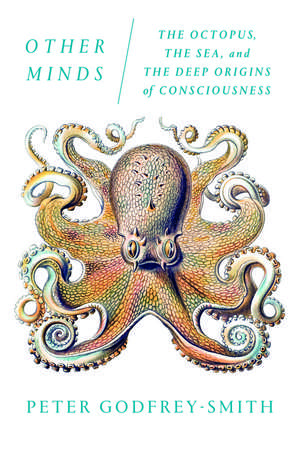
Other Minds
Autor Peter Godfrey-Smithen Limba Engleză Paperback – 17 oct 2017
Observăm în Other Minds o abordare rară care îmbină rigoarea filosofică cu biologia marină, adresându-se deopotrivă studenților la biologie, cercetătorilor în neuroștiințe și cititorilor pasionați de evoluție. Peter Godfrey-Smith propune o teză fascinantă: caracatița reprezintă cel mai apropiat model de „inteligență extraterestră” pe care îl putem studia, fiind rezultatul unei linii evolutive care s-a separat de a noastră acum sute de milioane de ani. Apreciem modul în care autorul transformă experiențele sale de scufundări în argumente despre originea conștiinței subiective, analizând cum celule marine dezordonate au format primele sisteme nervoase. Structura narativă urmărește tranziția de la moluște discrete la prădători cerebrali care și-au abandonat cochilia pentru a câștiga agilitate și inteligență. Credem că valoarea acestei ediții rezidă în capacitatea de a explica fenomene complexe — cum ar fi brațele caracatiței care „gândesc singure” datorită densității neuronale — fără a sacrifica precizia științifică. Cartea completează perspectiva oferită de Octopus, Squid, and Cuttlefish de Roger Hanlon, adăugând o dimensiune metafizică și filosofică pe care un ghid biologic pur nu o acoperă. În contextul operei sale, Other Minds este piatra de temelie a unei trilogii ce continuă cu Metazoare și Living on Earth, marcând tranziția autorului de la filosofia teoretică a științei către o explorare empirică a originilor minții. Ilustrațiile și planșele color incluse facilitează înțelegerea mecanismelor de camuflaj și semnalizare descrise, oferind un suport vizual necesar pentru a vizualiza aceste „celelalte minți” ale oceanului.
Preț: 110.37 lei
Carte disponibilă
Livrare economică 13-27 noiembrie
Livrare express 30 octombrie-05 noiembrie pentru 43.62 lei
Specificații
ISBN-10: 0374537194
Pagini: 272
Ilustrații: 8 Pages of Color Illustrations, 20 Black-and-White Illustrations Throughout / Notes, Index
Dimensiuni: 136 x 208 x 22 mm
Greutate: 0.25 kg
Editura: MACMILLAN USA
Colecția Farrar, Straus And Giroux
V-ar putea interesa
-
 The Hidden Life of TreesPeter WohllebenPreț: 72.66 lei
 -
 Exactly: How Precision Engineers Created the Modern WorldSimon WinchesterPreț: 94.74 lei
 -
 FreakonomicsSteven D. LevittPreț: 67.59 lei
 -
 Think Like a FreakSteven D. LevittPreț: 104.13 lei
 -
 Behave: The Biology of Humans at Our Best and WorstRobert M. Sapolsky-15%Preț: 82.85 lei97.52 lei
 -
 The Righteous MindJonathan Haidt-28%Preț: 78.29 lei108.70 lei
 -
 From Bacteria to Bach and BackDaniel C Dennett-18%Preț: 88.92 lei108.57 lei
 -
 The Worm at the CoreSheldon Solomon-30%Preț: 64.88 lei92.96 lei
 -
 Preț: 108.51 lei
 -
 Stuff MattersMark Miodownik-25%Preț: 64.98 lei86.08 lei
 -
 NietzscheRudiger SafranskiPreț: 173.57 lei
 -
 Modern Man in Search of a SoulC. G. JungPreț: 174.81 lei
 -
 History of Western PhilosophyBertrand RussellPreț: 242.60 lei
 -
 Rubens: His Life and Works In 500 ImagesSusie HodgePreț: 134.77 lei
 -
 Anatomy of StoryJohn TrubyPreț: 120.44 lei
 -
 -21%Preț: 432.18 lei545.61 lei
 -
 Everybody Lies: What the Internet Can Tell Us About Who We Really AreSeth Stephens-Davidowitz-25%Preț: 70.34 lei93.91 lei
 -
 -26%Preț: 101.15 lei136.83 lei
 -
 Are We Smart Enough to Know How Smart Animals Are?Frans De WaalPreț: 79.82 lei
 -
 Storm in a TeacupHelen Czerski-18%Preț: 65.55 lei79.83 lei
 -
 -49%Preț: 47.06 lei92.93 lei
 -
 I Contain MultitudesEd Yong-22%Preț: 73.26 lei93.71 lei
 -
 -28%Preț: 86.49 lei120.73 lei
 -
 -18%Preț: 107.87 lei131.01 lei
De ce să citești această carte
Recomandăm această carte oricui dorește să înțeleagă că inteligența nu este un atribut exclusiv uman. Cititorul câștigă o perspectivă nouă asupra evoluției conștiinței, descoperind cum natura a „inventat” mintea de mai multe ori. Este o lectură esențială pentru a înțelege complexitatea nevertebratelor, oferind un echilibru perfect între jurnal de observație subacvatică și tratat de filosofie a biologiei.
Despre autor
Peter Godfrey-Smith este un distins profesor de filosofie la Graduate Center, City University of New York, și profesor de istoria și filosofia științei la Universitatea din Sydney. Autor recunoscut, a fost premiat cu prestigiosul Lakatos Award în 2010 pentru lucrarea sa despre populațiile darwiniene și selecția naturală. Dincolo de activitatea academică, pasiunea sa pentru scufundări a oferit material documentar pentru publicații precum National Geographic, poziționându-l ca o voce unică capabilă să pună în dialog observația directă a vieții marine cu marile întrebări ale filosofiei minții.
Descriere scurtă
Although mammals and birds are widely regarded as the smartest creatures on earth, it has lately become clear that a very distant branch of the tree of life has also sprouted higher intelligence: the cephalopods, consisting of the squid, the cuttlefish, and above all the octopus. In captivity, octopuses have been known to identify individual human keepers, raid neighboring tanks for food, turn off lightbulbs by spouting jets of water, plug drains, and make daring escapes. How is it that a creature with such gifts evolved through an evolutionary lineage so radically distant from our own? What does it mean that evolution built minds not once but at least twice? The octopus is the closest we will come to meeting an intelligent alien. What can we learn from the encounter? In Other Minds, Peter Godfrey-Smith, a distinguished philosopher of science and a skilled scuba diver, tells a bold new story of how subjective experience crept into being--how nature became aware of itself. As Godfrey-Smith stresses, it is a story that largely occurs in the ocean, where animals first appeared. Tracking the mind's fitful development, Godfrey-Smith shows how unruly clumps of seaborne cells began living together and became capable of sensing, acting, and signaling. As these primitive organisms became more entangled with others, they grew more complicated. The first nervous systems evolved, probably in ancient relatives of jellyfish; later on, the cephalopods, which began as inconspicuous mollusks, abandoned their shells and rose above the ocean floor, searching for prey and acquiring the greater intelligence needed to do so. Taking an independent route, mammals and birds later began their own evolutionary journeys. But what kind of intelligence do cephalopods possess? Drawing on the latest scientific research and his own scuba-diving adventures, Godfrey-Smith probes the many mysteries that surround the lineage. How did the octopus, a solitary creature with little social life, become so smart? What is it like to have eight tentacles that are so packed with neurons that they virtually "think for themselves"? What happens when some octopuses abandon their hermit-like ways and congregate, as they do in a unique location off the coast of Australia? By tracing the question of inner life back to its roots and comparing human beings with our most remarkable animal relatives, Godfrey-Smith casts crucial new light on the octopus mind--and on our own.
Notă biografică
Descriere
'Brilliant' Guardian Waterstones Non-Fiction Book of the Month (March) SHORTLISTED FOR THE 2017 ROYAL SOCIETY SCIENCE BOOK PRIZE What if intelligent life on Earth evolved not once, but twice? The octopus is the closest we will come to meeting an intelligent alien. What can we learn from the encounter? In Other Minds, Peter Godfrey-Smith, a distinguished philosopher of science and a skilled scuba diver, tells a bold new story of how nature became aware of itself - a story that largely occurs in the ocean, where animals first appeared. Tracking the mind's fitful development from unruly clumps of seaborne cells to the first evolved nervous systems in ancient relatives of jellyfish, he explores the incredible evolutionary journey of the cephalopods, which began as inconspicuous molluscs who would later abandon their shells to rise above the ocean floor, searching for prey and acquiring the greater intelligence needed to do so - a journey completely independent from the route that mammals and birds would later take.
But what kind of intelligence do cephalopods possess? How did the octopus, a solitary creature with little social life, become so smart? What is it like to have eight tentacles that are so packed with neurons that they virtually 'think for themselves'? By tracing the question of inner life back to its roots and comparing human beings with our most remarkable animal relatives, Godfrey-Smith casts crucial new light on the octopus mind - and on our own.